
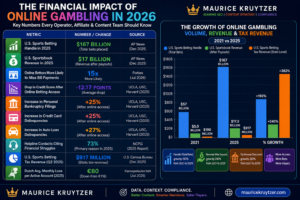
Americans wagered close to $167 billion on legal sports betting in 2025. Sportsbooks kept roughly $17 billion of that after paying out winnings. The gap between those two numbers matters more than most headlines suggest. The first figure is the total handle, the amount bet before any payouts. The second is operator revenue before taxes and costs. Treating the full $167 billion as consumer spending gives readers a distorted picture of what actually changed hands.
The growth curve alone tells a story. The legal US sports betting handle sat near $57 billion in 2021. Four years later it has nearly tripled. Mobile apps, live in-play markets and instant payments removed almost every barrier between wanting to bet and placing one. That same speed also removes the pause between one bet and the next.
Working inside Dutch iGaming content has made one thing clear: financial risk can no longer sit quietly in a disclaimer at the bottom of the page. Operators, affiliates and publishers all need to explain where the money goes, how fast-paced products change betting habits, and how legal protections differ from one market to the next.

Key Takeaways
- The $167 billion figure describes total betting volume, not industry profit. US sportsbooks earned close to $17 billion in revenue from that amount during 2025.
- Online access changes the shape of financial risk. Studies built on millions of US credit records connect mobile sports betting with lower credit scores, more debt collection activity, more missed payments and a higher chance of bankruptcy.
- The impact lands unevenly. Younger adults, frequent bettors and people already stretched financially appear to carry more of the risk.
- Money problems dominate helpline conversations. Over 73% of contacts with the US National Problem Gambling Helpline in 2025 named financial trouble as a reason for reaching out.
- Tax revenue has grown, but it doesn’t offset personal harm. US states collected $917 million in sports betting tax during the second quarter of 2025 alone.
- Dutch rules have cut down large losses among licensed operators, though they’ve also squeezed legal revenue and may be pushing high-spending activity toward unlicensed sites.
- Content teams need to keep facts, estimates and anecdotes clearly separated. A lawyer describing more gambling debt clients is useful context, but it isn’t the same as a national credit study.
- Strong compliance content goes beyond “gamble responsibly.” It explains limits, checks, product speed and the difference between licensed and unlicensed platforms.
Why the Financial Impact of Online Gambling Is Now a Content Problem, Not Just a Compliance One
Most general content teams treat gambling like any other consumer category, similar to travel or retail. That approach doesn’t hold up.
A casino review can steer where someone deposits real money. A bonus page can nudge a player toward a bigger deposit. A poorly worded wagering condition can leave a reader believing withdrawable funds are already theirs. Nearly every sentence on a gambling page can shape a financial decision.
That’s why the financial impact of online gambling has become an editorial matter as much as a compliance one. A page needs to describe the product honestly without turning risk into a footnote nobody reads.
Compliance isn’t a hidden ranking trick here. There’s no evidence that a Dutch license badge or a responsible gambling paragraph pushes a page higher in results. Compliance matters because it builds trust and limits business risk. Pages built on outdated numbers, expired rules or vague bonus terms are easier to challenge and harder for careful readers to believe.
There’s also a real gap between meeting the legal minimum and actually helping the reader. A page can satisfy every regulation and still fail the person reading it. “Only gamble what you can afford to lose” sounds reasonable, but it never explains how someone works out that number.
A more useful version gets specific. Rent, energy, groceries, insurance, debt payments and savings come first. Gambling money comes from whatever’s left after those costs are covered. Borrowed money should never count as a gambling budget, full stop.
Teams building out this kind of content structure often benefit from a clear framework for how betting-related pages get planned and reviewed, something covered in more depth in Dutch iGaming content planning approaches.
What the Numbers Actually Show About Financial Harm From Online Gambling
A July 2026 report covered by Forbes found that online sports bettors were 15 times more likely to report missed bill payments compared with people who only gambled at physical venues.
That figure needs context before it gets repeated anywhere. It shows a strong link between online betting and financial strain, not proof that online betting caused every missed payment. Online bettors also skew younger, bet more frequently and may already carry more debt than the comparison group. A responsible piece states the finding and its limits in the same breath.
Separate research linked to UCLA, USC and Harvard used millions of anonymized credit records and found that average credit scores dropped further in states that introduced online sports betting than in states with retail-only betting.
The most recent version of that research reports an average credit score decline of 12.17 points after online access arrived. The chance of a personal bankruptcy filing rose by roughly 25%, while credit card and auto loan delinquencies climbed by around 25% and 27% respectively. Debt sent to collections also increased.
These are state-level averages, not individual predictions. They don’t mean every bettor loses 12 credit score points or faces a 25% higher bankruptcy chance personally. The research tracks financial trends across states before and after legal changes, and other local factors like inflation and interest rates can influence debt too.
Still, the gap between retail and mobile betting is hard to dismiss. Betting in person requires time and travel. An app removes nearly all of that friction, letting someone deposit, bet, lose and repeat from a couch, a train seat or a desk at work.
Online sports bettors were 15 times more likely to miss bill payments than people who only gambled in person, according to the Forbes-covered report. The figure shows an association, not proof of direct cause.
Helpline data tells a similar story from a different angle. More than 31,000 people contacted the US National Problem Gambling Helpline in an average month during 2025. Nearly half were between 18 and 34 years old. Over 73% cited financial struggles as their reason for reaching out, up from 66% a year earlier.
That data only covers people who actively sought help, so it can’t estimate how many bettors experience harm silently. It does confirm why financial strain deserves a central place in responsible gambling content rather than an afterthought.
The World Health Organization also warns that gambling can divert household money away from food, housing and other essentials. It connects gambling harm to financial stress, family conflict, mental health issues, crime and suicide, and estimates that people gambling at harmful levels generate around 60% of total gambling losses.
Best for Operators: Turning the Financial Impact of Online Gambling Into a Trust Signal
Operators already hold the data needed to spot financial risk. Deposits, withdrawals, net losses, cancelled withdrawal requests, session length and shifts in betting pace are all visible on their end.
The weak move is waiting for a player to ask for help. The stronger move is acting the moment behavior changes.
A player who normally deposits €50 a week but suddenly makes five deposit attempts totaling €800 is showing a clear shift. That shouldn’t get treated as a normal jump in customer value. It should trigger a review, a check-in or a temporary restriction.
Dutch licensed operators carry specific obligations here. Since October 1, 2024, they must apply extra financial checks once a player wants to deposit more than €300 per calendar month for people aged 18 to 23, or €700 for players 24 and older. Acceptable evidence includes salary statements or tax records, while loans and tax refunds shouldn’t count as normal disposable income.
Those thresholds mark intervention points, not safety guarantees. A player on a limited income can experience real harm well below either figure.
The rules appear to be working as intended. Before October 2024, around 9.7% of Dutch players deposited above the relevant threshold. By March 2025, that figure had dropped to 2.2%. Average monthly loss per active account also fell, from €116 to €80, during the first eight months after the rules took effect.
This creates three practical content opportunities for operators:
- Explain affordability checks before a player ever hits one. Tell them which documents might get requested and why.
- Build limit-setting tools into onboarding rather than bolting them on after a large loss.
- Publish clear product risk information explaining why slots, live betting and micro markets can create faster spending patterns than a standard match bet.
The goal isn’t scaring every player away. It’s removing surprises. A player should know upfront that a large deposit request may trigger questions, and that a responsible operator might decline it.
Best for Affiliates: Writing About Debt, Bankruptcy and Betting Without Losing Reader Trust
Affiliates have less control over the gambling product itself, but they control every word used to describe it.
That makes language choices weigh heavier than they might elsewhere. “Instant betting action” sounds harmless until placed next to research showing that easier mobile access links to more debt and missed payments. “Small bets” sounds safe too, right up until someone places dozens of them across a single match.
Affiliates should keep four categories of evidence clearly separated:
- Official market data covers betting volume, revenue, tax collected and overall market size.
- Credit and banking research measures shifts in debt, payment behavior and bankruptcy rates.
- Helpline data shows what people seeking support report about their own situations.
- Personal stories and lawyer interviews illustrate how harm can play out individually, without proving how common that pattern is across the wider population.
Business Insider interviewed bankruptcy attorneys who described young clients carrying $20,000 to $50,000 in gambling-related debt. One attorney said balances could climb from zero to $25,000 within a few months. These accounts are serious, but they remain professional observations rather than a representative national sample.
That distinction protects the reader from an inflated impression, and it protects the publisher from turning a striking anecdote into a misleading claim.
Commercial reports deserve extra scrutiny too. A report might cite large loss or bankruptcy figures while also selling a gambling protection app or financial product. That doesn’t automatically make the data wrong, but it does mean the original source and method need checking before publication.
AI tools can help locate reports, compare versions and flag conflicting numbers. They can’t judge whether an estimate was lifted from an outdated study or taken out of its original context. A named editor still needs to verify every financial claim before it goes live.
The strongest gambling harm content doesn’t reach for the biggest number available. It reaches for the number that actually holds up.
Micro-Betting, Liquidity and the Overlooked Side of Financial Impact
Micro-betting breaks a single match into dozens of separate markets: the next point, the next corner, the next serve, the next pitch, the next possession.

Each individual stake can look trivial. The real financial risk shows up through repetition.
Twenty bets of €5 add up to €100 in total turnover. Fifty bets push that to €250. A player may still think of each decision as “just five euros,” even as the full session becomes an expensive one.
Fast settlement compounds the effect. When a market closes within seconds, the result can immediately fund the next bet, leaving almost no gap to reflect on total spending.
The connection between micro-betting markets and Dutch liquidity isn’t only about how many bets are available. Operators need enough capital and market activity to price events, accept stakes and settle results quickly.
For players, though, liquidity isn’t a safety feature. A highly liquid market may offer sharper prices and faster acceptance, but it can also make repeated betting far easier to fall into.
Business Insider reported that bankruptcy attorneys are hearing more about micro-betting from clients carrying gambling debt. One attorney described clients staking $10 or $20 at a time yet reaching hundreds of dollars within an hour. That’s a legal-practice example, not a national measurement, but it shows how small decisions stack into a large loss.
Content teams should show session-level cost, not just stake size. A calculator that turns bet frequency into hourly or match-level exposure gives players far more useful information than a generic warning ever could.
Best for Publishers: Localization and Dutch Accuracy Around Sensitive Financial Topics
Financial harm content often breaks down during translation.
A straight dollar-to-euro conversion rarely tells the full story. US credit card debt, bankruptcy rules and sports betting laws don’t map cleanly onto Dutch systems. A Dutch reader needs to know what a finding means locally, not just what it converts to.
The Netherlands runs a licensed online market with central self-exclusion through Cruks and mandatory affordability checks at licensed operators. The US regulates sports betting mostly at the state level, creating wide differences in payment methods, advertising rules and player protection from one state to another.
Dutch market figures need the same careful handling. The Kansspelautoriteit reported that licensed online operators generated €602 million in gross gaming revenue during the second half of 2025. Gross gaming revenue means stakes minus winnings, which is not the same as total deposits, betting turnover or operator profit.
The same report estimated around 500,000 people gambled online in an average month, spread across roughly 1.38 million active accounts. One player can hold accounts with several operators at once.
Average loss figures need clear framing too. The Ksa estimated an average loss of €124 per player per month near the end of 2025. That doesn’t mean every player lost €124. Some won, many lost less, and a smaller group lost considerably more.
Young adults deserve extra attention in this data. People aged 18 to 24 made up about 22% of active accounts, despite representing only 9.3% of the Dutch adult population. Their average loss per account was lower than older groups, but they used sports betting relatively more often.
A solid localization process checks the currency, legal meaning, age group, measurement period and gambling type before a single word gets rewritten.
Best for Content Teams: Building a Human Review Process Around Financial Data
A financial claim should pass through a simple editorial chain before it ever gets published.
First, trace the original source. A news article quoting a university study is a useful starting point, but the study itself needs checking too.
Second, identify exactly what the number measures. Handle, deposits, gross gaming revenue, net loss, tax revenue and operator profit are all different figures that get confused constantly.
Third, confirm the period and location. A 2024 US survey shouldn’t get presented as a 2026 Dutch market fact.
Fourth, read the method behind the number. A bettor survey, a credit bureau study and helpline records each answer a different question.
Fifth, add the limitation plainly. Tell the reader whether the source shows correlation, causation, self-reported behavior or professional observation.
Sixth, log the source and set a review date. Financial and regulatory pages shouldn’t depend on a link nobody ever revisits.
A useful internal record tracks the exact claim, original source, publication date, country, sample, method, editor and review date, along with any caveat attached to the number.
This discipline shapes page design too. A responsible gambling explanation buried below ten bonus banners isn’t credible. Neither is a debt-focused article surrounded by pop-ups pushing “bet now.” Risk information should stay as easy to find on mobile as any bonus offer, with deposit limits, time-outs and self-exclusion options never more than a tap away.
Best for Agencies and Affiliate Teams Scaling This Kind of Content
Scaling gambling content isn’t mainly a writing challenge. It’s a control challenge.
The more pages an agency publishes, the easier it becomes to repeat an outdated tax rate, an incorrect license claim or an expired bonus term. AI tools raise that risk further when one weak source gets copied across hundreds of pages without anyone catching it.
A better system applies reusable rules without producing reusable filler. Each operator review can follow the same evidence checklist while still reflecting its own test results, limits, payment speeds and terms.
Sensitive pages need a higher review bar. Topics like debt, bankruptcy, crypto payments, unlicensed casinos, Cruks and affordability checks shouldn’t move through the same quick approval process as a basic game guide.
Commercial goals also need to stay separate from editorial conclusions. An affiliate commission doesn’t prove an operator is safe. A high conversion rate doesn’t prove the content actually helped the reader. Revenue figures should sit alongside complaint patterns, withdrawal rules and legal protection, not replace them.
What Regulated Markets Get Right (and Wrong) About Reporting Financial Harm
Regulated markets build tools that illegal operators simply ignore. Dutch licensed operators must connect to Cruks, monitor player behavior, set deposit limits and step in when they spot signs of excessive play.
That protection has measurable value. After the October 2024 Dutch rules took effect, average account losses fell and far fewer players crossed the €300 or €700 net deposit thresholds.
The system still has gaps. Limits generally apply per operator rather than across every gambling account a person holds. A player who hits a limit with one company can simply continue with another.
The Ksa estimated in April 2026 that around 91% of Dutch online gamblers used only licensed operators. Roughly 47% of Dutch online gambling spend still flows to unlicensed sites, though, showing that legal channels haven’t closed the gap on their own. Advertising restrictions have reduced visibility for licensed brands, but they don’t automatically make unlicensed alternatives less appealing.
Conclusion: Treating Financial Impact as Core Content, Not a Footnote
The scale of online gambling in 2025 and 2026 makes financial impact impossible to treat as a side note. A $167 billion handle, a 12-point average credit score drop, a 25% rise in bankruptcy odds and a helpline where 73% of callers mention money problems all point to the same conclusion: this is a financial story as much as a betting one.
Operators that explain their checks build more trust than ones that hide behind a disclaimer. Affiliates that separate hard data from anecdote protect their credibility. Publishers that localize numbers accurately give Dutch readers information they can actually use. None of that requires exaggerating the risk. It just requires taking the numbers seriously enough to get them right.
Frequently Asked Questions
Is the $167 billion sports betting figure the same as industry profit?
No. That number is the total handle, meaning the total amount wagered. Operator revenue after paying out winnings was closer to $17 billion.
Does online betting cause financial harm, or is it just linked to it?
Most research shows a strong association rather than direct proof of cause. Online bettors tend to be younger and bet more often, which can also influence financial outcomes independently of the platform itself.
How do Dutch deposit limits work?
Licensed operators must apply extra financial checks once a player deposits more than €300 per month for those aged 18 to 23, or €700 for players 24 and older. These thresholds trigger review, not a guarantee of safety below them.
Why does micro-betting carry extra financial risk?
Individual stakes look small, but rapid settlement and constant market availability mean the total spent across a session can climb quickly without the player noticing.