
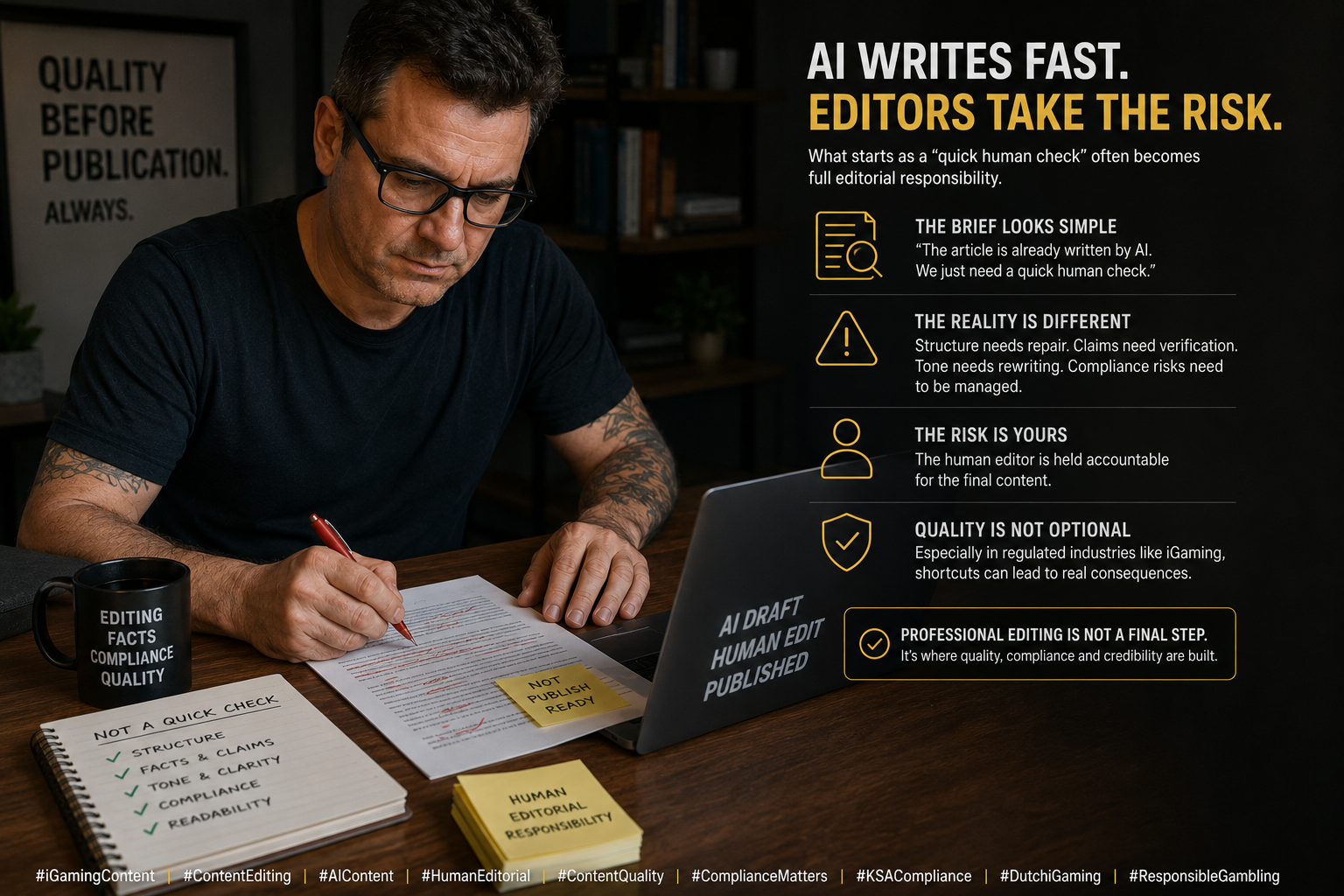
A familiar brief is appearing across freelance platforms: “The article is already written by AI. We just need a quick human check.”
On paper, it sounds efficient. In practice, the “check” often turns into full editorial responsibility. Structure needs repair, claims need verification, tone needs rewriting, and compliance risks need to be managed before anything can be published.
This shift is not about AI replacing writers. It is about redefining professional editorial work as a low-cost final step, while keeping the human editor accountable for the outcome.
For freelancers and content teams working in regulated industries like iGaming, this creates a clear risk. Quality, compliance, and credibility cannot be reduced to a last-minute correction.

The Reality Behind “AI Editing” Jobs
One recent freelance listing illustrates the issue clearly. Native Dutch editors were offered $0.01 per word, or $10 per 1,000 words, to process more than 200,000 words of AI-assisted content.
The task description included:
- Correct grammar and unnatural phrasing
- Remove repetition and improve flow
- Verify facts and flag unreliable claims
- Adjust tone for native Dutch readers
- Maintain keyword intent and structure
- Reduce “AI detection” scores
This is not proofreading. It is a combination of editing, rewriting, fact-checking, localisation, and quality control.
Yet the pricing reflects none of that complexity. The work is framed as light polishing, while the expectations match full editorial ownership.
How AI Tasks Are Repackaging Traditional Editorial Work
AI has not removed editorial roles. It has relabelled them.
Different job titles now describe what are, in reality, established professional responsibilities:
- An “AI post-editor” rewrites machine-generated drafts into readable content
- An “AI fact-checker” verifies claims that may not have credible sources
- An “AI humaniser” restructures repetitive and predictable phrasing
- An “SEO repair editor” restores clarity and intent in weak drafts
- A localisation editor adapts literal translations into culturally accurate language
The naming suggests limited effort. The actual work often requires deep intervention.
A short “review” can mean rewriting entire sections. A simple “fact check” can mean building the source base from scratch. This disconnect between label and workload is where the pricing problem begins.
Why $10 per 1,000 Words Breaks Down in Practice
At first glance, $10 per 1,000 words may seem workable for fast tasks. But AI-generated drafts are rarely consistent.
If an editor completes 1,000 words in 30 minutes, the rate appears to be $20 per hour before fees and taxes. That assumes minimal corrections.
In reality, several factors slow the process:
- Checking the full article for contradictions and repetition
- Verifying claims, especially in regulated markets
- Rewriting unclear or misleading sections
- Aligning tone with brand and audience expectations
If the same task takes one hour, the rate drops to $10. At 90 minutes, it falls below sustainable levels.
More importantly, quality cannot be assessed by scanning a few sentences. A responsible editor must review the entire piece, especially when accuracy and compliance matter.
The Risk of Treating Editorial Work as Cosmetic
The core issue is not AI itself. AI can support research, structure, and drafting when used correctly.
The risk appears when human input is treated as a final cosmetic step rather than a core part of content production.
In regulated sectors like Dutch iGaming, this approach creates clear exposure:
- Incorrect bonus terms or payment details
- Outdated regulatory references
- Misleading claims about operators or licences
- Content that fails to meet KSA expectations
Major publishers already recognise this. News organisations such as the Associated Press require strict human oversight for AI-assisted content. Fluent language alone is not a reliability signal.
The same principle applies to commercial content. If the human editor is responsible for accuracy, they must be given the time and scope to do the job properly.
The “AI Detection” Distraction
Many low-cost editing briefs include a requirement to “reduce the AI score.” This introduces another layer of confusion.
Detection tools do not measure editorial quality. They attempt to identify patterns, often with inconsistent results.
Research has shown that these systems can produce false positives and may unfairly flag non-native English writing. Strong human-written content can still be labelled as AI-generated.
Focusing on detector scores shifts attention away from what actually matters: accuracy, clarity, and usefulness.
For professional publishers, the priority should always be whether the content is correct, compliant, and trustworthy.
A Market Dividing Between Volume and Expertise
Recent data highlights a clear shift in freelance markets.
Research from Brookings indicates that roles exposed to AI, such as proofreading and copyediting, have seen a decline in both contract volume and earnings. Even experienced freelancers are affected.
At the same time, more complex AI-related work is gaining value. Upwork’s workforce research shows that freelancers who combine AI with domain expertise and editorial judgement tend to earn higher rates.
This creates a split:
- Low-cost, high-volume “AI clean-up” work where language is treated as a commodity
- Higher-value editorial work where expertise, accountability, and subject knowledge are essential
For professionals in regulated industries, the second category is where long-term value remains.
How Freelancers Can Protect Their Editorial Value
Freelancers do not need to reject AI-assisted work. But they need to define it correctly.
Start by separating services. Proofreading, editing, rewriting, fact-checking, and compliance review are different tasks. When combined, they require a different pricing model.
When the quality of the source text is unclear, avoid fixed per-word pricing. Hourly rates or clearly scoped projects provide more control.
A practical step is to request a paid sample of 500 to 1,000 words. Track the time required, identify factual issues, and estimate how much rewriting is needed. This turns assumptions into measurable data.
Another key point is sourcing. If a client expects fact-checking, they should provide references or define acceptable sources. Starting from zero turns editing into research work.
Specialisation also matters. A generalist competes on price. A Dutch iGaming specialist brings knowledge of regulation, player expectations, and terminology that cannot be replicated by prompts alone.
What Responsible Clients Should Change
Clients also need to adjust their approach to AI-assisted content.
Using AI for outlines or early drafts can improve efficiency. But responsibility must be clearly assigned across each stage of production.
A more sustainable model includes:
- Separate budgets for research, writing, editing, and compliance
- Clear expectations for sourcing and verification
- Evaluation based on accuracy and usefulness, not automated scores
This is not about increasing costs without reason. It is about reducing risk and ensuring that published content meets professional standards.
In industries where regulation and trust are critical, cutting corners at the editorial stage often leads to higher costs later.
AI Works Best With Clear Editorial Responsibility
AI can support content teams effectively when used within a structured workflow.
On AI-assisted content strategy for Dutch iGaming, the focus is not on replacing human editors, but on improving efficiency while maintaining control over accuracy, tone, and compliance.
This approach reflects how professional publishing teams operate today. AI assists. Human editors remain accountable.
Without that balance, the result is predictable: lower costs upfront, higher risks at publication.
Why Editorial Quality Still Defines Publishable Content
Content that is ready to publish must meet multiple standards at once. It needs to be factually correct, clearly written, aligned with brand tone, and compliant with local regulation.
These requirements cannot be handled as a final checklist. They are part of the editorial process from the start.
Frameworks like the casino review methodology show how structured, phase-based editing ensures that content is accurate, transparent, and useful for readers.
This level of consistency is difficult to achieve when editorial work is compressed into a low-cost “final pass.”
Work With an Editorial Process, Not a Patch
The “$10 AI editing” model is not sustainable for freelancers or publishers who care about quality. It reduces complex work to a simple label, while keeping full responsibility on the editor.
A better approach is to treat AI as part of a broader editorial system, where each stage has a clear role and value.
If you are working with Dutch iGaming content and need output that is accurate, compliant, and ready to publish, it helps to start with a structured process rather than fixing issues afterwards.
The goal is not to produce more content at lower cost. It is to produce content that can be trusted. That still depends on human editorial judgement.