
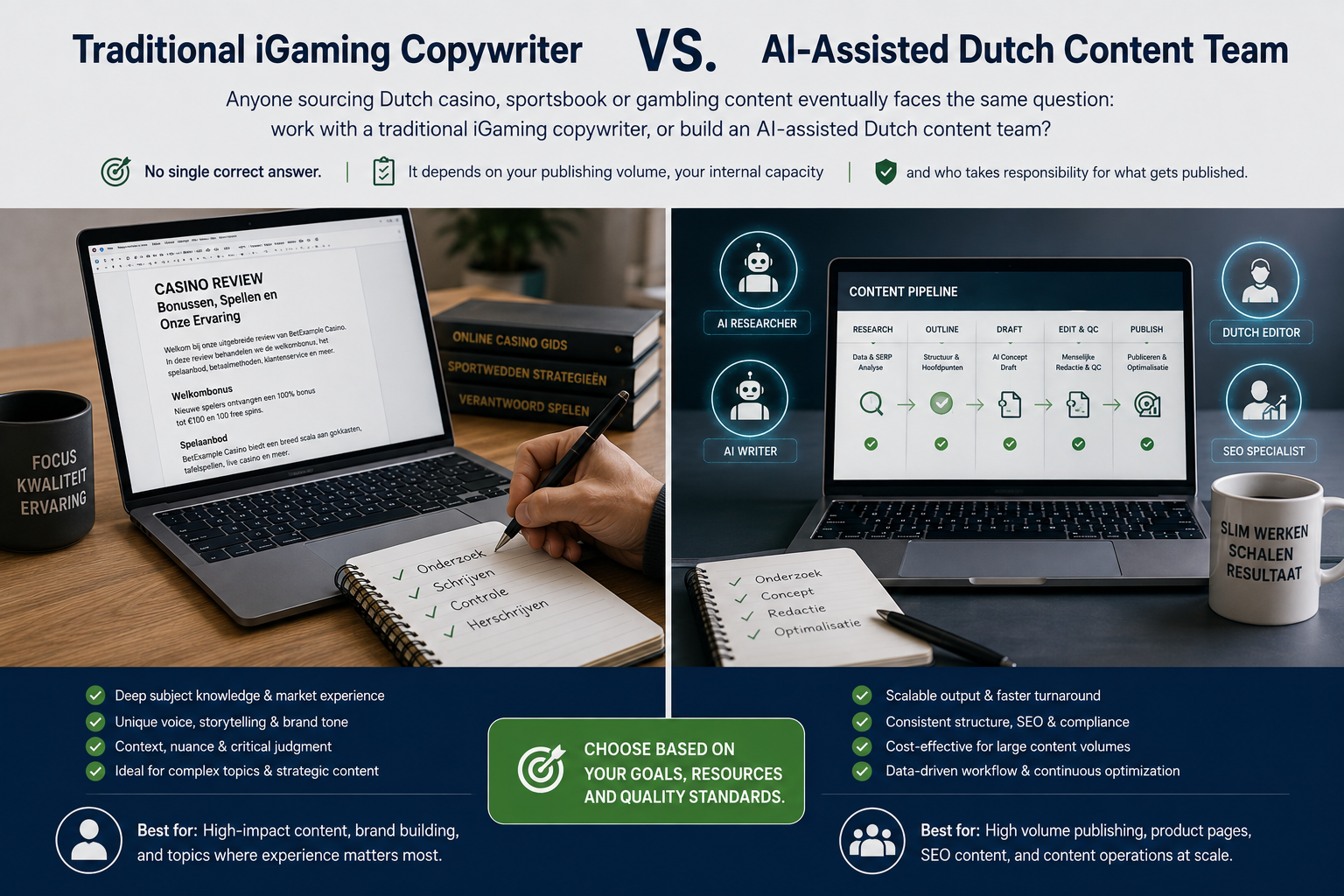
Anyone sourcing Dutch casino, sportsbook or gambling content eventually faces the same question: work with a traditional iGaming copywriter, or build an AI-assisted Dutch content team? There is no single correct answer. The right choice depends on your publishing volume, your internal capacity and who takes responsibility for what gets published.
A traditional copywriter suits businesses that need a handful of well-crafted, highly personal articles and prefer working directly with one specialist. An AI-assisted Dutch content team makes more sense when research, planning, localisation, editing and recurring production all need to happen inside one controlled workflow.
I’m Maurice Kruytzer, a Dutch iGaming content specialist and AI-assisted editor with more than eight years of experience in the regulated Dutch gambling market. My own approach sits between these two models. AI helps me research and produce content more efficiently, but I stay responsible for every editorial decision: what gets included, how the Dutch reads, and whether the final piece meets regulatory standards.

Key Takeaways
- Choosing between a traditional copywriter and an AI-assisted team is a workflow decision, not a quality contest.
- AI increases research and production capacity. It cannot take editorial responsibility.
- Sports betting and casino content require specialist interpretation that generic AI output cannot supply on its own.
- A hybrid model, AI for efficiency plus a Dutch specialist for accountability, works well for regulated content.
- Ask about verification and accountability before asking about tools.
What’s the Real Difference Between These Two Models?
The distinction people usually reach for, “human content” versus “AI content,” misses the point. The more useful question is whether you need one writer working manually, or a human-led editorial system that uses AI as one tool among several.
A traditional copywriter typically handles research, drafting and editing alone, article by article. An AI-assisted team distributes those tasks: AI supports research and first drafts, while a Dutch specialist manages structure, localisation, factual accuracy and final sign-off.
You can see how I structure that service on my Dutch iGaming content services page, covering casino content, sportsbook previews, betting guides, localisation and editorial support.
When Does a Traditional iGaming Copywriter Make More Sense?
Choose a traditional copywriter when your publishing schedule is limited, your briefs are already strong, and you mainly need someone to turn those briefs into accurate Dutch copy.
If your company publishes two expert opinion pieces a month and already has an SEO manager, compliance specialist and editor in-house, a strong freelance Dutch iGaming copywriter may be everything you need. The system already exists. The writer only has to deliver inside it.
A single copywriter also tends to work better when content depends heavily on personal interviews, opinion pieces or a distinctive individual voice. Layering extra process onto that kind of writing often adds friction instead of removing it.
When Does an AI-Assisted Dutch Content Team Add More Value?
The calculation shifts once volume increases. Picture an affiliate site publishing casino reviews, sportsbook previews, payment guides, bonus explainers and regulatory updates every month.
At that scale, consistency becomes the real challenge:
- Does every writer explain wagering requirements the same way?
- Are payment method pages reflecting current information?
- Does the Dutch read naturally, or does it feel translated?
- Are internal links added with a clear logic?
- Are similar pages targeting different reader questions, or quietly competing with each other?
This is where a structured editorial workflow earns its place. My own framework, described on the Dutch iGaming AI content strategy page, combines research, analysis, Dutch editorial control and reader intent rather than treating each article as an isolated task.
Why Specialist Knowledge Still Decides the Outcome
iGaming content includes details that generic writers, and generic AI prompts, regularly get wrong: wagering requirements, sportsbook markets, payment methods, account verification, bonus mechanics, and Dutch regulatory context under Kansspelautoriteit rules.
Sports betting content makes this especially visible. Take my Netherlands versus Turkey preview from Euro 2024: it combined match statistics, bookmaker odds and specific betting markets. The article didn’t stop at naming the favourite. It explained what the odds represented, why the pricing looked the way it did, and which markets readers were likely comparing.
That level of interpretation needs more than fluent grammar. It requires understanding what an odd actually communicates, and knowing where analysis ends and an unsupported promise begins.
A Second Example: Combat Sports Content Needs Judgement, Not Just Data
The same principle holds outside football. My GLORY 107 betting article, covering Donovan Wisse against Chico Kwasi and the rest of the card, pulled together fight records, knockout rates, strikes landed per minute, strikes absorbed per minute, accuracy figures and bookmaker odds, then connected them to real betting questions.
This is exactly the kind of article where AI-assisted research earns its keep: there’s a lot of data to gather and compare. But collecting statistics automatically isn’t the same as understanding whether they matter.
A high knockout percentage can look impressive on its own. Weight class, opponent quality, recent form and fighting style can all change how relevant that number actually is. Deciding what the reader should take from the numbers still falls to the writer, not the dataset.
AI Should Save Time, Not Replace Expertise
There’s a wrong way to use AI in regulated content: generate, paste, publish. There’s a better way: research, structure, draft, verify, edit, publish.
AI can genuinely help with several of those stages. It should never own all of them. My own workflow uses AI for research and drafting efficiency, while a Dutch specialist stays responsible for the finished piece. That process, including AI-assisted drafting paired with editorial validation, localisation and compliance checks, is described in more detail on my Dutch iGaming AI content strategy approaches page.
This distinction matters more in regulated markets than almost anywhere else. Recent Kansspelautoriteit enforcement shows why: in 2026 alone, the regulator issued roughly €36 million in fines across seven cases, some against illegal operators, others against licensed brands over duty-of-care failures. Content that misrepresents risk, bonus terms or compliance obligations isn’t just a quality issue, it’s a regulatory one.
What Should You Ask Before Hiring Either Option?
Don’t start by asking whether someone uses AI. Ask what they actually know.
- Can they explain betting odds correctly?
- Do they understand casino bonus conditions and wagering terms?
- Can they spot weak Dutch localisation when they see it?
- Can they show published gambling content, not just a portfolio page?
- Who verifies the factual claims before publication?
- Who takes responsibility if AI output turns out to be wrong?
Those questions reveal far more about quality and accountability than any list of tools someone claims to use.
Building Content Operations That Scale Without Losing Trust
Once a business moves beyond needing “a writer” and starts asking “how do we build a reliable Dutch content operation,” the conversation changes. It becomes about consistency across casino reviews, sportsbook previews, payment guides and compliance updates, not just about individual articles.
My casino review work follows a documented methodology focused on licensing accuracy, sourcing and responsible gambling messaging, detailed on the casino review methodology page. The same discipline applies to sportsbook content: understanding markets, explaining odds clearly and keeping match context accurate, an approach covered on the Dutch sportsbook content strategy page.
That kind of operational consistency is difficult for one freelance writer to maintain alone once volume grows past a certain point. It’s easier to sustain inside a workflow built specifically to support it.
Final Verdict: Team or Copywriter?
If you need a small number of articles and already manage research, structure and editing internally, a good traditional iGaming copywriter is the right call.
If you need recurring Dutch content across multiple iGaming subjects, an AI-assisted editorial team offers more flexibility and a sturdier production structure.
The word that matters here is “assisted.” AI should make an experienced specialist faster. It shouldn’t replace the specialist’s judgement. That’s the model I use: AI tools combined with the final call of an experienced Dutch iGaming writer and editor.
Speed helps in regulated gambling content. Knowing exactly what you’re writing about still matters more.
If you’re weighing up which model fits your publishing needs, or you want a second opinion on an existing content workflow, feel free to look through my Dutch iGaming content services or get in touch directly. I’m happy to talk through what would actually work for your situation, no obligation attached.