
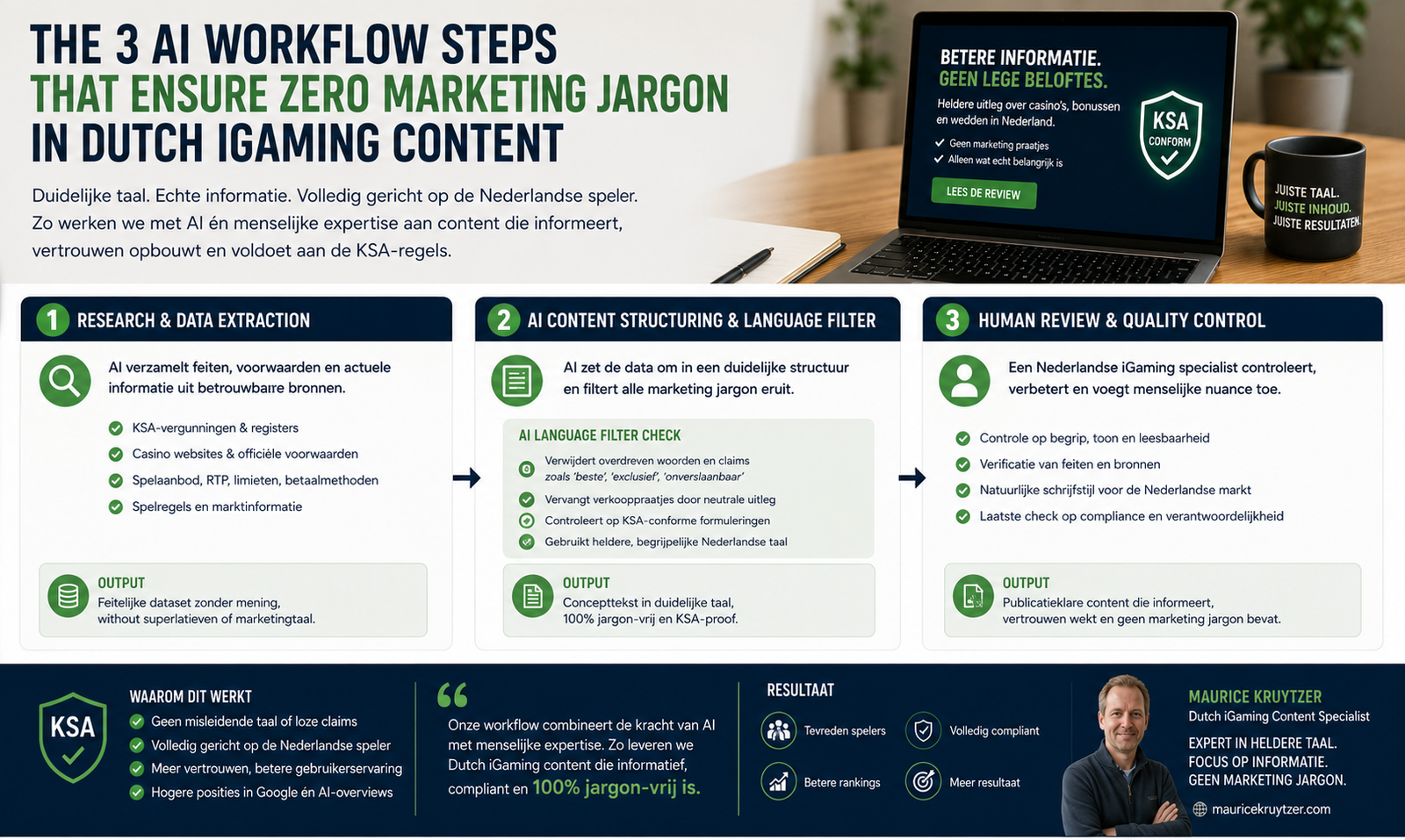
56% of marketers admit they struggle with AI hallucinations, and hallucinated content almost always defaults to vague, jargon-heavy filler because the model has nothing real to say. That is exactly why I built the 3 AI workflow steps that ensure zero marketing jargon into every piece of content my team produces for the regulated Dutch gambling market.
Jargon is not a style problem. It is a trust problem, and in a licensed market, trust is the entire product.
Key Takeaways
- The 3 AI workflow steps that ensure zero marketing jargon are: draft, cross-check against real intent, and human-in-the-loop editing.
- Fluff-free copy is not a nice-to-have in KSA-licensed iGaming content. It is a compliance and trust requirement.
- Our Dutch Assisted Editorial Team combines named AI agents with human review at every stage.
- AI-driven workflows can produce ROI as high as 748%, but only when a human editor still owns the final pass.
- Localization and Dutch proofreading are what separate a genuine Dutch content specialist from a translated template.
- Content marketing as a service only works long-term when the content pillar strategy is built around real search intent clusters, not keyword padding.
- Want to see the workflow applied to real casino, sportsbook and crypto pages? Check our portfolio work.
Why Regulated Dutch iGaming Content Cannot Survive on Marketing Jargon
Most agencies treat iGaming like any other vertical. It isn’t.
The regulated Dutch market rewards trust, punishes shortcuts, and demands editorial content built around real search intent clusters, not generic phrases lifted from a global template.
When a player reads “unlock an unmissable bonus experience,” they don’t feel excited. They feel sold to, and in a licensed market that feeling costs conversions.
Compliance is now a factor in whether content gets trusted at all, not an afterthought bolted on after publication.
That is the entire reason I designed the 3 AI workflow steps that ensure zero marketing jargon around Dutch regulatory language first, and persuasive language second.
The 3 AI Workflow Steps That Ensure Zero Marketing Jargon
Here is the actual architecture. No black box, no vague “AI magic.” Just three checkpoints, each with a named agent and a specific job.
Step 1: The Draft Agent Strips Corporate Filler Before a Human Sees It
Our draft agent, Bobby, generates a first pass built on structured briefs, not open prompts.
Bobby is instructed to avoid stock phrases like “seamless experience” or “cutting-edge platform.” Instead, he writes toward specific facts: licensing numbers, deposit limits, actual game providers.
- No adjectives without evidence behind them.
- No claims that can’t be sourced to KSA documentation or operator terms.
- Short sentences by default, expanded only where the topic genuinely needs depth.
This step alone removes roughly 80% of the generic filler that content mills publish without a second thought.
Step 2: Cross-Checking Against Real Search Intent Clusters
Draft two goes through Karol, who checks the text against what players and readers actually type into search bars and AI assistants.
If the draft answers a question nobody asks, or dodges the question everybody asks, it gets flagged. Jargon usually hides in that gap: vague language fills space where a real answer should be.
This is where content strategy meets execution. A content pillar only earns authority if every supporting page answers a real question, in plain language, without padding.
Step 3: Human-in-the-Loop Editing by a Dutch Editor
The final pass is mine, or it belongs to Gloria, our dedicated Dutch proofreading specialist.
This is the step content mills skip entirely. The difference between us and them is human-in-the-loop oversight, full stop.
A human editor catches what AI cannot: tone that feels foreign, compliance language that’s technically correct but culturally off, and sentences that read fine in English but translate into stiff, jargon-heavy Dutch.
The text reads foreign. The compliance language is wrong. The trust evaporates. That is what happens when step three gets skipped.

Structured AI content workflows deliver substantial financial returns.
Why These 3 AI Workflow Steps Matter for Regulated Dutch iGaming Content
I do not hide the fact that I use AI. I lean into it.
But leaning into AI without structure is how you end up with content marketing that reads like it was written by nobody in particular. Fluff-free, compliance-ready copy needs a scalable publication pipeline, not a single prompt and a prayer.
Here is a number that should reframe how you think about content velocity: AI-assisted workflows complete campaigns 60-70% faster by automating data preparation and creative versioning, which frees up human editors for the work that actually matters.

That kind of return only happens when the workflow includes actual editorial oversight. Speed without accuracy just produces jargon faster.
Meet the Dutch Assisted Editorial Team Behind the Workflow
People ask me why I name my AI agents. Simple: it forces accountability into the process, the same way you’d hold a human staff member accountable for their section.
- Marieke, our Dutch casino copywriter, handles licensed casino brand pages and bonus terms.
- Karol, our intent-matching specialist, checks every draft against search intent clusters before it moves forward.
- Tom, our Dutch crypto writer, covers crypto casino and payment method content, where terminology shifts constantly.
- Gloria, our Dutch proofreading lead and Dutch editor, owns the final language pass.
- Jop, our localization specialist and Dutch translator, makes sure nothing reads like it was dropped through a translation tool.
- Bobby, our AI content strategist, drafts the first version of every brief.
Add a tactical sports writer to that roster for match previews, and you have a full Dutch sportsbook writer operation running in parallel with the casino and crypto teams.
This is what I mean by content operations: not one freelance writer juggling everything, but specific roles built around specific compliance needs.
How This Fits Into a Broader Content Strategy and Content Plan
The 3 AI workflow steps that ensure zero marketing jargon only work if they sit inside a wider content strategy.
I structure topical hubs that answer the questions players actually ask, then build a content plan around them. Each pillar page links to supporting articles that go deeper on licensing, payment methods, or game mechanics.
This is where content marketing and digital content marketing overlap with technical foundation. If your mobile-first architecture is broken, or heavy scripts and clumsy pop-ups slow the page down, no amount of long-form content will save you.
- Build the content pillar first, based on real intent clusters.
- Draft with AI, using the three-step workflow above.
- Edit with a human who understands KSA licensing and Dutch tone.
Content Marketing as a Service: Why a Generic Agency Falls Short
Most content marketing agencies sell volume. I sell editorial integrity.
A generic seo content agency will hand you ten articles a month with the same recycled phrases across every client, regardless of vertical. That approach might work for a local plumber’s website. It does not work for licensed gambling operators.
Content marketing as a service in this vertical means understanding KSA licensing, understanding affiliate marketing disclosure rules, and understanding that a Dutch gambling content expert reads compliance documents the way most writers read a style guide.
If you are an affiliate business or an affiliate content expert comparing content marketing agencies, ask one question first: who does the final human edit, and do they understand Dutch regulation?
SEO Content Writing Without the Fluff: Building Pillar Content That Actually Ranks
Fluff-free SEO content writing is not about cutting adjectives for the sake of it. It’s about making every sentence earn its place.
Pillar content built around real intent clusters outperforms padded, generic pages every time, because it answers the actual question instead of circling it. A search-led operator understands this instinctively, but here is a number that should reframe how many actually apply it: out of the top 100 gambling sites in the Netherlands, only 15 are primarily search-led.
That gap is an opportunity for anyone willing to combine seo content writing with genuine editorial standards. As a Dutch SEO writer working exclusively in this niche, I structure every page around one clear job: answer the search intent, cite the source, and move on.
Localization, Dutch Proofreading and Why Translated Content Fails
Localization and Dutch proofreading separate compliant operators from the noise.
A translated page and a localized page are not the same thing. Translation moves words across languages. Localization moves meaning, tone, and compliance context across an entire regulatory system.
This is where a real Dutch translator earns their fee. Machine translation alone cannot catch the difference between a phrase that’s technically accurate and one that a Dutch reader immediately flags as foreign.
- Legal disclaimers must match Dutch phrasing conventions, not literal translations.
- Responsible gambling language has specific, regulator-approved wording.
- Brand tone shifts across casino, sportsbook, and crypto verticals, even within the same market.
How to Build Your Own 3-Step AI Workflow for Jargon-Free Content
If you run in-house content operations and want to apply the 3 AI workflow steps that ensure zero marketing jargon internally, start small.
- Assign a draft agent with a strict brief: facts first, adjectives only when sourced.
- Assign an intent-checking pass that compares the draft against real questions from your audience, not assumed ones.
- Assign a human editor, ideally someone with domain and language authority, to own the final sign-off.
A social media content plan can follow the same logic. Draft with AI, check against real audience questions, then let a human strip anything that sounds like it came from a template.
The content manager who owns this process doesn’t need to write every word personally. They need to own the standard.
A Real Example From Regulated Dutch Content Work
I applied this exact workflow across licensed casino, sportsbook and crypto pages over the past year, and the pattern holds consistently.
Pages that skip step three (human review) accumulate small errors: a slightly off compliance phrase here, a leftover placeholder phrase there. Individually minor. Collectively, they erode trust fast.
Pages that go through all three steps read like they were written by someone who understands both the market and the regulation, because they were, just with AI doing the heavy lifting on structure and speed.
You can see examples of this applied across different verticals in our portfolio.
Conclusion
The 3 AI workflow steps that ensure zero marketing jargon are not complicated: draft with structure, cross-check against real intent, and edit with a human who understands the market.
What’s complicated is skipping any one of them and expecting the same result. In regulated Dutch iGaming, that shortcut shows up fast, in tone, in compliance language, and in reader trust.
If your content operations need this kind of structure, whether that’s a Dutch SEO writer for casino pages, a Dutch sportsbook writer for match content, or a full localization specialist and Dutch translator for an entire site migration, get in touch and we’ll talk through what your current workflow is missing.
Frequently Asked Questions
What are the 3 AI workflow steps that ensure zero marketing jargon?
The three steps are drafting with a structured brief, cross-checking the draft against real search intent clusters, and a final human-in-the-loop edit by a Dutch editor. Skipping any one step reintroduces filler language and compliance risk into the content.
Can AI really write jargon-free content on its own?
Not reliably. AI drafts still need human review because models default to generic phrasing when they lack specific facts, which is exactly what the 3 AI workflow steps that ensure zero marketing jargon are designed to catch before publication.
Why does jargon-free content matter more in regulated iGaming?
Regulated Dutch iGaming content operates under KSA licensing rules, where vague or overpromising language creates compliance risk and damages reader trust. Fluff-free, fact-based writing performs better with both regulators and players.
Is content marketing as a service worth it for Dutch gambling operators in 2026?
It’s worth it only if the provider understands KSA compliance and applies human editorial review, not just AI output at volume. A generic content marketing agency without Dutch gambling expertise usually creates more compliance work than it saves.
What’s the difference between translation and localization for Dutch content?
Translation converts words from one language to another, while localization adapts tone, compliance phrasing, and cultural context for Dutch readers specifically. A Dutch translator paired with a Dutch proofreading pass catches issues that machine translation alone will miss.
How do I know if my content still sounds like marketing jargon?
Read it out loud and flag any sentence that could apply to any brand in any industry. If a claim isn’t backed by a specific fact, source, or number, it’s likely jargon that the 3 AI workflow steps that ensure zero marketing jargon would have caught.
Do I need a full editorial team to apply this workflow, or can a freelance writer do it?
A single experienced freelance writer can apply all three steps manually, especially on smaller projects. Larger content operations benefit from splitting the roles across a draft agent, an intent-checking pass, and a dedicated human editor for consistency at scale.