
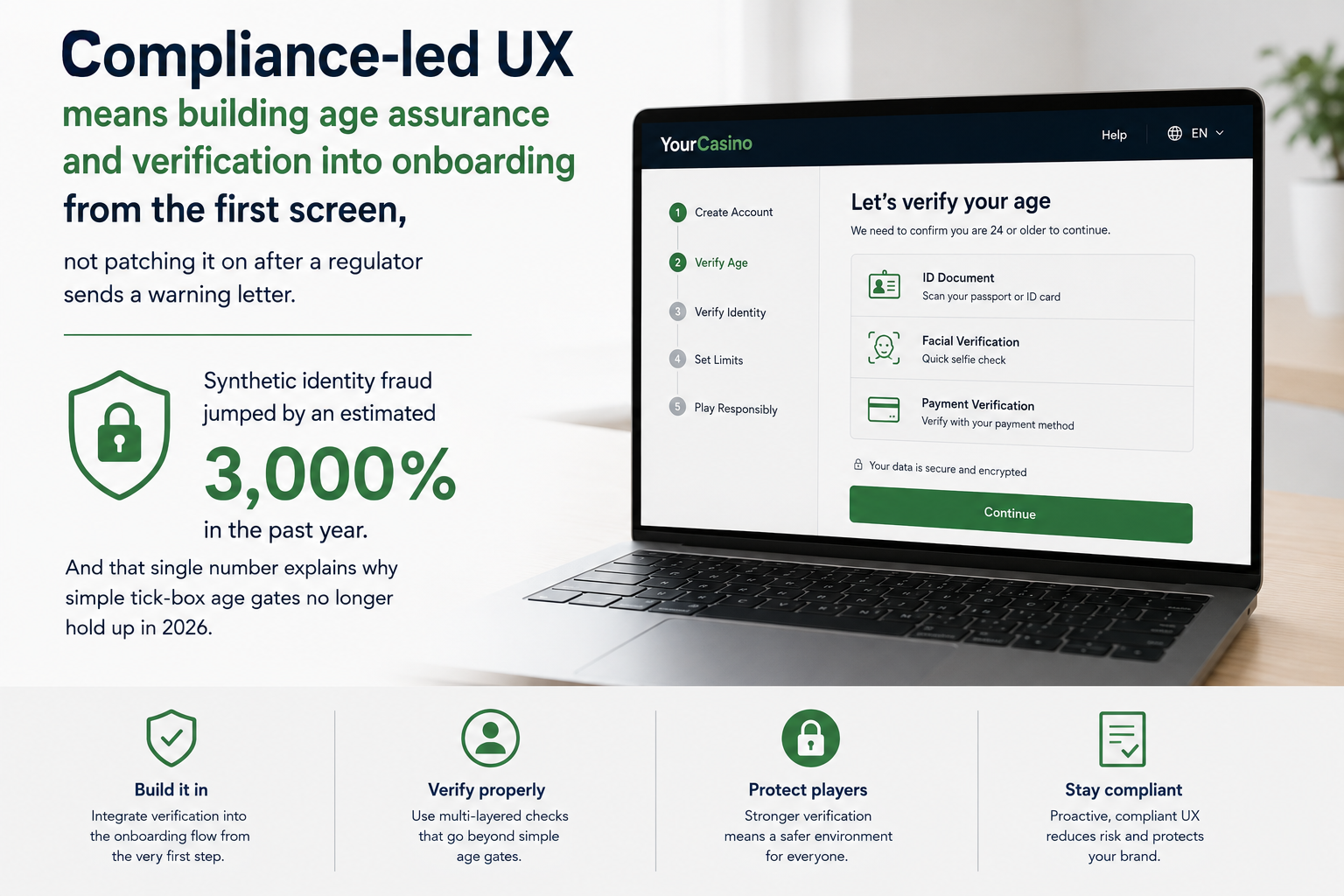
Compliance-led UX means building age assurance and verification into onboarding from the first screen, not patching it on after a regulator sends a warning letter. Synthetic identity fraud jumped by an estimated 3,000% in the past year, and that single number explains why simple tick-box age gates no longer hold up in 2026.
Key Takeaways
| Question | Answer |
|---|---|
| Why can’t age verification stay a separate step? | Bolt-on checks create friction, drop-off, and workaround behaviour. Compliance-led UX builds verification into the natural onboarding flow instead. |
| Does stricter verification always mean more friction? | No. Layered age assurance methods let low-risk users pass quickly while higher-risk sign-ups face stronger checks. |
| What role does content play in age assurance UX? | Clear copy at each verification step reduces abandonment and explains why data is requested, which builds trust. |
| How does this apply to the Dutch market specifically? | KSA duty-of-care rules require operators to actively prevent underage and vulnerable player access, not just react to complaints. See our Dutch iGaming AI content strategy for how content and compliance intersect. |
| Can AI tools help with verification content? | Yes, but human editorial review remains necessary for accuracy, tone, and regulatory alignment. |
| What happens if onboarding UX ignores compliance? | Regulators can issue fines, and users route around weak checks using VPNs or false details, defeating the purpose entirely. |
| Where can I see real onboarding content examples? | Our portfolio of Dutch iGaming projects shows compliance-aligned content built for regulated onboarding flows. |
Why Compliance-Led UX Matters for Age Assurance and Verification in Onboarding
Onboarding is the first real conversation a platform has with a new user. If that conversation opens with a clumsy age check bolted onto the end of registration, trust takes a hit before the relationship even starts.
Compliance-led UX treats age assurance and verification as part of onboarding design from day one, not a legal requirement stapled on afterward. That distinction shapes everything from screen order to copy tone to which verification method appears first.
We’ve worked with operators who redesigned their sign-up flow around this principle and saw fewer support tickets within weeks. The lesson is consistent: users don’t mind checks, they mind checks that feel like an afterthought.
The Cost of Treating Age Verification as a Bolt-On
When verification sits outside the main flow, users hit an unexpected wall right when they’re most motivated to sign up. That moment of friction is exactly when abandonment spikes.
Regulators have noticed the same pattern from the other direction. High-friction, poorly explained checks push users toward workarounds rather than compliance.

That’s the paradox facing every compliance team in 2026. Stricter rules without better UX design don’t reduce risk, they just move it somewhere less visible.
Designing Age Assurance and Verification as Part of Onboarding, Not a Bolt-On
Good onboarding design treats verification as one of several onboarding steps, sequenced logically rather than dropped in as an obstacle. Users should understand why a step exists before they’re asked to complete it.
Practical design choices that support this include:
- Explaining the purpose of an age check before requesting documents or biometric data
- Matching the verification method to the risk level of the product, not applying one method to everyone
- Giving users a clear time estimate so they know what to expect
- Offering an alternative path when a primary method fails, rather than a dead end
- Writing confirmation messages that close the loop instead of leaving users guessing
Modern facial age estimation now sits within roughly ±1.5 years of accuracy, which is precise enough for most tiered verification models. That accuracy makes layered approaches realistic rather than theoretical.
What Compliance-Led UX Looks Like in Practice for 2026 Onboarding Flows
In practice, compliance-led UX means age assurance and verification appear at the point where they make contextual sense, not at a random checkpoint. A sports betting sign-up and a casino sign-up don’t need identical verification depth, because the underlying risk profiles differ.
We’ve seen this play out directly in the regulated gambling space, where operators balance strict duty-of-care obligations against user experience expectations covered in our gambling content and UX coverage. The operators getting this right treat verification copy as editorial content, not legal boilerplate.
That’s a subtle but important shift. Copy written by someone who understands both compliance requirements and reader psychology performs differently than copy written purely to satisfy a legal checklist.
Balancing Friction and Safety in Age Verification UX
The tension between friction and safety isn’t going away in 2026, it’s intensifying as regulation spreads. Nineteen U.S. states have now passed age verification laws for harmful content, each with slightly different requirements, and the UK’s Online Safety Act carries fines of up to 10% of global annual turnover for platforms that fail to protect minors.
Florida saw VPN usage spike by 1,150% the day its own age verification law took effect, a pattern that mirrors the UK almost exactly. Fragmented regulation makes a single global onboarding flow harder to maintain, which is exactly why compliance-led UX needs to be built with flexibility from the start rather than patched market by market.
Public pressure adds another layer. Seventy-four percent of UK parents report their children have experienced online harms, yet only 11% of those children actually tell a parent, which is precisely why automated, effective age assurance matters more than manual reporting systems ever could.
AI Workflows and Age Assurance: Where Automation Helps and Where Human Review Still Matters
AI workflows now support much of the heavy lifting in age assurance, from document scanning to facial estimation to fraud pattern detection. That’s genuinely useful, especially at scale.
But AI workflows shouldn’t replace human judgment in the onboarding copy that sits around those checks. An AI content strategist can draft the first version of verification messaging quickly, yet a Dutch editor still needs to review tone, clarity, and legal accuracy before anything goes live.
We treat this the same way we treat every other piece of regulated content we produce. AI speeds up the first draft, human review protects the final result, and that combination is what separates trustworthy onboarding copy from generic AI-generated content advice that ignores compliance nuance entirely.

The age verification market is expanding fast as 2026 approaches.
The global age assurance market is projected to reach $10.4 billion by 2029, up from $5.7 billion in 2025, growing at roughly 17.3% a year. That growth rate confirms age assurance is becoming permanent infrastructure rather than a temporary compliance fix.
KSA Compliance and the Dutch iGaming Onboarding Standard
The Dutch market sets a useful benchmark for compliance-led UX because KSA duty-of-care requirements demand active prevention, not passive policy statements. Operators licensed under the Remote Gambling Act (KOA) are expected to build player protection into the product itself.
This is where a Dutch gambling content expert or Dutch casino copywriter earns their keep. They understand both the regulatory language KSA expects and the tone that keeps Dutch players engaged rather than alienated during onboarding.
The same logic extends across verticals. A Dutch sportsbook writer or Dutch crypto writer working on regulated onboarding content faces near-identical constraints, just applied to different risk categories and different player expectations.
Building a Compliance-Led UX Strategy for Age Assurance in Dutch iGaming
A workable strategy starts with mapping every onboarding touchpoint where age assurance and verification could realistically sit, then deciding deliberately where each check belongs. That mapping exercise alone eliminates most bolt-on design mistakes.

From there, an SEO strategy and content plan need to align with legal review cycles, not run separately from them. Our Dutch iGaming content services are built around exactly this kind of coordinated approach, where compliance sign-off happens alongside content creation instead of after it.
Dutch content operations that separate compliance review from content production almost always end up rewriting pages twice. Building the two processes together from the outset saves both time and legal exposure.
Working With a Dutch iGaming Content Writer to Get Onboarding Copy Right
Onboarding copy is deceptively technical work. It needs the tone of an SEO copywriter, the precision of a compliance manager, and the patience of a Dutch proofreading specialist checking every claim twice.
This is why many operators bring in a dedicated iGaming content writer or Dutch SEO writer rather than assigning verification copy to a generalist. A Dutch content specialist who already understands KSA language, player protection terminology, and localisation nuance writes faster and with fewer compliance flags than someone learning the space from scratch.
Affiliate businesses face a parallel challenge. An affiliate content expert working across multiple operator partnerships needs to track different verification requirements per brand, which is where affiliate marketing content and compliance genuinely intersect rather than sitting in separate departments.
We’ve also seen value in bringing a localization specialist and Dutch translator into the process early, rather than translating finished English copy afterward. Verification tone rarely survives a literal translation, and a content manager who understands that difference protects both compliance and readability.
For teams without in-house capacity, a freelance writer with specific Dutch iGaming and compliance experience often fills the gap faster than hiring a full-time role. Our Dutch iGaming trends coverage tracks how these staffing and compliance patterns are shifting through 2026.
Conclusion
Compliance-led UX for age assurance and verification isn’t a trend, it’s becoming the baseline expectation for any regulated onboarding flow in 2026. Platforms that design verification as part of onboarding, rather than bolting it on afterward, see fewer drop-offs, fewer compliance flags, and more trust from the users they’re trying to protect.
If your onboarding flow still treats age assurance as a separate legal hurdle, that’s worth revisiting before the next regulatory update forces the issue. We’re happy to look at your current flow and talk through where compliance-aware content and onboarding copy could reduce friction without cutting corners on safety.
Frequently Asked Questions
Is age assurance the same as age verification?
No, age assurance is the broader category that includes estimation methods like facial analysis, while age verification specifically confirms identity through documents or official records. Compliance-led UX often blends both, using lighter assurance methods first and verification only when risk requires it.
Why is age verification UX getting stricter in 2026?
Regulation has expanded fast, with 19 U.S. states now requiring age checks for harmful content and the UK’s Online Safety Act carrying fines up to 10% of global turnover. Compliance-led UX has become the practical way to meet these rules without destroying conversion rates.
Does adding age verification always hurt conversion rates?
Not if it’s designed as part of onboarding rather than added as an afterthought. Poorly placed checks cause abandonment, but well-sequenced compliance-led UX with clear explanations tends to perform close to flows without verification at all.
Can AI handle age verification content without human review?
AI workflows can draft initial verification copy and support fraud detection, but human editorial review remains essential for legal accuracy and tone. This is especially true in regulated markets like the Netherlands, where KSA language requirements leave little room for AI-only publishing.
What is the KSA duty-of-care requirement for age verification?
KSA duty-of-care rules require Dutch operators to actively prevent access by minors and vulnerable players, not simply respond to complaints after the fact. This pushes compliance-led UX from a nice-to-have into a licensing requirement.
How much friction is acceptable in age assurance onboarding?
The right amount of friction matches the risk level of the product being accessed. Layered approaches, using quick checks for low-risk scenarios and stronger verification for higher-risk products, tend to balance safety and user experience most effectively.
Is compliance-led UX worth the investment for smaller platforms in 2026?
Yes, because the age assurance market is growing at roughly 17.3% annually and regulatory scrutiny is increasing across nearly every region. Smaller platforms that build compliance-led UX into onboarding early avoid the costlier rebuild many larger platforms now face.