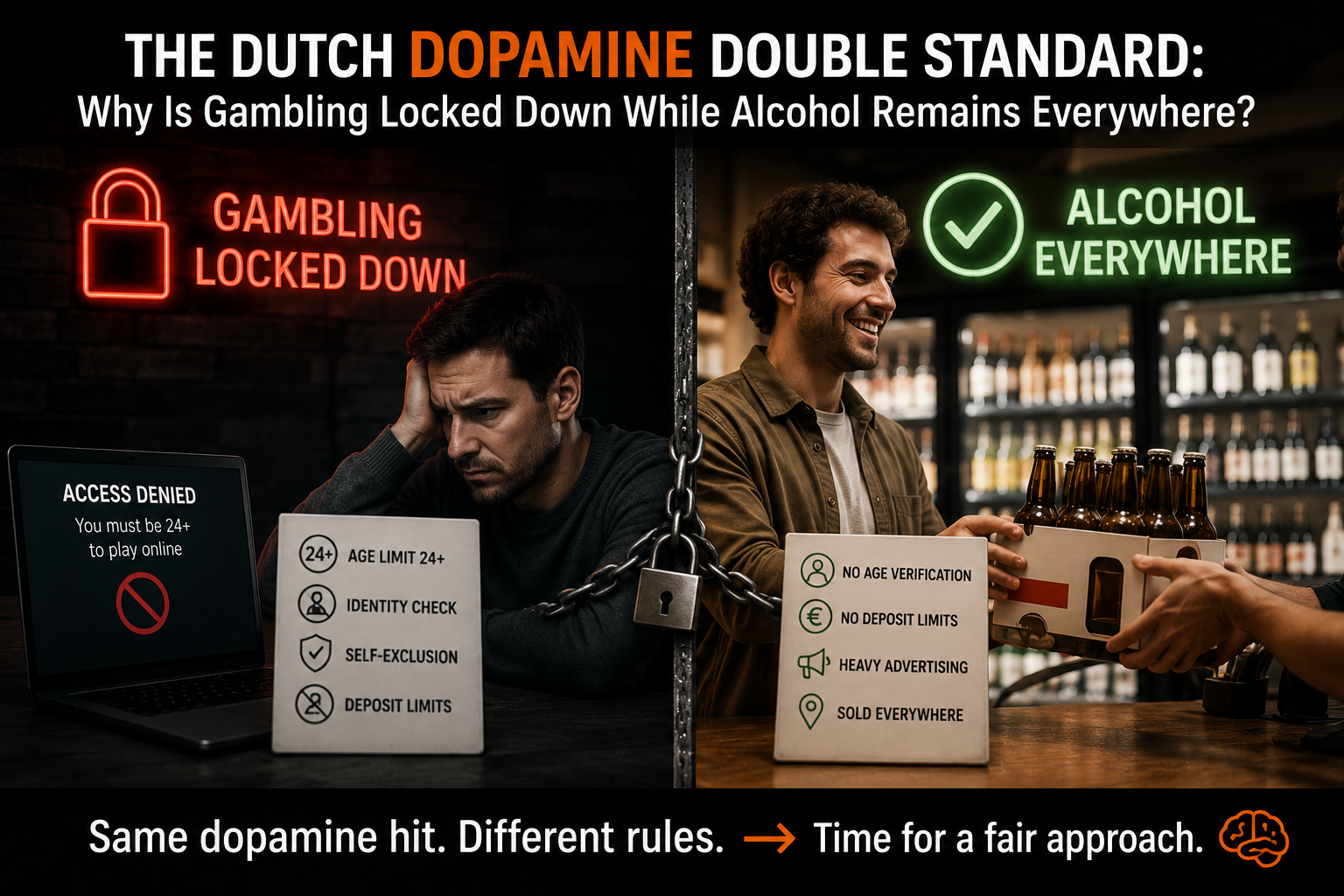
In the Netherlands, alcohol remains easy to find, from supermarkets to restaurants, as long as sellers follow the rules. Online gambling, by contrast, sits behind identity checks, account protection requirements, advertising restrictions, and behavioral interventions. That difference is not only policy design, it reflects what society is willing to fear, manage, and treat as “normal life.”

Alcohol and gambling are both addictive risks, but the policy lens is not the same
The Dutch Alcohol Act does not treat alcohol like an exceptional product. It restricts sales to minors, caps discounts at 25%, and requires age controls for online purchases. In practice, adults can still buy beer and wine in ordinary places and consume it in normal social settings.
Online gambling operates under a different assumption: the product is available on demand, handled through accounts, and supported by payment flows that can accelerate losses. As a result, licensed operators must verify identity, check Cruks, and comply with duties of care. Deposit behavior can also trigger financial safeguards. In addition, the advertising framework is tighter, and restrictions on sports sponsorship by online gambling firms have been in place since 1 July 2025.
That contrast raises a legitimate question. If both activities can create addiction and harm, why does one remain culturally friction-light while the other gets friction-heavy?
We regulate the product we fear, not always the harm we measure
One reason alcohol feels “everywhere” is that it is deeply normalized. In 2025, 76.2% of Dutch adults reported drinking alcohol. That prevalence matters because policymakers often shape rules around what the public already treats as ordinary, not around what could happen under the wrong conditions.
The harm picture is still substantial. Trimbos estimates net social costs for alcohol in the Netherlands at roughly €2.3 billion to €4.2 billion per year. Those costs include healthcare, productivity losses, and costs involving police and justice.
Alcohol also functions as a carcinogen, and heavy or long-term use can damage multiple organ systems. It can impair judgment and coordination in the short term and contribute to disease over time.
Gambling creates a different damage profile. You do not get liver disease from roulette in the way you can from alcohol. However, gambling can undermine financial stability extremely quickly. In Trimbos findings on Dutch adults who gambled during 2024 (excluding people who only played lotteries), some reported using savings, reducing spending on necessities like groceries or medication, borrowing money, or paying bills late. Among people classified as problem gamblers, 67% said they experienced financial problems at least sometimes.
Treatment data also points to scale. In specialist addiction care in 2025, 3,108 people were treated with gambling as the primary addiction, up from 2,708 in 2024. Trimbos notes that not every provider reports into that dataset, so the true treatment count may be higher.
Different pathways, different symptoms, but harm still travels through the same shared destinations, bank accounts, relationships, employers, and healthcare systems.
Dopamine is part of the story, but policy should not use simplistic neuroscience
It is tempting to say gambling and alcohol are addictive because both “give dopamine hits.” That framing is catchy, but too narrow. For gambling disorder, research highlights how uncertainty and reward anticipation interact with dopamine-related learning systems. The possibility of a win, especially when outcomes stay unpredictable, can reinforce continued play.
That helps explain why near misses, bonus visuals, or the moment you wait for a roulette outcome can feel rewarding even before money is won. The mechanism is not just pleasure, it is learning under uncertainty.
Alcohol affects reward systems too, but heavy use can shift the pattern. As dependence develops, drinking can move from seeking pleasure toward managing anxiety, withdrawal, or other negative states. The behavioral direction changes with time, not just intensity.
So it is better to treat both products as capable of interacting with reward and habit systems, while acknowledging that their physical and behavioral consequences are not the same.
Speed and friction explain a major part of the regulatory difference
Online gambling has a structural speed advantage. In a bar or at a football canteen, alcohol still requires ordering and consumption. Physical intoxication creates limits. Venues also have closing times and natural friction between intention and access.
Online gambling is closer to instant escalation. Deposits can be made quickly, bets follow in seconds, and the next round appears immediately. The entire product sits on a phone, and the pathway from interest to spending can compress dramatically.
This is why Dutch rules increasingly focus on monitoring behavior, limiting deposits, and intervening when risk signals appear. KSA data referenced in the original argument suggests that after stronger responsible gambling rules were introduced in October 2024, the share of accounts losing more than €1,000 per month fell substantially. While no single metric can capture all effects, it supports the idea that friction and intervention can change outcomes.
That leads to the next uncomfortable question. If reduced availability, advertising constraints, and financial friction can reduce harm in gambling, why is availability discussed and designed so differently for alcohol?
Trimbos has assessed alcohol policies such as higher prices and fewer sales locations precisely because reducing availability can reduce alcohol-related harm. Alcohol and gambling do not need identical rulebooks, but they should be assessed using the same underlying principle: which interventions reduce harm without creating worse unintended consequences?
Gambling regulation needs strong controls, but alcohol regulation is not absent
It is risky to push the comparison too far. The same “tight control” logic cannot automatically transfer from gambling to alcohol without addressing differences in how the products operate.
Online gambling has unique characteristics that make harm escalation faster and less visible. Money is both the stake and the consequence. A player can lose a meaningful portion of monthly income without showing obvious physical signs associated with severe intoxication. In addition, gambling uses uncertainty continuously. Each spin or bet carries the possibility of reversing loss, which can sustain engagement even when outcomes keep going against the player.
Those features support why Dutch policy keeps Cruks requirements and intervention duties in place. Cruks can exclude someone from Dutch licensed online gambling, casinos, and gaming halls for at least six months. More than 111,000 registrations were recorded by 30 January 2026, which indicates the system is not theoretical, it is being used as a protective tool.
Alcohol lacks a national system that can block every supermarket, bar, and webshop from selling to a person for six months by one exclusion action. A similar mechanism would raise different enforcement, privacy, and practicality concerns. But the contrast still matters when we ask why alcohol gets so much cultural tolerance by default.
At the same time, alcohol regulation does exist. Sales to people under 18 are prohibited. Online buyers must confirm adulthood, and age must be checked on delivery. Promotions cannot exceed a 25% discount. Marketing aimed at young people is limited through advertising rules and industry codes.
Enforcement is also being tightened for online delivery. Investigations found minors could still obtain alcohol too easily through online channels. Planned measures intended for 2027 would allow delivery companies themselves to be fined for handing alcohol to minors.
So it is not accurate to claim that gambling is tightly managed while alcohol is completely free. The real issue is degree and design, how policy treats harm prevention before problems become visible.
A more coherent approach would focus on harm and environment, not moral messaging
A coherent Dutch policy conversation would start by admitting that addiction policy often reflects culture. Alcohol has centuries of social acceptance. Online casinos became mainstream on Dutch phones more recently. That history shapes which risks feel normal and which feel like an exceptional threat that must be controlled digitally.
Instead of relying on tradition, policy should focus on measurable harm. For gambling, that means keeping effective financial limits, transparent monitoring, Cruks, and action against illegal operators.
For alcohol, it could mean taking pricing, availability, digital sales pathways, and exposure through advertising more seriously, not treating excessive drinking primarily as an individual’s poor decision. Where harm is predictable and environments shape behavior, “just be responsible” becomes less informative than changing the conditions that make loss more likely.
Both sectors also suffer from the same communication failure. People with addiction struggle with impaired control. Shame-based messaging does not fix the mechanism. Prevention works better when the environment changes early, before willpower and denial do all the work.
The double standard is also about how we talk about addiction
Dutch political debate can treat online casino advertising as a consumer threat while alcohol remains woven into celebrations, business dinners, sport, and everyday shopping. That may not automatically mean gambling rules are too strict. But it can signal that alcohol-related harm still gets framed as normal life.
Gambling can destroy finances quickly. Alcohol can cause physical harm in ways gambling cannot. Both affect families, work, mental health, and public services. The mechanisms differ, so the regulation can differ too.
However, the regulation should follow evidence, not comfort. The key question should not be “which is worse,” because both can be seriously damaging. The more useful question is why society is willing to engineer strong protective friction around one addictive product while treating similar protective friction around another as an attack on normal life.
That is a difficult question, but it is also the one worth asking if the aim is real harm reduction rather than cultural convenience.
Where content and policy analysis can meet: regulated iGaming deserves more than generic takes
If you work in publishing, compliance, or operator communication, the comparison between alcohol and gambling is only helpful when it translates into practical, evidence-based drafting and careful framing. In regulated Dutch iGaming, inaccurate claims about player protection or licensing duties can create compliance risk, and vague language about interventions can mislead decision-makers.
That is why professional editorial work matters. If you want to build regulation-aware, critical yet factual content for the Dutch market, you can review Maurice Kruytzer’s work and approach, and request editorial support where needed.
Recommended further reading
- Jellinek, gambling and related behavioural impacts
- Maurice Kruytzer, editorial approach for regulated Dutch iGaming
- Our Works, examples of regulated-market editorial delivery
Solid next step
If you plan to publish on regulated Dutch gambling topics, treat “harm reduction” as a drafting principle, not a slogan. Ask what friction changes outcomes, which safeguards prevent escalation, and how you can describe addiction without turning it into either moral theatre or marketing copy.
If you want help turning those principles into a publish-ready article for the Dutch market, contact Maurice Kruytzer for editorial support and regulation-aware review.