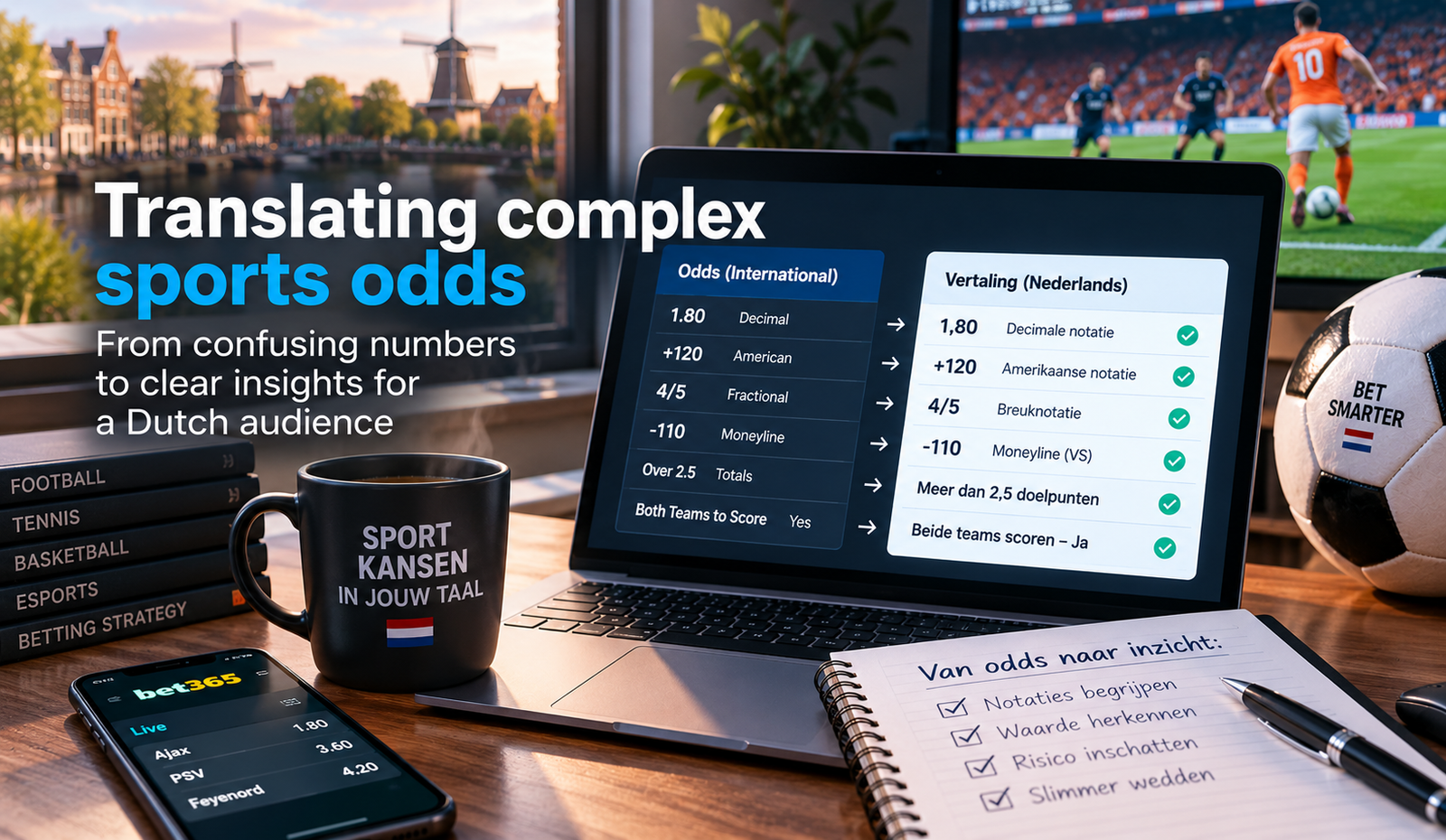
In 2026, bettors are staring at an overwhelming wall of numbers, and the most useful edge is not “better picks” but translating complex sports odds into actionable player intelligence that you can actually use. That single shift turns odds from abstract entertainment math into decisions you can explain (and defend) before kickoff.

Key takeaways: translating complex odds into decisions you can use
| 1) Start with probability, not hype Convert prices into implied probability so you can compare scenarios, not just odds. | 2) Treat odds as inputs Odds only become player intelligence once you attach context like role, matchup, and availability. |
| 3) Map markets to usage Alt lines are distributions, not single guesses, so you need a range-based view. | 4) Build a “human-in-the-loop” workflow Draft fast, verify precisely, translate cleanly, and sign off with accountability. |
| 5) Localisation is not just translation Dutch framing, disclosures, and responsible language matter in 2026 publishing and player-facing explainers. | 6) Keep one workflow for odds explainers If you reuse structure for match previews, odds guides, and explainers, your intelligence stays consistent. |
FAQ-style quick answers
| |
If you only “read odds,” you end up reacting. If you translate them, you end up with usable intelligence: what is likely, what is fragile, and what should change your bet.

Step 1: Convert prices into implied probability (and sanity-check them)
The first real move in translating complex sports odds into actionable player intelligence is simple: turn odds into implied probability. Prices are a communication format, not the information itself.
But implied probability is only step one. We also need to account for why the market might be pricing a player differently across bet types. That usually comes down to whether the market is assuming a role, a script (game state), or a distribution of outcomes.
- Moneyline style markets: Often reflect a broader team expectation, so player props need context.
- Player props: Reflect role and usage assumptions, so you can map them to player-specific drivers.
- Alt lines and buckets: Force you to view expectations as a distribution, not a yes/no.
In other words, translating complex sports odds into actionable player intelligence is not “find a number that looks good.” It is “extract what probability the market is actually betting on, then test if your context supports it.”
Step 2: Treat lines as distributions, not single predictions
One reason odds feel confusing is that bettors often look at a single line like it is the whole story. It is not. Alt lines, ladders, and multiple thresholds are the market telling you how it expects the outcome to behave across a range.

That is where translating complex sports odds into actionable player intelligence gets practical. Instead of asking “Will the player hit over?”, you ask “Where does this player’s expected distribution sit, and which thresholds do I actually have an edge on?”
When we handle odds explainers and betting explainers, we structure our work to keep this distribution mindset consistent. We draft the probability view first, then translate it into usage and matchup context so the reader knows what matters.

Step 3: Attach player role, matchup context, and availability to the probability
Odds tell you what the market believes. Player intelligence tells you what your bet depends on. Translating complex sports odds into actionable player intelligence means connecting probability to the actual reasons the outcome happens.
That connection usually needs three context layers:
- Role and usage: Is the player operating in a system that supports volume, efficiency, or specific action types?
- Matchup and game script: Are opponent tendencies aligned with what the prop requires?
- Availability and timelines: If there is an injury or minutes restriction, the “when” matters as much as the “if.”
For example, if a prop assumes consistent involvement, a late injury update changes the implied distribution. You do not just adjust the number, you adjust the explanation you give yourself, and the bet logic behind it.
This is also why “translation” is more than rewording. We build the context into the workflow so the intelligence stays accurate when markets move.
Step 4: Build a repeatable editorial workflow that keeps intelligence accurate in 2026
Odds move, lines update, and teams adjust roles. In 2026, the market changes quickly enough that a good translation workflow is not a nice-to-have, it is how you avoid stale thinking.
Our sports betting editorial workflow is phase-based, and the goal is clear: the final step should be quality control, not guesswork. We separate drafting from verification, then translate meaningfully, then sign off with accountability.
If you want a framework you can apply to your own bettor workflow, borrow the logic:
- Draft: Convert odds into probability framing and list the assumptions behind each line.
- Verify: Check context details, especially injury updates, role expectations, and schedule realities.
- Translate: Turn the probability framing into player intelligence, in plain language.
- Sign off: Confirm that the “why” still matches the line you are actually betting.
If you are building or scaling this for content teams, this matters even more. You can read our practical best-practice setup in Sports betting editorial workflow: the practical best-practice setup we use in 2026.
Step 5: Localise the explanation so players understand the “decision rules”
Translating complex sports odds into actionable player intelligence only works if the explanation matches how readers think. That is where localisation comes in, especially for Dutch audiences and regulated environments.
Localisation is not just swapping words. We embed compliance framing and responsible gambling language into the workflow so the intelligence is delivered clearly, with correct expectations and disclosures.
For content teams, the “translation stage” should include:
- Terminology consistency: Use the same terms for roles, lines, and thresholds across pages.
- Risk framing: Make uncertainty part of the explanation, not an afterthought.
- Proofread like compliance: Treat accuracy checks as part of publishing quality, not something you do at the very end.
If you run a player-facing product or a content operation, you also need internal processes that handle Dutch phrasing, probability explanations, and “why this line matters” statements without shortcuts.
For teams looking to produce or scale odds guides and explainers for Dutch markets, we cover practical setup and QA inside our Dutch iGaming content services for localisation and editorial QA.
Step 6: Use AI as a drafting accelerator, not the decision maker
AI in 2026 is everywhere, but bettors still have to make the bet. So translating complex sports odds into actionable player intelligence cannot be outsourced to “the model” without guardrails.
In real workflows, we use AI to speed up structure and drafting, then rely on human verification for accuracy and compliance. The important part is accountability, especially for live updates where lines can shift and context can change fast.
Here is what we mean in practice:
- AI can draft: odds-to-probability framing, templates, and explainers.
- Humans must verify: injuries, role notes, and factual assumptions.
- The workflow must include sign-off: you should know who is responsible for the final “why.”
If your workflow treats AI output as final, you are not translating odds, you are just copying whatever came out of the pipeline.
How to apply this to your own bet prep: a quick template
If you want a practical way to use translating complex sports odds into actionable player intelligence in your own routine, use this template for each prop you consider.
| What you see | What you do |
| Odds and line | Convert to implied probability, then note what assumption the market is likely using. |
| Alt lines | Treat them as a distribution, identify which thresholds match your belief, and decide where you actually have an edge. |
| Context inputs | Add role, matchup, and availability timelines so your “why” matches the bet logic. |
| Update risk | Check what would break your assumptions, then decide whether to wait or bet with uncertainty included. |
This is the difference between picking outcomes and translating complex sports odds into actionable player intelligence. It is also why your notes become valuable, even when you miss.
Want to scale it? Use workflow thinking, not random insight posts
If you run content operations, the biggest mistake we see is inconsistent explanations. One week you explain probability, the next week you hand-wave. That inconsistency is what makes player intelligence feel unreliable.
Our practical playbook for odds guides, match previews, and betting explainers is designed to keep structure stable at scale, and to keep the intelligence aligned with what the reader actually needs. You can see the approach in Sports betting analysis content services: the practical playbook we use to build match previews, odds guides, and betting explainers.
And if your goal is to put this kind of decision-ready intelligence in front of professionals across the Dutch iGaming market, you can explore advertising opportunities here: advertise with MauriceKruytzer.com.
Conclusion: translating complex sports odds into actionable player intelligence is a workflow, not a feeling
Translating complex sports odds into actionable player intelligence is not a magic trick. In 2026, it is a practical chain, convert to implied probability, treat lines as distributions, attach role and matchup context, then keep the explanation accurate with a phase-based workflow and human sign-off.
If you do that, your odds reading stops being reactive. You end up with intelligence you can use, update, and defend, even when the market tries to move the goalposts.
Frequently Asked Questions about translating odds into player intelligence
How do I translate complex sports odds into actionable player intelligence in 2026?
Start by converting odds into implied probability, then attach role, matchup, and availability context. In 2026, the edge is making your explanation match the bet logic, not just finding a tempting price.
What does “treat alt lines as a distribution” actually mean?
It means you assume the outcome is spread across multiple thresholds, not a single binary result. When you translate complex sports odds into actionable player intelligence, you decide which parts of the distribution your context supports.
Why do player props often need more context than team odds?
Team odds usually reflect broad expectations, while player props depend on usage, role, and specific game-state assumptions. Translating complex sports odds into actionable player intelligence means mapping probability to those player-specific drivers.
How should I handle injuries when translating odds into player intelligence?
Don’t just note that someone is “out” or “questionable.” Include timelines, role impact, and how late changes would shift the implied probability behind the line.
Can AI help with translating odds into player intelligence, or is it just noise?
AI can accelerate drafting and odds-to-probability framing, but humans still need to verify context and sign off. If you skip verification, translating complex sports odds into actionable player intelligence becomes copy-paste errors.
Is translating odds into intelligence only useful for bettors, or also for content teams?
Both. Bettors get decision-ready explanations, and content teams get consistent, compliant frameworks for odds guides and explainers in Dutch markets. The workflow mindset is the real value.
EDITORIAL CONCLUSION
Translating complex sports odds into actionable player intelligence works best when you treat odds as inputs, build context into the process, and keep a repeatable workflow that holds up when lines and information change in 2026.
Written by Maurice Kruytzer