The Netherlands does not yet have a full ban on gambling advertising, but the rules already leave little room to manoeuvre. Since 1 July 2023, online gambling companies cannot use untargeted advertising on television, radio, billboards, public indoor spaces or in print. Online ads are still allowed, but only if operators can prove that at least 95% of the people reached are 24 or older. Sports sponsorship deals were phased out completely by 1 July 2025.
A much bigger shift could be coming. The Dutch coalition agreement published in January 2026 outlines a plan for a total advertising ban on online gambling, along with stronger duties of care, tougher action against illegal platforms and a review into limiting the number of licences issued. None of this is law yet. It is a political direction, not a rule already in effect.
The conversation around this is rarely as simple as “advertising causes harm” versus “advertising is harmless.” Advertising can increase gambling activity, particularly among younger or more vulnerable groups. But licensed operators also need some way to signal to players which sites are legitimate. When legal brands lose visibility while illegal ones remain easy to find, player protection can actually weaken rather than improve.
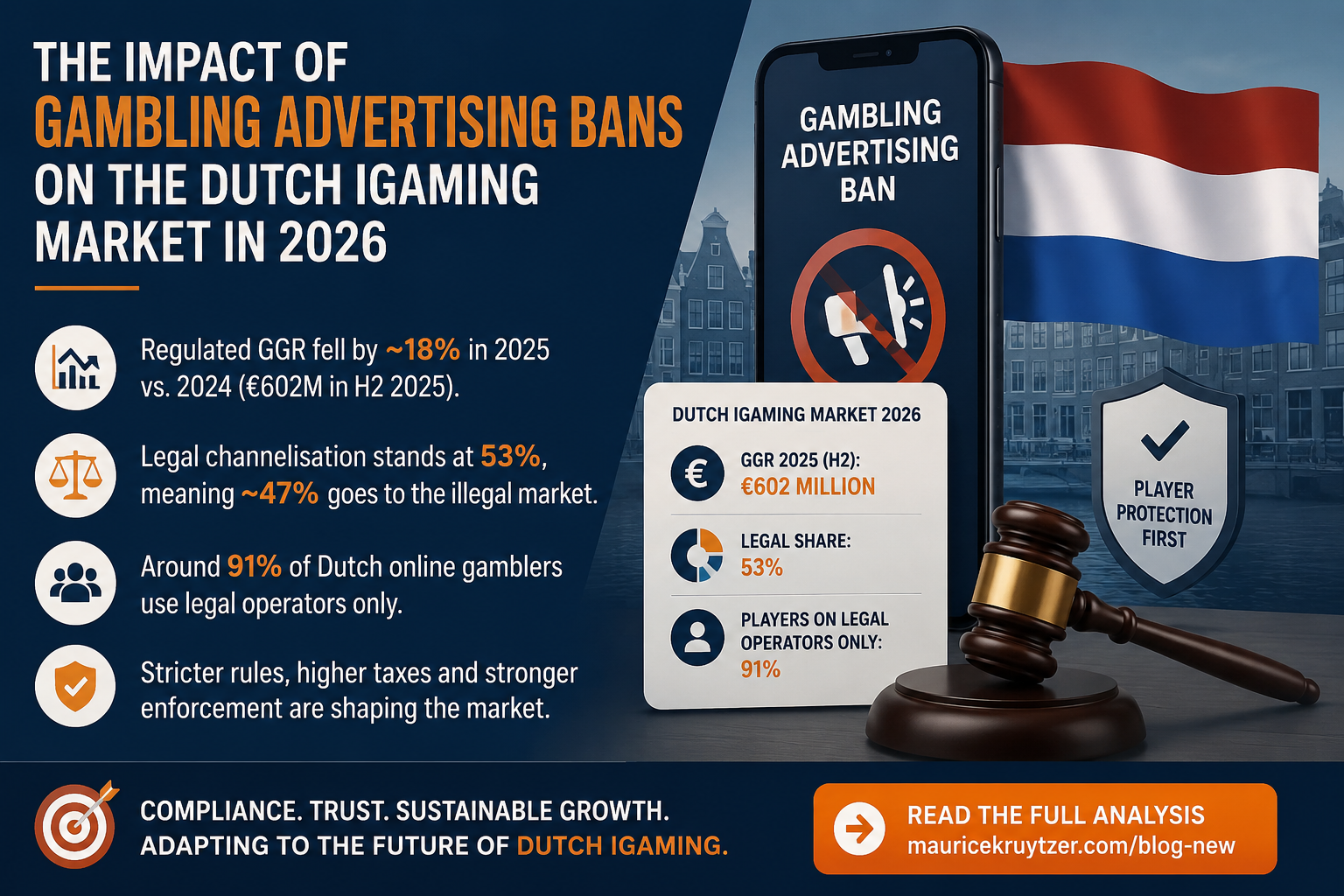
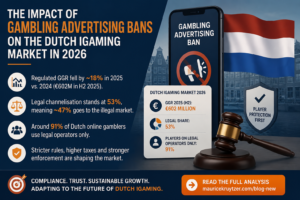
The numbers back up why this balance matters so much. Dutch regulated gross gaming revenue dropped by roughly 18% in 2025 compared with 2024. Yet the regulator’s latest estimate shows licensed operators still captured only about 53% of total online gambling spending, meaning the illegal market held close to 47%, not the smaller figure some industry reports have suggested.

Key Takeaways
- Advertising bans reduce visibility, not necessarily harm. Restrictions limit how often licensed operators can reach audiences, but they don’t automatically reduce the appeal of illegal alternatives.
- The 2025 revenue drop wasn’t caused by one single rule. Deposit limits, tax changes, market conditions and illegal competition all played a part in the 18% decline.
- Roughly 47% of Dutch online gambling spend still flows to unlicensed sites, even though around 91% of players say they use legal operators exclusively. A smaller group of heavy spenders appears to account for a disproportionate share of illegal-market losses.
- Organic search and direct traffic are becoming the backbone of operator visibility as paid and mass-media channels shrink. This makes a fluff-free content approach more valuable than ever.
- Further restrictions are possible in 2026, but the coalition’s proposed total ban would still require new legislation before it applies.
What’s Behind the Push for Stricter Advertising Rules in 2026?
Public health concerns sit at the centre of this policy shift. Gambling harm goes well beyond financial loss. It can involve debt, chronic stress, damaged relationships, deteriorating mental health and, in the most serious cases, suicide. The World Health Organization has backed broad protective measures, including advertising and sponsorship limits, binding loss caps, self-exclusion systems and tighter product controls.
Evidence also points to a real link between advertising exposure and gambling behavior. Reviews of the research consistently find connections between seeing gambling ads, holding more favorable views of gambling, and actually placing bets. These effects tend to be stronger among younger audiences and people already struggling with gambling problems.
Political momentum is building on the back of this evidence. Belgium introduced a near-total advertising ban in July 2023. The Netherlands banned untargeted online advertising the same month and later phased out sponsorship entirely. Now the incoming Dutch coalition wants to push further with a complete ban covering online gambling.
Other markets are choosing different paths. Australia hasn’t adopted the full ban recommended by a 2023 parliamentary inquiry. Instead, its government introduced a narrower package of restrictions in July 2026, including limits tied to live sport broadcasts and stadium advertising, with implementation planned for 1 January 2027.
The UK hasn’t committed to a nationwide total ban either. A 2026 public poll found 70% of respondents wanted tighter restrictions, while only 27% backed a complete ban outright. Public opinion signals pressure, but it doesn’t equal policy.
There’s also a competitive argument for caution. Licensed operators pay tax, run identity verification and follow strict player protection rules. Illegal platforms skip all of that. A ban that only affects licensed brands can shift the competitive balance without actually removing the illegal advertising players still see every day.
How Advertising Restrictions Affect Player Behaviour and Illegal Market Growth
Belgium’s experience offers a useful warning against oversimplified claims about what advertising bans actually achieve.
A study using Belgian health survey data found that 68% of respondents had seen gambling advertising at least once in the previous six months, and 52% reported seeing it weekly. This data was gathered starting in January 2024, roughly six months after Belgium’s ban took effect, not a full year on.
People exposed to weekly online gambling ads had roughly double the odds of gambling online weekly themselves, compared with those reporting no exposure at all (an odds ratio of 2.03). A similar pattern showed up for offline gambling too.
This doesn’t prove the ban failed, nor that advertising alone drives every gambling decision. The study captured a single point in time, and people who already gamble frequently may simply notice more gambling content around them.
What it does highlight is an enforcement gap. A national ban can’t block every foreign broadcast, social media post, illegal operator or promotional image circulating online. The public keeps seeing gambling brands even while domestic licensed companies operate under tight restrictions.
This creates three distinct risks worth tracking:
- Licensed brands lose visibility. Players may struggle to identify which operators actually hold a Dutch licence.
- Illegal marketing keeps running. The Ksa has flagged illegal gambling promotion on platforms like TikTok and warned that unlicensed sites remain easy to find through ordinary search results.
- Heavy spenders behave differently from casual players. A small group can account for a large share of total spending, which means most players staying with legal operators doesn’t guarantee most money does too.
The Dutch channelization figures illustrate this exactly. Around 91% of online gamblers appear to use legal operators exclusively, yet licensed operators capture only about 53% of total gross gaming revenue. The smaller group using illegal sites seems to be losing significantly more money per person.
Judging advertising restrictions purely on total revenue misses the point. Regulators should also track exposure among young people, harm indicators, illegal search traffic, self-exclusion uptake, and how many players can actually identify a licensed operator.
How Operator Strategy Is Shifting Under Tighter Advertising Rules
Dutch regulated online gambling revenue reached €602 million in the second half of 2025, up slightly from €600 million in the first half. That stabilization is a small silver lining, but the full-year total still landed roughly 18% below 2024.
The regulated Dutch market lost roughly 18% of its gross gaming revenue in 2025 compared with 2024. The regulator has not pinned the drop on any single rule. (Source: AffPapa)
That industry summary is a helpful starting point, but the official Ksa data adds important nuance. Player protection rules, reduced high-value deposits, gambling tax, competitive pressure and illegal play can all move revenue at once. Attributing the entire drop to advertising restrictions oversimplifies what’s happening.
The Dutch deposit rules deserve careful reading too. Since October 2024, licensed operators must contact players once net deposits hit €300 in a month for young adults or €700 for anyone 24 and older. Depositing beyond that requires an affordability check. These are intervention thresholds per operator, not blanket national caps, and that distinction matters for anyone comparing markets.
Gambling tax climbed from 34.2% in 2025 to 37.8% in 2026, adding real pressure to operator margins. Tax alone doesn’t explain player behaviour, though. Higher tax can translate into worse odds, thinner bonuses, fewer product options or internal cost-cutting. Whether players respond by switching to illegal sites depends heavily on how easy those sites are to find and how the overall experience compares.
One unexpected trend: active accounts rose even as revenue stayed weak, climbing from an average of 1.29 million in the first half of 2025 to 1.38 million in the second half. The Ksa estimated around 500,000 people gambled online monthly, meaning individual players often hold multiple accounts. This can reflect players spreading deposits across operators or simply more low-spending customers entering the market. Account counts should never be read as a direct proxy for player numbers.
For operators, the practical takeaway is straightforward. Acquisition strategies built around mass visibility no longer work the way they used to. Teams need stronger first-party data, genuinely useful product pages, clear licence information, accessible responsible gambling tools and content that answers the questions players actually have.
AI tools can support research, drafting and page structure, but they can’t carry legal responsibility. Every claim about bonuses, licence status, deposit rules, Cruks, withdrawals or player protection needs a human review before it goes live.
The Channel Shift: Why Organic Visibility Matters More After an Advertising Ban
As television, radio, outdoor media and sports sponsorship disappear from the toolkit, digital channels carry more weight. That includes targeted ads, email, direct traffic, apps, comparison sites and organic search.
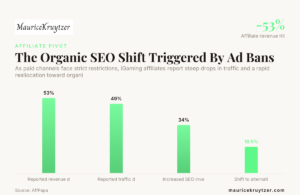
This illustrates the strategic shift toward organic visibility rather than representing official Ksa market figures.
Organic search has a natural advantage here. Someone searching for a licence check, a withdrawal timeline or a deposit limit already has a specific question in mind. Well-written content can answer that question without interrupting someone who never showed interest in gambling in the first place.
That doesn’t make organic content automatically safe or unregulated. A page built for search can still promote gambling irresponsibly, mislead readers or target people it shouldn’t. Illegal operators use the same tactics, and the Ksa has openly warned that Dutch players can stumble onto illegal gambling sites through completely normal search behaviour.
Organic growth works best as one piece of a wider plan, not a substitute for everything else. A solid strategy tends to combine:
- Useful, question-driven search content;
- Clear license and operator information pages;
- Direct and branded traffic;
- Responsible retention practices;
- Email sent with proper consent;
- Compliant targeted advertising;
- Fast-loading mobile pages;
- Customer service that solves actual problems.
Measuring success honestly matters just as much as building the strategy. Teams should track non-branded search traffic, rankings for genuinely useful questions, verified first deposits, player value and responsible gambling signals. More traffic isn’t automatically a win if it’s coming from the wrong country, the wrong age group or people hunting for illegal alternatives.
Building Compliance-Ready Content That Still Performs
Following the rules isn’t a confirmed way to rank higher on Google. Google has never published a policy stating that a Ksa-compliant page automatically outranks a non-compliant one purely because of its legal status.
Compliance is a legal and trust requirement first. Helpful, well-structured content is what actually supports visibility.
Google’s own guidance says its systems aim to reward helpful, reliable, people-first content, and it explicitly warns against low-value content produced mainly to game rankings, whether written by a person, generated by AI, or some mix of both.
For a Dutch gambling page, trustworthy content should make several things easy to verify at a glance:
- The name of the licensed operator;
- Ksa licence or register number;
- The legal minimum age;
- Bonus terms and wagering conditions;
- Payment and withdrawal details;
- Fees, limits and exclusions;
- Responsible gambling tools available;
- How Cruks fits into the picture;
- The date the page was last checked
Licensed Dutch operators fall under active regulatory supervision, and players can check a company’s name, website, app and licence number directly through the Ksa register before signing up anywhere.
Cruks is another meaningful distinction between legal and illegal platforms. Every licensed Dutch operator must connect to the central self-exclusion system. Illegal sites offer no such protection and, in some cases, actively target people who have already excluded themselves.
Wording matters here too. “Fast withdrawals” means nothing without a specific time range and conditions attached. “Safe casino” is meaningless without licence details, security information and a working complaints process. “Best bonus” isn’t useful if the wagering requirement or cash-out cap stays hidden in fine print.
Compliance-ready content, in short, isn’t just copy that’s been signed off by a legal team. It’s content that gives readers enough real information to understand the offer before they risk any money.
What a Dutch Content Team Needs to Look Like in a Restricted Market
A large team isn’t the requirement here. Clear ownership is.
A Dutch gambling content operation needs someone who understands local law, someone who verifies facts, and someone who owns search performance end to end. Smaller companies might have one experienced person covering all three; larger ones typically split the work across compliance, editorial, search and legal functions.
The core roles break down clearly:
- A Dutch gambling editor who controls tone, accuracy and local language, and understands terms like Cruks, gross gaming revenue, net deposit limits and duty of care.
- A compliance reviewer who checks every claim against current Dutch rules, including calls to action, age targeting and bonus terms.
- A search specialist who studies what readers are actually looking for and ensures pages stay findable and usable, without turning every paragraph into a keyword list.
- A subject expert who understands the specific differences between casino, sports betting, poker, payments and crypto content, since a sportsbook settlement rule isn’t the same as a casino withdrawal rule.
- A content manager who tracks sources, review dates, page ownership and correction logs as laws and operator terms shift.
Translation tools and AI can support this process, but a native Dutch final review stays necessary. Literal translations frequently get legal terminology, tone and risk warnings wrong in ways that change the actual meaning.
The strongest workflow isn’t the one that publishes the most content. It’s the one that can show exactly where every important claim came from and when it was last checked. You can find more examples of this approach on our team page.
Matching Your Team to the Right Response
Licensed operators need to protect channelization, not just revenue. Hiding legal brands entirely leaves an opening for unlicensed competitors, while overly aggressive promotion can increase harm and damage trust. Affiliates carry a different kind of risk. They may not control the gambling product itself, but they do control the claims used to send players there. And a well-ranking page can still be unsafe if it promotes an unlicensed operator or buries important bonus terms.
Agencies need a defined approval process so everyone knows who checks licence status, who signs off on promotional language, and who updates pages when rules shift. Publishers, meanwhile, should keep information separate from sales pressure. A genuinely useful licence guide helps readers verify an operator even if they never click through to sign up.
Conclusion
The Netherlands hasn’t banned gambling advertising outright, but the direction of travel is unmistakable. Sponsorship is gone, targeted advertising sits under strict age-verification rules, and a 2026 coalition proposal could push toward a complete ban on online gambling promotion. Meanwhile, the illegal market still holds close to half of all online gambling spend, even with 91% of players reportedly sticking to licensed operators.
That gap between player numbers and money flow is the real story here. It’s a signal that enforcement, visibility and trust matter just as much as the advertising rules themselves. For operators, affiliates and publishers working in this space, the practical response isn’t chasing loopholes. It’s building content and product experiences that make legal operators genuinely easier to find, understand and trust than anything operating outside the rules. For more market analysis and content strategy examples tailored to this shifting landscape, visit our Dutch iGaming coverage.