Here’s a number worth sitting with: 87% of Dutch citizens agree that AI development should be carefully regulated to ensure safety. For any operator or affiliate building a Dutch iGaming AI content strategy in 2026, that single statistic changes how you should think about every prompt, every workflow and every published page.

I’m Maurice Kruytzer, a Dutch content specialist who has spent more than eight years writing, editing and managing content for iGaming brands, affiliate networks and publishers. What follows is a practical breakdown of how a working Dutch iGaming AI content strategy actually gets built, not the theory version.
Key Takeaways
| Question | Short Answer |
|---|---|
| What makes a Dutch iGaming AI content strategy different from a generic AI content plan? | It combines AI drafting speed with mandatory human review, Dutch compliance knowledge and local tone, not just translated English copy. |
| Can AI write iGaming content on its own? | AI can draft structure and research fast, but Dutch gambling regulations and player trust demand a human editor checks every claim before publishing. |
| Is there a real content strategy playbook for this niche? | Yes, see our Dutch iGaming strategy guide for 2026 for the full framework. |
| What role does compliance play in AI content workflows? | A huge one. Advertising rules shift often, and our breakdown of Dutch gambling advertising bans in 2026 shows why compliance checks can’t be automated away. |
| Do Dutch players actually trust AI-generated content? | Partially. 60% of consumers are open to AI-generated marketing content, but 57% of Dutch respondents worry about accuracy, so transparency and quality control matter. |
| Who should manage this process? | A content manager or Dutch content specialist who understands both AI workflows and iGaming compliance, working alongside a freelance writer or in-house team. |
| Is a Dutch iGaming AI content strategy worth the investment in 2026? | Yes, because generic content loses players fast. 3 in 5 consumers leave a platform after irrelevant experiences, and localized, accurate content is what keeps them. |
What Does a Dutch iGaming AI Content Strategy Actually Look Like in 2026?
A working Dutch iGaming AI content strategy is not “type a prompt, publish the output.” It’s a repeatable process where AI handles research and drafting, and a human handles accuracy, tone and compliance.
In practice, this means every piece of content, whether it’s a bonus review, a match preview or a responsible gambling guide, passes through at least three stages. Draft, fact-check, localize.
- Draft: AI tools generate structure, research angles and first-pass copy based on approved briefs.
- Fact-check: A Dutch gambling content expert verifies odds, bonus terms, licensing details and regulatory claims.
- Localize: A Dutch translator or localization specialist adjusts tone, idioms and cultural references so the copy reads like it was written for Dutch players, not translated at them.
Skip any of these steps and you end up with content that reads well but gets facts wrong, or reads accurately but sounds foreign. Neither builds trust with Dutch audiences.
Why Human Oversight Still Defines a Winning Dutch iGaming AI Content Strategy
This is the part brands underestimate most. AI is fast, but iGaming is a regulated, high-stakes niche where a single wrong number in a bonus review can cost a brand its credibility.
Dutch players are not naive about this either. Trust here is earned, not assumed, and that starts with getting the basic facts right before anything else.

That statistic alone explains why raw AI output rarely survives contact with a real Dutch iGaming audience. An editor who understands both the language and the licensing rules has to review every claim, every bonus term and every statistic before it goes live.
Advertising restrictions add another layer. We track this closely in our piece on how advertising bans are reshaping Dutch gambling promotion in 2026, and it’s a good reminder that content teams need to know the rules as well as they know the keywords.
Building AI Workflows That Support a Dutch iGaming AI Content Strategy
Good AI workflows are less about the tools themselves and more about the checkpoints built around them. We use AI for outlining, first drafts, competitor research and data synthesis.
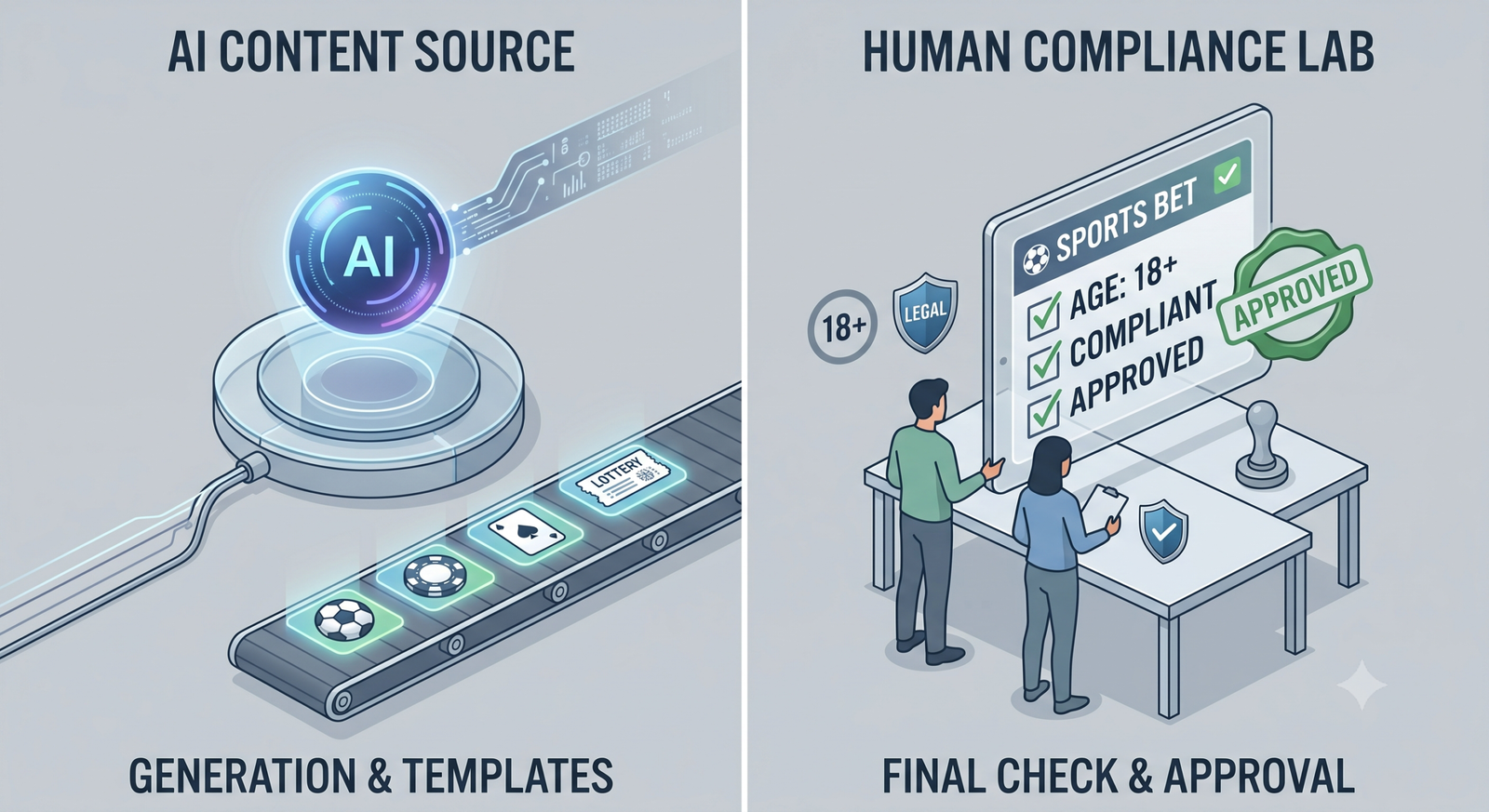
What we never automate is the final review, the compliance check or the tone pass that makes copy sound distinctly Dutch rather than machine-translated.
For iGaming brands targeting the Netherlands, accuracy and privacy aren’t optional, they’re baseline expectations before trust is earned.
Privacy matters here too. 53% of Dutch citizens express concern over privacy and data protection when using generative AI, which means any AI workflow touching player data or personalization needs a clear, documented process.
For teams building their own approach, our detailed framework in the 2026 strategy guide for Dutch iGaming brands walks through how content, compliance and structure fit together without slowing down publishing schedules.
The Roles Behind a Strong Dutch SEO Writer and Content Specialist Team
A Dutch iGaming AI content strategy is only as good as the people running it. We rely on a mix of specialists, not a single generalist trying to do everything.
- A Dutch SEO writer who understands both language nuance and search intent for Dutch players.
- An AI content strategist who designs the workflow, briefs and quality checkpoints.
- A localization specialist or Dutch translator who ensures tone and idiom feel native, not converted.
- An SEO copywriter focused on structure, headers and readability.
- A content manager overseeing calendars, briefs and consistency across verticals.
- A Dutch editor and Dutch proofreading pass before anything ships.
- Often, a freelance writer brought in for volume during busy periods or new market launches.
Each role solves a different problem. Skip the editor, and errors slip through. Skip the localization specialist, and copy reads like it was written somewhere else entirely.
Localizing Across Casino, Crypto and Sportsbook Verticals
iGaming isn’t one content niche, it’s several, and each demands its own expertise. A Dutch casino copywriter needs to understand game mechanics and bonus structures.
A Dutch crypto writer needs to explain blockchain payments and volatility without losing non-technical readers. A Dutch sportsbook writer needs to know odds formats, live betting and the specific leagues Dutch bettors follow.
This is where an affiliate content expert earns their keep, connecting product knowledge with what actually drives clicks and signups. Micro-markets are a good example of this shift.
Our analysis of micro-betting markets and Dutch liquidity trends in 2026 shows how quickly new betting formats create fresh content opportunities that generic AI output simply won’t cover accurately without specialist input.
Sports Betting Analysis Content Services: A Practical Case Study
One data point reframes how operators should think about content investment: 85% of active bettors say they actively research stats and data before placing a wager, rather than betting blind.
That’s the entire business case for professional sports betting analysis content. Readers want depth, not filler, and brands that deliver it earn the trust that converts into signups.
We built a full playbook around this idea, covering compliance-ready match previews, statistical breakdowns and odds analysis structured around real search intent clusters. You can read the complete sports betting analysis content services playbook for the exact framework we use with clients.
This is a good example of an iGaming content writer working alongside AI tools rather than replacing them. AI speeds up the research phase, but the analysis and voice come from someone who actually understands sports betting.
Affiliate Marketing Content That Builds Trust, Not Just Clicks
Affiliate marketing in iGaming lives or dies on trust. 72% of consumers rotate between services based on promotions, which means content has to do more than list offers.
It needs to build enough credibility that a reader chooses to stay rather than jump to the next bonus. Dishonest or manipulative content patterns work against this entirely.
We’ve written extensively about this in our breakdown of gambling UX dark patterns in 2026, and the same principle applies to content: manipulation might convert once, but it damages retention long term.
A good affiliate content expert writes reviews that are honest about downsides, not just upsides. That honesty is what separates content that ranks and converts from content that gets ignored after one visit.
Content Operations: Combining AI Speed With Dutch Proofreading Accuracy
Dutch content operations is the unglamorous part of this whole process, but it’s where consistency actually gets built. Briefs, style guides, review cycles and publishing calendars all need to run smoothly for AI-assisted content to scale without quality dropping.
We treat AI workflows as a production line with checkpoints, not a shortcut that skips steps. Every draft goes through Dutch proofreading before publication, regardless of how polished the AI output looks.
Mobile matters here too. 58.2% of the digital media market share belongs to smartphones, so any content operation that doesn’t check for scannability on mobile is losing more than half its audience before they finish reading a paragraph.
Measuring Success: What a Content Manager Should Track in 2026
A content manager running a Dutch iGaming AI content strategy needs clear metrics beyond publish volume. Time on page, scroll depth and return visits tell you more about content quality than word count ever will.
We also track how well interactive formats perform, since the interactive media segment is projected to grow at a CAGR of 15.2% through 2034. Gamified reviews and personalized betting guides are becoming standard expectations, not novelties.
Half the market, 50% of consumers, already knowingly interacts with AI and expects it to be useful. That’s the bar. Content needs to help someone find the right game, bonus or bet faster, not just fill a template.
| Metric | Why It Matters for Dutch Players |
|---|---|
| Time on page | Shows whether content actually answers the question or gets abandoned quickly. |
| Return visits | Indicates trust; players come back when content proves reliable over time. |
| Mobile scroll depth | Critical given that over half the market reads content on a phone. |
| Conversion after read | Confirms content built enough trust to move a reader toward signup. |
Conclusion
A working Dutch iGaming AI content strategy is not about replacing writers with AI, it’s about combining AI speed with human accuracy, Dutch compliance knowledge and genuine local tone.
The brands that get this right treat every piece of content as a trust exercise, not just a publishing task. That means a Dutch content specialist reviewing claims, a proofreader checking language, and a strategist keeping the whole system compliant with rules that change often.
If you’re building or refining your own Dutch iGaming AI content strategy and want a second opinion from someone who has been doing this for years, feel free to get in touch. We’re always happy to talk through what’s working and what isn’t.
Frequently Asked Questions
Is AI-generated content allowed for Dutch iGaming brands in 2026?
Yes, but it must go through human review for accuracy and compliance before publishing. A Dutch iGaming AI content strategy without editorial oversight risks factual errors and regulatory issues.
What is the difference between a Dutch SEO writer and a general content writer?
A Dutch SEO writer understands local search intent, idiom and iGaming regulations specific to the Netherlands, not just fluent Dutch grammar. This makes a real difference in how content performs with local audiences.
Do Dutch players trust AI-written casino or sportsbook reviews?
Partially. Many are open to AI-assisted content, but a significant portion worry about accuracy, so transparency and visible editorial standards matter for building trust.
How does localization differ from simple translation in iGaming content?
Localization adjusts tone, cultural references and phrasing so content reads naturally for Dutch players, while translation only converts words. A localization specialist handles the former; a translator alone often can’t.
What roles are needed to run an effective Dutch iGaming AI content strategy?
Typically a content manager, AI content strategist, Dutch SEO writer, editor and proofreader, sometimes supported by freelance writers for volume. Each role covers a gap that AI alone can’t fill.
Is investing in specialized iGaming content still worth it in 2026?
Yes, since generic content loses players quickly and specialized, accurate content builds the trust needed for long-term retention. A well-run Dutch iGaming AI content strategy pays off through better engagement and lower churn.
Can one person handle an entire Dutch iGaming AI content strategy alone?
It’s possible for smaller projects, but larger operations benefit from a team covering strategy, writing, localization and proofreading separately. Combining all these skills in one experienced freelance writer or specialist can work well for lean teams too.