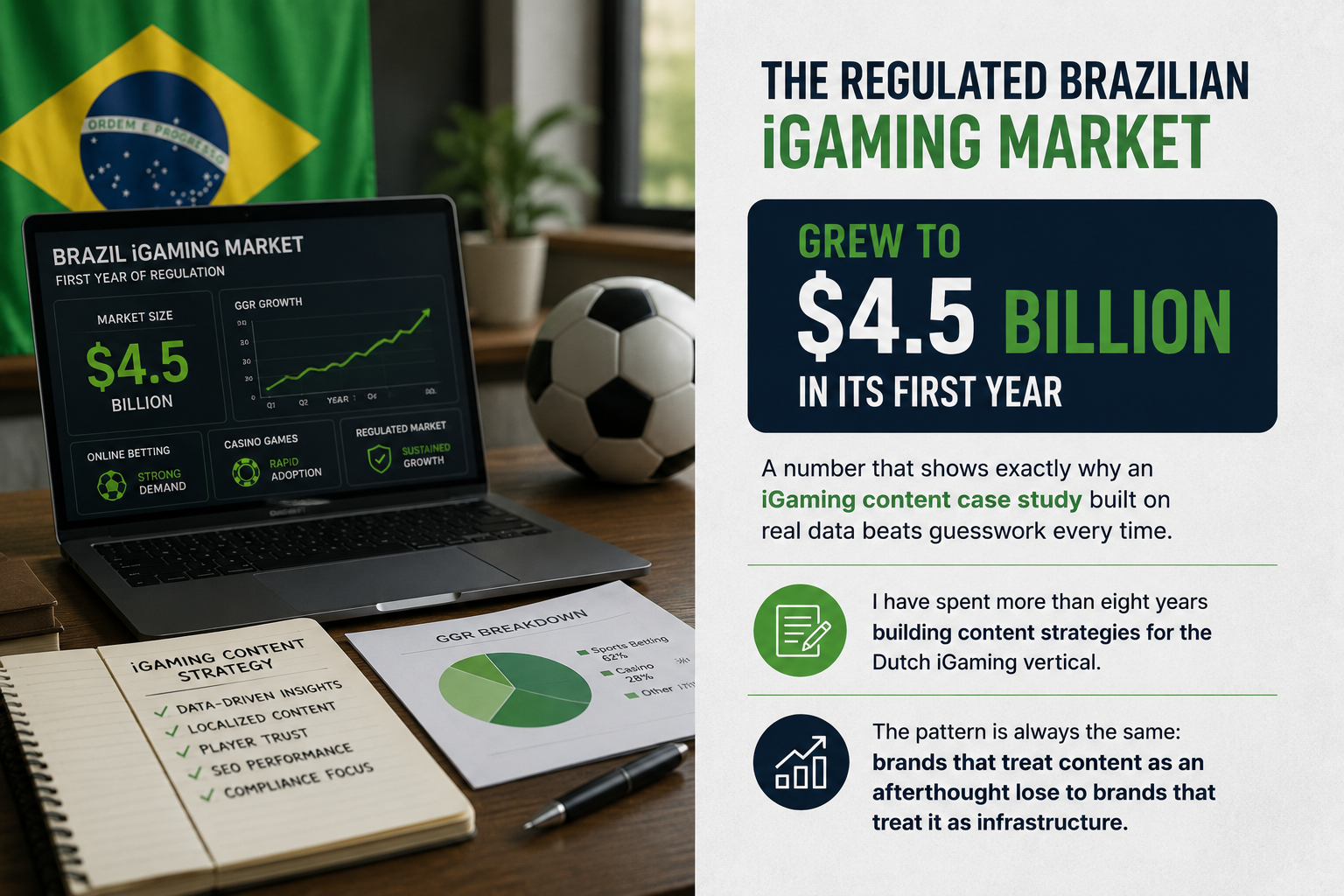
The regulated Brazilian market grew to $4.5 billion in its first year, a number that shows exactly why an iGaming content case study built on real data beats guesswork every time. I have spent more than eight years building content strategies for the Dutch iGaming vertical, and the pattern is always the same: brands that treat content as an afterthought lose to brands that treat it as infrastructure.
Key Takeaways
- Mobile-first architecture is non-negotiable: A strong iGaming content case study always starts with technical foundations, not word count. See my full breakdown in the fluff-free playbook.
- Compliance is a ranking factor: KSA licensing language, done properly, builds trust faster than any backlink campaign.
- Human-in-the-loop AI wins over content mills: Speed without oversight produces text that reads foreign to Dutch players.
- ROI is measurable, but rarely measured well: Most agencies can’t tell you what their content actually returns.
- Localization separates compliant operators from noise: A single mistranslated compliance disclaimer can undo months of trust building.
- Topical hubs outperform thin pages: Depth on real player questions beats volume on generic ones.
- Portfolio proof matters: Browse actual project outcomes in Our Works before committing budget to any agency.
What Makes a Strong iGaming Content Case Study
Most agencies treat iGaming like any other vertical. It isn’t.
A real iGaming content case study has three ingredients that generic marketing case studies skip entirely: regulatory context, mobile performance data, and a clear before/after on organic visibility. Without all three, you’re reading a sales brochure dressed up as proof.
I build every case study around actionable intelligence, not vanity metrics. That means showing the technical starting point, the content architecture applied, and the traffic outcome measured over a realistic window, usually six to twelve months.
Inside My Own iGaming Content Case Study: The Fluff-Free Playbook Results
Here is a number that should reframe how you think about the market: out of the top 100 gambling sites in the Netherlands, only 15 are primarily search-led. That gap is the opportunity every iGaming content case study should be built around.
The market leader, nederlandseloterij.nl, pulls over 82% of its traffic from mobile. That single data point shaped how I approach every client brief since.

If your technical foundation is wrong, no amount of long-form content will save you. I structure topical hubs that answer the questions players actually ask, and I test every hub against mobile load speed before a single word gets published.
Why Most iGaming Content Case Studies Skip the Technical Foundation
Heavy scripts, bloated images and clumsy pop-ups kill rankings before the content ever gets read. This is the part most published case studies conveniently leave out, because it’s less glamorous than a traffic graph.
In the Netherlands, 82.1% of sports bettors prioritize internet and mobile apps over any other channel. An iGaming content case study that ignores this reality is measuring the wrong thing entirely.
- Compress images before they ever touch a CMS
- Strip render-blocking scripts from money pages
- Test Core Web Vitals on 4G, not office wifi
- Build content templates that load fast on a train with one bar of signal

The Human-in-the-Loop Team Behind Every iGaming Content Case Study
I do not hide the fact that I use AI. I lean into it.
My Dutch Assisted Editorial Team runs on named agents with specific jobs: Marieke handles intent mapping, Karol drafts long-form structure, Tom checks compliance language, Gloria proofreads Dutch localization, Jop writes tactical sports content, and Bobby audits technical output before anything ships. The difference between us and the content mills is human-in-the-loop oversight.
Every iGaming content case study I publish gets reviewed by a person before it gets reviewed by an algorithm. That order matters more than most agencies admit.
Compliance as a Strategy: A Dutch iGaming Content Case Study Lesson
Compliance is now a ranking factor, not an afterthought. The regulated Dutch market rewards trust, punishes shortcuts, and demands an SEO architecture built around real search intent clusters.
Every operator I’ve worked with underestimates how much KSA licensing language shapes trust signals. Get the disclaimer wrong, or bury it, and the whole page loses credibility with both players and reviewers.
Compliance is now a ranking factor, not an afterthought.
I treat regulatory text as a weapon, not a checkbox. A compliance-ready page that reads naturally in Dutch will always outperform a technically compliant page that reads like a legal disclaimer bolted onto marketing copy.
Localization Failures: What a Bad iGaming Content Case Study Teaches You
The text reads foreign. The compliance language is wrong. The trust evaporates.
I’ve seen this pattern repeat across dozens of failed launches: an operator translates English content into Dutch instead of writing for Dutch players from the first sentence. Localization and Dutch proofreading separate compliant operators from the noise, and this is where most competitors quietly fail.

What happens when an iGaming brand stops publishing thin pages and starts building topical depth
Measuring ROI: The Numbers Behind a Winning iGaming Content Case Study
Most content teams can talk about traffic. Fewer can talk about return.
Organic search still drives 53% of trackable web traffic across content-led businesses, which is exactly why an iGaming content case study without organic data isn’t telling the full story. Affiliate content partnerships return between $12 and $15 for every $1 invested, a figure that should reshape how operators budget for content versus paid media.
Despite these returns, only 36% of marketers can accurately measure content ROI. That gap is an opportunity for any agency willing to build a real measurement framework instead of a vanity dashboard.
Best Practices for Building Your Own iGaming Content Case Study
If you’re an operator or affiliate looking to build your own iGaming content case study, start with the foundation, not the output.
- Audit technical performance first. No content strategy survives a slow, cluttered site.
- Map real search intent clusters. Write for the questions Dutch players actually type, not the keywords your tool suggests.
- Build compliance into the copy, not around it. KSA language should feel native to the page, not bolted on.
- Use AI with oversight. A scalable publication pipeline only works with human review at every stage.
- Track ROI from day one. Set a baseline before you publish anything, so the case study has a real before/after.

Conclusion
A credible iGaming content case study never separates content quality from technical foundation, compliance, and measurable return. I build my content strategy around all four, because leaving one out produces a case study that looks good on paper and fails in the market.
If you want to see how this approach performs on real Dutch iGaming projects, my portfolio speaks louder than any pitch deck.
Frequently Asked Questions
What is an iGaming content case study?
An iGaming content case study documents a real project, showing the starting technical and content baseline, the strategy applied, and the measurable traffic or revenue outcome. A credible one includes compliance context specific to the market, not just generic traffic charts.
Is an iGaming content case study worth reading before hiring an agency?
Yes, and it’s arguably the most important document to review before signing a contract. A real case study shows methodology, not just results, so you can judge whether the approach fits your market and licensing situation.
How long does it take to see results in an iGaming content case study?
Most credible case studies measure results over six to twelve months, since organic content growth compounds rather than spikes. Anyone promising overnight results in a regulated market like the Netherlands is skipping the compliance and trust-building phase entirely.
Why does compliance matter in an iGaming content case study?
Compliance language, including KSA licensing disclosures, directly affects how trustworthy a page reads to both players and platforms. A case study that ignores this misses the single biggest differentiator in the regulated Dutch market.
Can AI-generated content produce a strong iGaming content case study?
Yes, but only with human-in-the-loop oversight at every stage of drafting, compliance review, and localization. AI without editorial review produces text that reads foreign and erodes the trust a case study is supposed to demonstrate.
What should I look for in an iGaming content case study before working with an agency?
Look for specific, verifiable numbers tied to a named project, clear explanation of the technical and compliance work involved, and a realistic timeframe. Avoid case studies built entirely on vague traffic percentages with no context on market or licensing conditions.
How is ROI measured in a Dutch iGaming content case study?
ROI is typically measured through organic traffic growth, affiliate conversion value, and a comparison against paid acquisition costs over the same period. Since organic search drives the majority of trackable traffic in most iGaming verticals, a case study without this data is incomplete.