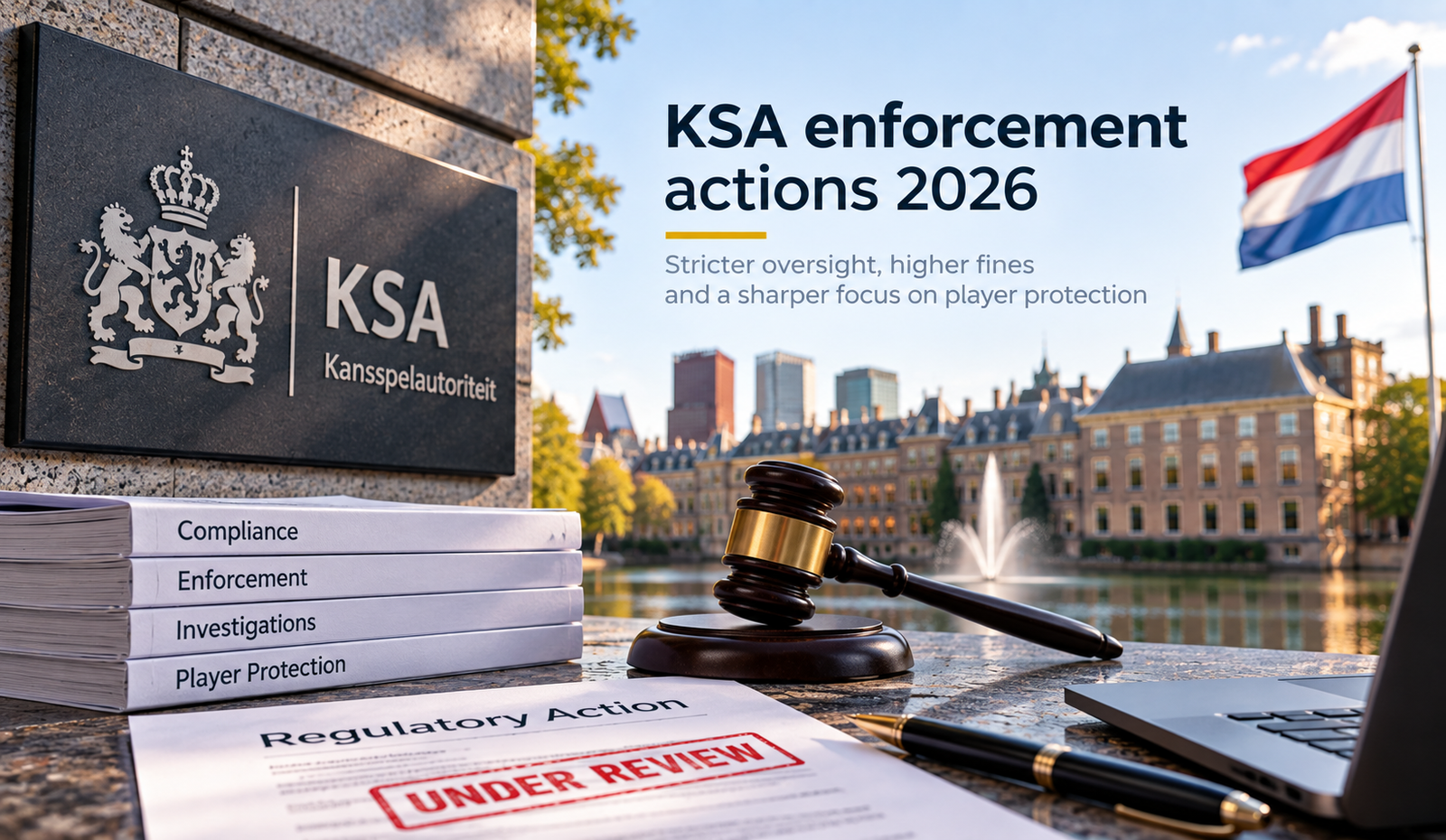
KSA enforcement actions 2026 are increasingly about paperwork, proof, and speed. Here is a number that should reframe how you think about compliance enforcement in 2026: 151,000.

Key Takeaways
| 1) Enforcement is moving faster | In 2026, regulators (and enforcement ecosystems around them) are tightening how quickly issues are detected and actioned. |
| 2) Fines escalate with intent | The most severe penalties track deliberate misstatements and bad-faith behavior, not just “mistakes”. |
| 3) Governance details matter | Directors and officers can be targeted where financial reporting is involved. |
| 4) Your compliance story must be coherent | If your documentation, marketing claims, and verification steps do not line up, enforcement risk goes up. |
| 5) Human-in-the-loop beats “copy-paste policy” | We use a human-in-the-loop AI architecture (with Marieke, Karol, Tom, Gloria, Jop, Bobby) to keep content compliance-ready. |
| 6) Build for 2026 reality, not 2025 excuses | Your operational pipeline should assume scrutiny, not hope it away. |
- What are “KSA enforcement actions” in 2026? Enforcement actions typically involve penalties and legal consequences for compliance failures under relevant KSA frameworks.
- Which part hurts most? Deliberate misstatements and bad-faith handling usually carry the highest exposure.
- What should affiliates do? Tighten what you publish, what you claim, and how quickly you remove non-compliant pages.
- How do operators respond? Align documentation, governance, player protection procedures, and content claims under one compliance-ready workflow.
- Need help with Dutch iGaming content compliance-ready? We can support that through Dutch iGaming content services.
Now let’s get into the practical meaning of KSA enforcement actions 2026 for the Dutch iGaming ecosystem. Yes, the keyword is Saudi-focused, but the operational lessons travel well.

Note on evidence: The research data provided here does not include a scrapeable list of specific “KSA enforcement actions 2026” decisions. So we focus on enforcement dynamics and penalty ranges that can be used to harden your compliance approach in 2026.
Fast reality check: If your technical foundation is wrong, no amount of long-form content will save you. Enforcement does not care how pretty your articles look.
If you are an operator, this is your playbook problem. If you are an affiliate, it becomes your publication pipeline problem. Either way, it is the same root issue: integrity across the whole chain.
KSA enforcement actions 2026: why penalties are getting harsher in practice
In 2026, enforcement is increasingly tied to intent and governance quality. That is not a vibe. It shows up in penalty tiers and how legal frameworks describe conduct.
Here are the enforcement signals we can derive from the provided research statistics:
- Serious exposure when financial statements include false or misleading information.
- Severe consequences when deception, lying, or false impressions are used to unlawfully obtain money.
- High penalties when documents are forged or when money handling is done in bad faith.
This matters for iGaming because enforcement risk is never just about “one incident.” It is about consistency: operator procedures, marketing claims, user verification, and the evidence trail behind all of it.
Most agencies treat iGaming like any other vertical. It isn’t. The regulated Dutch market rewards trust, punishes shortcuts, and demands an SEO architecture built around real search intent clusters. Enforcement pressure makes that even more literal.
Reframe: KSA enforcement actions 2026 are not only “about casinos.” They are about the compliance quality of the entire commercial output, including content.
Penalty tiers in 2026: what the provided ranges imply for governance
KSA enforcement actions 2026 often map onto a simple question: did you control the process, or did you improvise it later?
We see that pattern in maximum penalty references. For decision-makers, that means governance is not a committee activity. It is a daily operational discipline.

The practical takeaway for operators is straightforward:
- Make financial claims defensible. If your public-facing narrative relies on internal numbers, those numbers need a clean chain of custody.
- Reduce ambiguity in governance. Who approves what, where, and when. Write it down, enforce it, and archive it.
- Assume evidence requests. Enforcement usually wants proof, not intention.
For content and marketing teams, the same logic applies. If your compliance language is inconsistent, your evidence base breaks. The text reads foreign, the compliance language is wrong, the trust evaporates.
From “KSA enforcement” to daily iGaming operations in 2026
Here is where most teams get lazy. They treat “enforcement risk” like a legal department problem. It is not.
Enforcement risk touches:
- Player protection, because verification, limits, and responsible gambling messaging must be implemented, not merely written.
- Marketing and affiliates, because claims must match product reality and local rules.
- Supplier and game integrations, because data, UX flows, and terms need to remain aligned over time.
- Editorial workflows, because even “neutral” content can create risk if it misstates regulated availability, terms, or safeguards.
In 2026, compliance is now a ranking factor, not an afterthought. And yes, that applies beyond Saudi. In the Netherlands, it shows up as authorization confidence and player protection credibility.
So what do you do?
- Run compliance checks on content before publication. Not after someone screenshots it.
- Use a content production pipeline with human-in-the-loop oversight. We lean into AI, but oversight is mandatory.
- Localise properly. Dutch proofreading and localisation separate compliant operators from the noise.
We structure topical hubs that answer the questions players actually ask. But the editorial integrity layer has to be compliance-ready, or it is just an expensive way to publish errors at scale.
Evidence, intent, and documentation: the real risk in KSA enforcement actions 2026
KSA enforcement actions 2026 do not reward “good intentions.” They reward documentable control.
That is why we care about internal documentation quality and not just external messages. When decisions rely on written records, any gap becomes a liability.
In practice, that means you should tighten the evidence behind:
- Regulatory disclosures, including how you present terms, availability, and safeguards.
- Verification processes, especially where your onboarding claims differ from what users actually experience.
- Payments and handling procedures, including how you describe controls around money flows.
- Updates over time, because content changes faster than governance people think.
Dry but true: heavy scripts, bloated images, and clumsy pop-ups kill credibility before the content ever gets read. Enforcement can be triggered by user complaints, by monitoring systems, or by inconsistencies. Either way, clarity wins.
If you cannot show your process, you do not have a process. You have a story. Enforcement will test the story.

Penalty tiers for 2026 enforcement actions span over twelvefold from lowest to maximum fines.
Building a compliance-ready content pipeline for 2026
For operators and content teams, the question is not “can we publish more.” It is “can we publish without breaking integrity.”
In 2026, our model for this looks like:
- Topic intake tied to real intent clusters, so you do not create pages that do not serve decision-making.
- AI-assisted drafting with human-in-the-loop oversight, so accuracy stays measurable.
- Compliance-ready review that checks claims, terminology, and player protection language.
- Dutch localisation QA for language clarity, not “style preferences.”
If you are trying to scale publishing while facing KSA enforcement actions 2026 pressure (or simply tightening your governance discipline), you need the workflow, not another spreadsheet.
And yes, this is where we can help. If you need Dutch iGaming content built for the local market, see our Dutch iGaming content services.
What affiliates should change after KSA enforcement actions 2026
Affiliates are often treated like “distribution.” Enforcement thinking treats affiliates like part of the commercial output.
So in 2026, we suggest affiliates focus on three things:
- Claim hygiene. If your page implies availability, benefits, or safeguards, you need evidence and alignment with what the operator can defend.
- Fast takedown ability. When enforcement risk appears, you need a removal and update workflow that is measured in hours, not weeks.
- Content consistency. Your FAQ pages, bonus pages, and responsible gambling content must not contradict each other.
In other words, your “publication pipeline” becomes your compliance pipeline. Most affiliate teams do not treat it that way until they have a problem.
If you want a sanity check on how we think about scalable publication pipelines and editorial integrity, you can also take a look at Harbor SEO tools for content architecture planning.
Gen Z, social controls, and indirect enforcement pressure in 2026
KSA enforcement actions 2026 can also create indirect pressure. When compliance frameworks align with safety concerns, the public narrative shifts.
The provided research includes a signal around social media controls for minors in KSA. Even if your operator is targeting regulated adults, your marketing channels and messaging still face the same scrutiny.
For iGaming in 2026, that translates into a practical adjustment: make responsible gambling content more than a footer. Use clear language, align it with onboarding and verification, and ensure your marketing materials can be defended if questioned.
Compliance is not a “poster.” It is operational consistency.
How to prepare your team right now for KSA enforcement actions 2026
Let’s make this actionable. If you are an operator, a sportsbook owner, a content lead, or an affiliate manager, your next steps should be simple and measurable.
- Audit your public claims against your operational reality (including verification and player protection flows).
- Lock down governance evidence, so decision-makers can show how approvals and updates actually work.
- Rebuild content QA for 2026, with human-in-the-loop oversight and localisation QA.
- Create a takedown workflow for affiliates and publishers that can respond quickly to compliance risk.
Most mistakes happen because teams assume “it will be fine.” KSA enforcement actions 2026 punish that assumption.
We do not write like a corporate press release. We write like a no-nonsense editorial team that wants integrity at scale. That means compliance-ready content architecture, not content mills.
Conclusion
KSA enforcement actions 2026 are a clear reminder that compliance is not optional, and it is not only legal. The strongest operational advantage in 2026 comes from evidence-backed governance, consistency across content and product, and human-in-the-loop oversight that keeps your pipeline compliance-ready.
If you want to publish at speed without losing integrity, that is the work. Not the myth.
Written by Maurice Kruytzer