The Kansspelautoriteit wordmark exists for one reason: to help Dutch players spot licensed gambling operators at a glance. That single function is exactly why misuse of the logo carries weight.
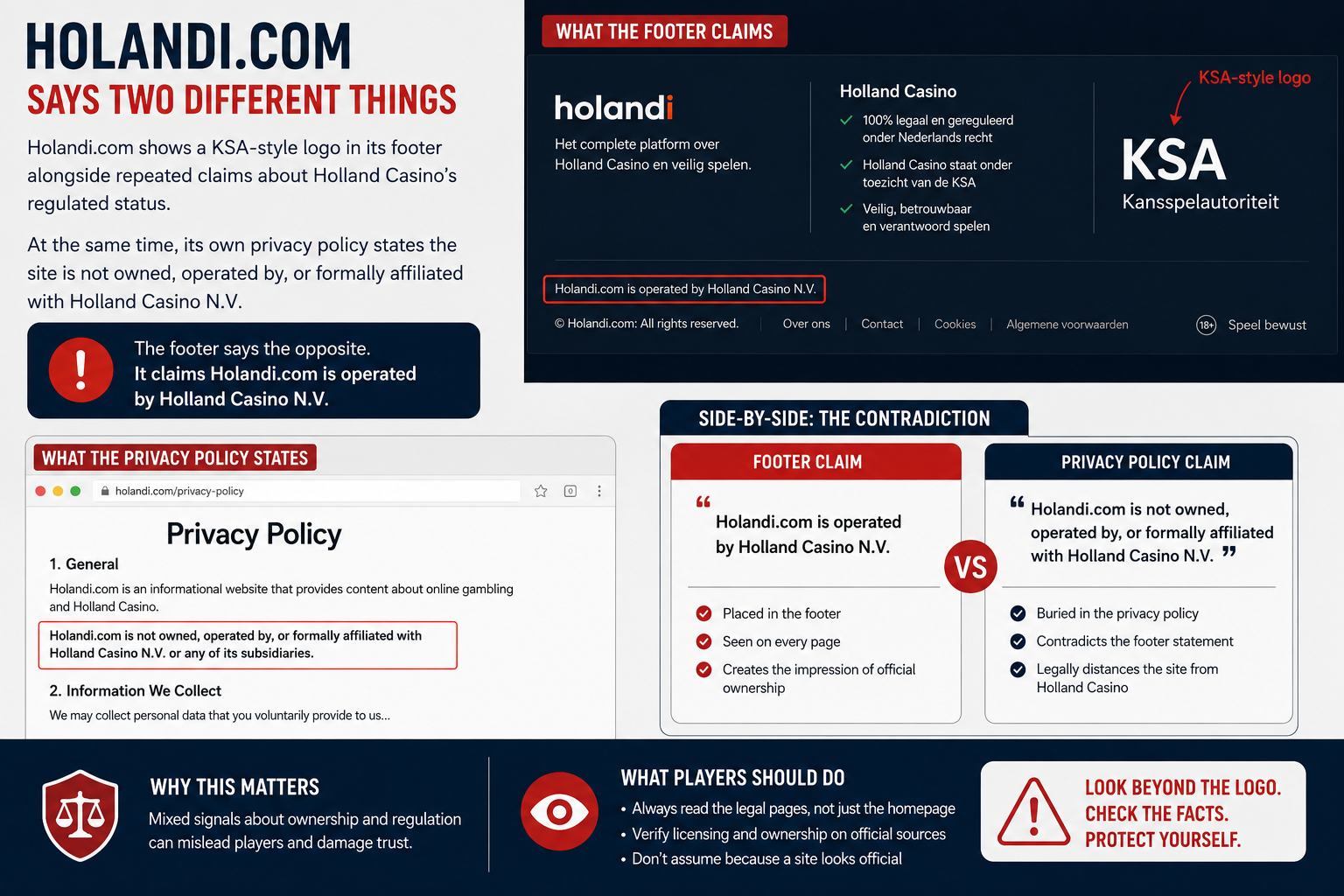
Holandi.com shows a KSA-style logo in its footer alongside repeated claims about Holland Casino’s regulated status. At the same time, its own privacy policy states the site is not owned, operated by, or formally affiliated with Holland Casino N.V. The footer says the opposite. It claims Holandi.com is operated by Holland Casino N.V.
That contradiction sitting on the same domain is worth unpacking, especially for anyone producing or reviewing Dutch casino content.

Key Takeaways
- The KSA wordmark signals regulatory status, not general trustworthiness, and comes with strict display rules.
- Holandi.com’s footer and privacy policy contradict each other on whether Holland Casino operates the site.
- The licence number shown for Holland Casino on Holandi.com does not match Holland Casino’s actual KSA licence.
- Incorrect licensing data can affect how players understand Dutch gambling tax obligations.
- Publishers should verify licence numbers directly against KSA records rather than copying them from other sites.
What the KSA Wordmark Is Actually Meant to Communicate
Licensed Dutch remote gambling operators are permitted to display a specific KSA wordmark on their platforms. The regulator’s stated goal is straightforward: give players a quick, reliable way to identify legal providers.
The conditions attached to that permission are not loose. The mark has to keep its original appearance, use an approved colour scheme, sit in a clearly visible spot, and link through to licensing details on the KSA website. Licence holders are also not allowed to pass the mark on to third parties for their own use.
None of this makes the logo a generic “we talk about gambling” badge. It is a regulatory signal, and it is meant to be treated that way by everyone who displays it.
A Comparison Site That Also Claims to Be the Operator
This is where Holandi.com’s positioning gets confusing. Its own terms describe the site as an informational and comparison resource, not a gambling operator. It refers to Holland Casino as a separate, third-party operator throughout.
The privacy policy repeats that separation in its own words.
Yet the footer states plainly that Holandi.com is operated by Holland Casino N.V. and holds a KSA licence.
I could not locate a KSA publication granting Holandi.com a licence under its own name. The KSA’s official Holland Casino record points to hollandcasino.nl, not to Holandi.com. I also found no published KSA enforcement action naming Holandi.com as of 9 August 2026.
That last point matters for accuracy. It would be wrong to say the KSA has formally ruled against Holandi.com. What is fair to say, based on the publicly available evidence, is that the site’s own claims about its regulatory status don’t hold together.
The Licence Number Doesn’t Belong to Holland Casino
The footer claim becomes more concerning once you check the actual licence reference against KSA records.
Holandi.com lists Holland Casino’s licence as 1610/01.247.166.
Holland Casino’s own official site currently lists its licence as 1610/01.247.085.
Separately, KSA records show that 1653/01.247.166 was issued to Play North Limited, an entirely different licensee.
Put side by side, Holandi.com appears to have combined two unrelated identifiers into one number:
- 1610 correctly points to Holland Casino.
- 01.247.085 is Holland Casino’s actual remote gambling licence suffix.
- 1653 correctly points to Play North Limited.
- 01.247.166 is Play North Limited’s licence suffix, not Holland Casino’s.
- 1610/01.247.166, the number shown on Holandi.com, matches neither licence holder correctly.
That kind of mismatch would not survive a basic fact check before publication, which is exactly why licence numbers deserve a direct source check rather than a copy-paste from another site.
Why This Goes Beyond a Simple Content Mistake
Licensing information isn’t cosmetic. Dutch players who use a KSA-licensed operator get protections tied to the regulated market, and the KSA points consumers toward the Kansspelwijzer specifically to confirm legal providers.
Tax treatment depends on this too. The Belastingdienst confirms that winnings from a KSA-licensed online operator are not personally filed or taxed by the player. Winnings from an operator without a Dutch licence can require the player to file, particularly once monthly winnings exceed stakes.
In other words, a wrong licence number isn’t just an inaccurate detail buried in a footer. It touches how a player might understand their own tax position.
Outdated Tax Figures Add to the Problem
Holandi.com’s terms reference a 29.5% gambling tax rate and a €449 threshold. Neither figure matches current guidance.
The Belastingdienst confirms the gambling tax rate from 1 January 2026 is 37.80%. It also treats online winnings differently from the simpler offline prize threshold that gets referenced elsewhere on Holandi.com’s own page.
The site’s terms even acknowledge that some data was last checked in early 2025. That’s a familiar publishing issue in this sector: a page can display a 2026 copyright year in the footer while the regulatory content underneath it is a full year, or more, out of date.
The KSA Already Flags This Type of Signal as a Concern
The KSA’s 2026 penalty policy for illegal remote gambling addresses situations where a website creates the impression that gambling is legal in the Netherlands, or that it operates under KSA supervision, when that isn’t accurate.
Specific examples named in that policy include falsely implying a Dutch licence exists, incorrectly displaying the KSA remote gambling wordmark, and using branding associated with licensed Dutch operators without authorisation.
This doesn’t automatically place Holandi.com inside that enforcement category, particularly since the site describes itself as an information resource rather than a gambling operator. But the policy shows exactly why the regulator treats these visual and textual signals seriously. Players rely on them to make quick judgments about legitimacy.
What the Official Holland Casino Site Gets Right
Holland Casino’s actual website leaves far less room for doubt. It clearly names Holland Casino N.V., shows company registration details, and displays the correct KSA licence reference tied to that entity.
Its support pages also spell out the residency rules without ambiguity: Dutch citizenship or residency, plus a valid Dutch home address, are required to register.
The KSA register itself links Holland Casino directly to hollandcasino.nl. That gives a reader three consistent data points that all point in the same direction: brand, legal entity, and domain.
That alignment is what proper licence verification should look like on any Dutch casino page.
A Practical Verification Checklist for Publishers
The lesson for anyone producing Dutch casino content isn’t complicated, though it does take more time than copying a licence number from an existing article. Before publishing anything with regulatory claims, check:
- The KSA licence database directly, rather than a competitor’s article.
- The operator’s current legal pages, since licence numbers and entities can change.
- Current bonus terms, which shift more often than most content calendars account for.
- Payment and withdrawal details as published by the operator.
- Game provider information, where it’s part of the claim being made.
- Belastingdienst guidance whenever tax rates or thresholds are mentioned.
None of this is exciting work. But it’s considerably less time-consuming than correcting the same wrong licence number after it has spread across a hundred pages of a site.
Why Research Comes Before Drafting in My Own Process
I’m Maurice Kruytzer, a Dutch iGaming content writer and AI-assisted editor with more than eight years in this regulated market. My process keeps research and drafting as separate stages on purpose. Licence details, product specifics, and bonus terms get checked before a single sentence of the article is written, and everything goes through human editorial review before publication.
This Holandi.com case is a clear example of why that separation matters. Writing quickly is a useful skill. Knowing what shouldn’t be published without verification first is the skill that protects both readers and the publisher’s own credibility.
FAQ
Does a KSA-style logo on a website automatically mean the KSA licensed that site?
No. The wordmark is meant for licensed operators under strict display conditions. Its presence on a comparison or information site doesn’t confirm that site holds a licence in its own name.
How can I check whether a licence number is genuine?
Cross-reference the number against the KSA’s own public register rather than trusting what appears on an operator’s or affiliate’s page.
Why does licensing accuracy affect Dutch gambling tax?
The Belastingdienst applies different tax treatment depending on whether an operator holds a valid KSA licence. Incorrect licensing claims can lead players to misunderstand their own filing obligations.
What should a publisher do if it finds outdated or incorrect licence data on its own site?
Treat it as a compliance issue, not a minor edit. Verify the current licence number and entity directly with the KSA, then update every page referencing it.
Get Your Dutch Casino Content Verified Before It Goes Live
If your existing Dutch casino pages contain recycled licence numbers, outdated tax figures, or unverified “regulated” claims, proofreading alone won’t fix that. It needs a proper fact check against official sources.
I offer casino reviews, Dutch iGaming SEO content, payment and compliance writing, localisation, and human verification through my Dutch iGaming Content Services. If you’d rather see how a compliance-first content process holds up under scrutiny before you commit, take a look at The 2026 KSA Content Compliance Master Checklist or how to find an independent casino expert you can trust.
Generating a licence number takes seconds. Confirming it belongs to the right company, on the right domain, under the right legal entity, takes a bit longer. For regulated gambling content, that extra step is the one that actually protects your readers and your reputation.