KSA Netherlands Issues Formal Warning to VBet Over Prohibited World Cup Betting Markets
Published 16 July 2026 · Dutch iGaming Compliance Desk
Here is a number that should reframe how you read this story: despite 91% of Dutch players using licensed operators, only about 53% of total gambling expenditure actually stays inside the Dutch regulated market. That leakage is exactly why KSA Netherlands, formally known as the Kansspelautoriteit, has stopped treating “we removed it fast” as good enough. As a Dutch gambling content expert who tracks KSA Netherlands enforcement notices the way traders track earnings calls, I watched this VBet case unfold in real time, and it is a clean case study in why compliance is now a ranking factor, not an afterthought.
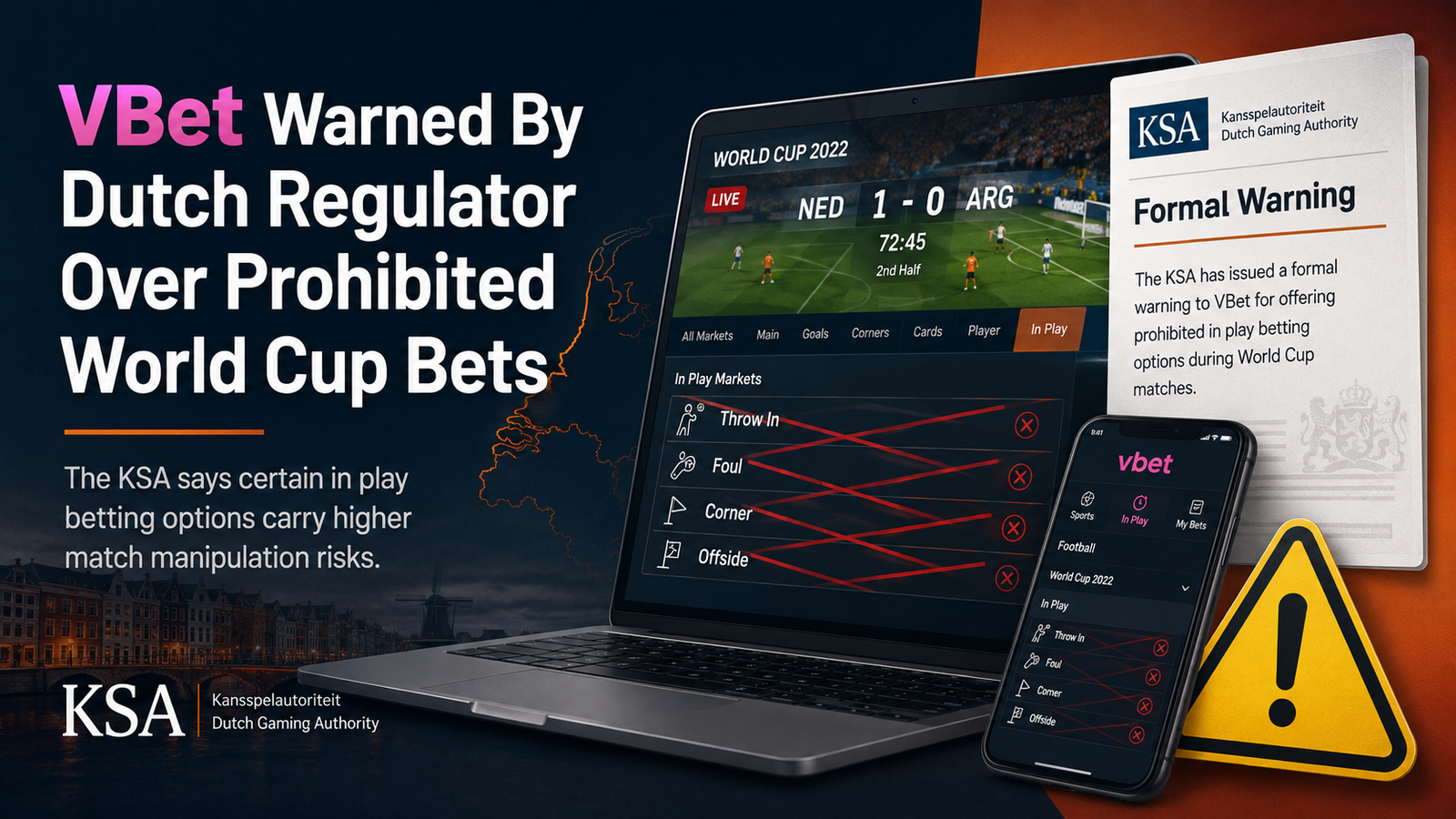
The regulator has issued a formal warning to VBet after the operator offered sports betting markets that are simply prohibited in the Netherlands. VBet, which operates in the Dutch regulated market through SCGO Limited, allowed customers to place live bets on throw ins, fouls, corners and offsides during matches at the 2026 FIFA World Cup. KSA Netherlands discovered the markets as part of its increased supervision during the tournament. VBet pulled the betting options immediately once the regulator made contact.
That should have been the end of it. It wasn’t. This was not the first time the operator had been approached about prohibited sports bets, and the repeated nature of the violation is why KSA Netherlands escalated to a formal warning instead of quietly closing the file once the markets disappeared.
Which Betting Markets Did VBet Offer?
According to KSA Netherlands, VBet offered live betting markets tied to individual in-match events. These included bets on whether a throw in, foul, corner or offside decision would occur during a specific stretch of play.
Fluff-free version of the concern: these events look harmless. They happen in almost every football match. The regulator’s issue was never frequency. It was influence.
- A player can deliberately concede a corner.
- A player can commit a foul on command.
- A player can allow the ball to leave the pitch at a chosen moment.
None of that changes the final score. All of it can decide whether a specific bet wins. That is a different integrity risk than a traditional match-winner bet, where moving the outcome usually requires several people cooperating. Moving a single throw in or foul may require exactly one player. For that reason, Dutch licensed bookmakers cannot simply switch on every market their international technology or data provider happens to offer.

Why Are These Bets Prohibited Under KSA Netherlands Rules?
Dutch sports betting rules restrict wagers on events that carry an increased risk of manipulation. KSA Netherlands explains that some in-match events are relatively easy for a single participant to influence, which makes them vulnerable to what the industry calls spot fixing.
Match fixing targets the overall result. Spot fixing is narrower: it manipulates one specific action or moment without necessarily changing the final score. A footballer can intentionally concede a corner while genuinely trying to win the game. He can cause a throw in at a chosen minute. Once money can be placed on that small moment, the financial incentive to manipulate it grows.
That is exactly why KSA Netherlands considers markets involving corners, fouls, throw ins and offsides unsuitable for the licensed Dutch market. In its sports betting integrity guidance, published on 18 December 2025, the regulator clarified which market types operators may and may not offer. The responsibility for checking each market’s legality sits with the operator, full stop. A bookmaker cannot pass the blame to an external trading platform or an international sports data supplier and call the market “automatically imported.”
Previous VBet Betting Violation
This case matters more because VBet had already been here before. Earlier in 2026, KSA Netherlands investigated VBet alongside Holland Casino Online after receiving a report about bets on own goals. Own goal markets are prohibited for the same reason as spot-event bets: a player can directly influence whether one happens. Both operators adjusted their offers once the regulator intervened, and VBet introduced measures meant to stop a repeat.
The earlier case was closed without a formal penalty. That leniency assumed the fix would hold. The discovery of another prohibited betting offer during the World Cup shows it didn’t fully hold, which is precisely why the current response is more serious. KSA Netherlands has now issued an official warning and made it explicit that another violation could trigger enforcement action.
The safest operator is not the one that removes an illegal market fastest. It is the one whose systems prevent that market from reaching Dutch players at all.
What Happens After a KSA Netherlands Warning?
No financial penalty appears attached to this warning. VBet’s speed in removing the markets likely kept the response at this level rather than something heavier. But the operator is now on clear notice: another similar failure and the regulator has administrative fines and further regulatory orders on the table.
This should not be read as a minor technical correction. A repeated compliance failure signals that an operator has not built effective controls between its international betting platform and the specific rules of the Dutch market. VBet’s next move will almost certainly involve reviewing how markets are selected, approved and displayed to Dutch customers. Automated market feeds can carry thousands of possible wagers, and each one needs checking against local restrictions before it ever reaches a customer. During a tournament, when markets get added and changed at speed, weak controls stop being invisible.
Why Every Dutch SEO Writer and Content Team Should Be Watching This
I do not hide the fact that I use AI. I lean into it, but only inside a human-in-the-loop structure that keeps editorial integrity intact. Stories like this VBet warning are exactly why. If you are a Dutch SEO writer, a Dutch content specialist, or an iGaming content writer publishing under a Dutch license, you are not just writing about odds and promotions anymore. You are writing inside a regulatory environment where one wrong claim about a betting market can undercut the trust your entire content operation is built on.
An affiliate content expert covering World Cup markets needs to know the difference between a legal match-winner bet and a prohibited spot-event market before publishing a “best odds” roundup. Getting that wrong isn’t a style issue. It’s a compliance issue that follows the operator, and by extension the publisher, straight back to KSA Netherlands.
KSA Netherlands Increases World Cup Supervision
The warning followed a deliberate increase in supervision by KSA Netherlands during the 2026 World Cup. Before the tournament started, the regulator reminded every licensed operator that Dutch gambling rules apply in full, covering both advertising and the sports betting products actually offered to customers.
Major tournaments always spike betting interest. Operators respond with more promotions, more live markets, more ways to bet on individual matches. That commercial pressure also raises the risk of mistakes, especially for international operators running systems built to serve several regulated markets at once. A market permitted elsewhere can still be prohibited in the Netherlands. The VBet case proves that a general compliance policy is not enough. Operators need market-level controls that stop a prohibited wager before a Dutch customer ever sees it.
What This Means for the Dutch Gambling Market
The warning sends a wider message to every licensed bookmaker operating in the Netherlands. Removing an illegal market after the regulator notices it is not the standard. Preventing that market from appearing in the first place is. KSA Netherlands states plainly that license holders are responsible for ensuring their complete betting offer follows Dutch rules, and that responsibility cannot be transferred to an odds supplier, a platform provider or an external trading team.
This is the difference between holding a Dutch gambling license and maintaining compliance every single day. A license grants legal access. It does not guarantee that every product or process stays compliant. Sportsbooks add events, odds and live markets constantly, so compliance has to run continuously, not as a one-time check at platform launch.
My Dutch Assisted Editorial Team Behind This Analysis
Most agencies treat iGaming like any other vertical. It isn’t. Covering a story like this VBet warning properly requires the same market-level controls the regulator is demanding from operators, just applied to content instead of odds feeds. That’s why every KSA Netherlands story that runs through my scalable publication pipeline goes through a named process, not a black box:
- Marieke — our Dutch translator and localization specialist, making sure regulatory terms like “spot fixing” and “administrative order” read native, not machine-translated.
- Karol — AI content strategist, mapping intent clusters around KSA Netherlands enforcement before a single sentence gets drafted.
- Tom — SEO copywriter and lead on SEO strategy, structuring the piece so mobile-first architecture and topical authority work together instead of against each other.
- Gloria — Dutch editor and the Dutch proofreading layer, the last human check before anything ships to a client’s site.
- Jop — content manager overseeing Dutch content operations, keeping the pipeline moving when a tournament produces three regulatory stories in a week.
- Bobby — tactical sports writer, doubling as a Dutch sportsbook writer whenever a market-integrity story like this one breaks mid-match.
The difference between us and the content mills is human-in-the-loop oversight. AI workflows get us to a fluff-free first draft fast. Human judgment decides what actually survives into the published version. That combination is what a Dutch gambling content expert, a Dutch casino copywriter, or a Dutch crypto writer all need in 2026, because the compliance surface keeps expanding into every corner of the vertical, not just sportsbooks.
A Warning With Broader Consequences
VBet responded fast once the prohibited betting options were flagged. That helped resolve the immediate problem. It did not remove the regulator’s concern about the repeated nature of the violation. The formal warning puts real pressure on the operator to fix internal controls, because another incident moves this from a warning straight into financial or administrative sanction territory.
For the wider industry, the lesson is direct: international betting platforms need careful adaptation to Dutch regulation, especially during tournaments when the volume of live markets grows fast. More betting options can improve a sportsbook’s commercial appeal. In a regulated market, more markets also mean more compliance risk, and that risk doesn’t stay contained to the trading desk.
It reaches content too. Whether you’re an affiliate content expert building odds comparisons, a freelance writer covering World Cup betting news, or a content manager running affiliate marketing campaigns across several Dutch-facing brands, the same rule applies: the text has to match the rulebook, not the international feed. The regulated Dutch market rewards trust, punishes shortcuts, and demands an SEO copywriter who treats KSA guidance as source material rather than an obstacle.
If your technical foundation is wrong, no amount of long-form content will save you. And if your compliance language is wrong, the trust evaporates just as fast, whether the reader is a customer, an affiliate partner, or the regulator itself. That’s the actionable intelligence behind this VBet case: build the controls before the tournament starts, not after the regulator calls.