Netherlands Gambling License Requirements 2026: Navigating the Renewal Era
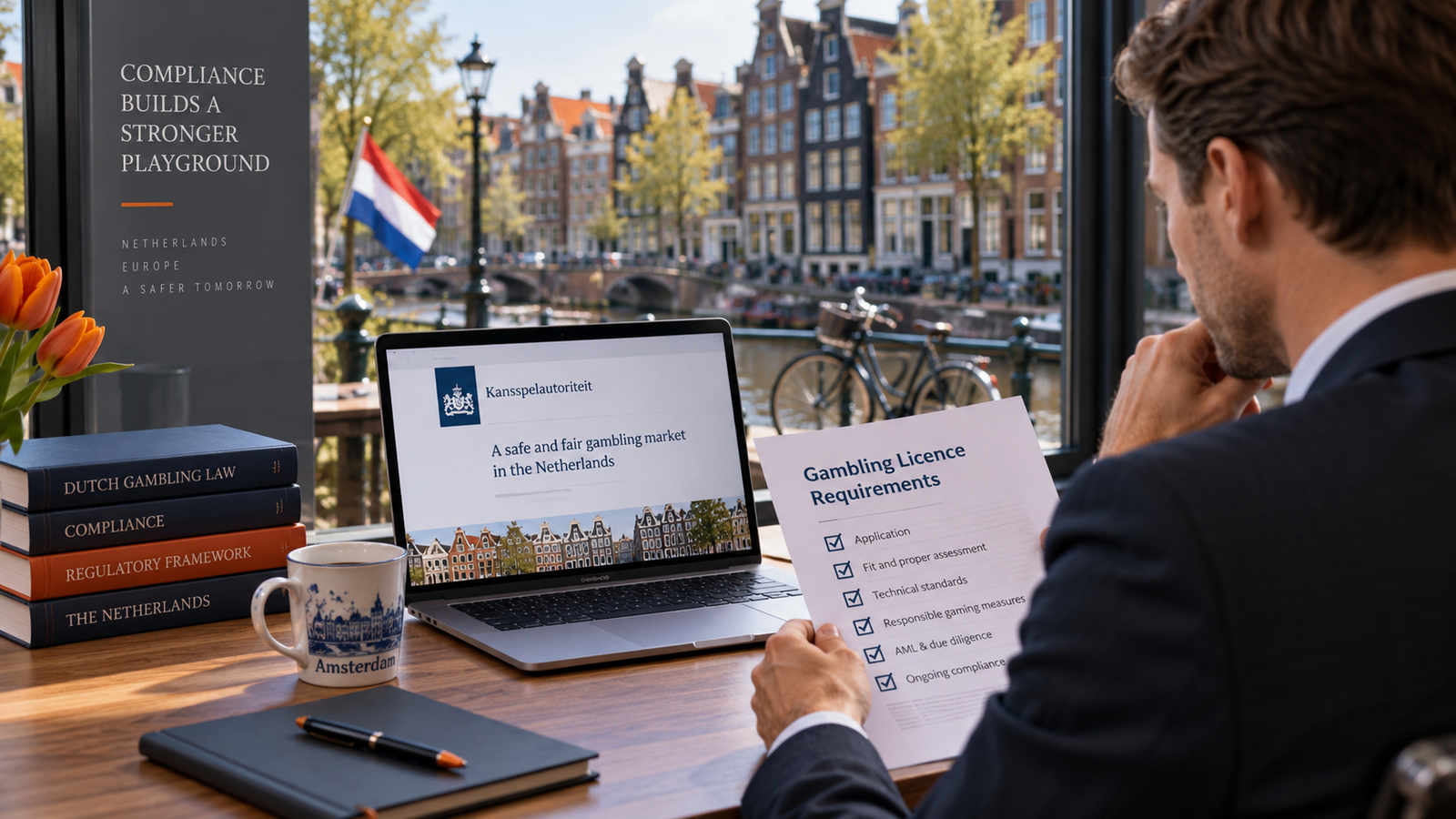
As the Dutch iGaming market approaches its first major renewal cycle, the Kansspelautoriteit (KSA) is tightening the criteria for operators. Understanding the Netherlands gambling license requirements 2026 is no longer about entry—it is about survival in a mature, highly regulated environment.
The Dutch online gambling landscape is entering a critical transition phase. In October 2021, the first batch of remote gambling licenses was issued under the Remote Gambling Act (KOA). These licenses were granted for a five-year term, meaning that 2026 represents the first time the KSA will conduct a comprehensive “Renewal Test” for the market’s pioneers. This is not a mere formality; it is a rigorous re-assessment of suitability, financial health, and operational compliance.
Operators looking to maintain their presence in the Netherlands must prepare for significantly higher financial hurdles and stricter technical oversight. The regulator has made it clear that the “experimental” phase of the market is over. In 2026, the Netherlands gambling license requirements will prioritize deep integration with national exclusion registers and proactive, data-driven player protection measures that go far beyond simple cooling-off periods.
Reach professionals across the Dutch iGaming market. Explore advertising and partnership opportunities on MauriceKruytzer.com.

The Financial Realities of 2026: Fees and Capital
One of the most immediate changes for anyone evaluating Netherlands gambling license requirements 2026 is the cost of the application itself. Effective April 1, 2026, the KSA has increased the non-refundable application fee to €61,300. This represents a significant jump from the previous €48,000, reflecting the increased administrative burden on the regulator to audit complex multi-brand operations.
Beyond the application fee, the KSA maintains strict financial solvency requirements. Operators must demonstrate a minimum capital of €800,000. This capital must be unencumbered and readily available to ensure that the operator can meet its financial obligations to players, even in the event of a market downturn or significant regulatory fines. Additionally, a financial guarantee (often a bank guarantee) of at least €50,000 is required to cover potential administrative fines or unpaid gambling taxes.
| Requirement Type | 2026 Specification | Notes |
|---|---|---|
| Application Fee | €61,300 | Non-refundable; effective April 1, 2026 |
| Minimum Capital | €800,000 | Must be proven via audited financial statements |
| Financial Guarantee | €50,000 | Minimum; may be higher based on risk profile |
| License Duration | 5 Years | Subject to ongoing “Duty of Care” audits |
Technical Compliance: CRUKS and the CDB
Technical infrastructure remains the backbone of the Netherlands gambling license requirements 2026. The two most critical components are the integration with CRUKS (Centraal Register Uitsluiting Kansspelen) and the maintenance of a Control Database (CDB). The KSA requires real-time access to anonymized player data to monitor for patterns of problematic gambling or money laundering.
For the 2026 renewal cycle, the CDB requirements have evolved. The regulator now expects higher data fidelity and faster reporting intervals. Operators who experienced “technical hiccups” in their first term will find the KSA far less lenient during the renewal process. The ability to demonstrate a 100% success rate in checking the CRUKS register before every player session is a non-negotiable prerequisite for license extension.
The “Duty of Care” Evolution
If the first five years of the Dutch market were focused on “launching,” the 2026 era is focused on “intervening.” The KSA’s expectations regarding the Duty of Care have shifted from passive monitoring to active intervention. To meet the Netherlands gambling license requirements 2026, operators must employ automated systems capable of detecting sudden changes in player behavior—such as increased deposit frequency, late-night play, or failed payment attempts—and trigger immediate, documented interventions.
Training also takes center stage. By 2026, all staff involved in player-facing roles or data analysis must have completed “Advanced Responsible Conduct of Gambling Training.” This training is not a one-time event; the KSA expects ongoing education that reflects the latest psychological research into gambling addiction and the effectiveness of different intervention strategies.
Beyond the License: A Post-Launch Audit Checklist for 2026
Sustaining KSA compliance requires a proactive internal audit rhythm. Use this checklist to ensure your operation stays ahead of the 2026 regulatory climate:
- CRUKS Verification Audit: Verify that no player has bypassed the registration check in the last 12 months.
- CDB Data Integrity: Ensure that the data transmitted to the KSA matches your internal records with zero discrepancies.
- Intervention Documentation: Audit your “Duty of Care” logs. Are you documenting the outcome of interventions, or just the fact that they occurred?
- Advertising Compliance: Review all affiliate partnerships. Ensure no “untargeted” advertising is reaching prohibited demographics.
- AML/KYC Refresh: Conduct a “probity check” on all directors and ultimate beneficial owners (UBOs) to ensure they still meet the KSA’s reliability standards.
- Dutch Language Quality: Ensure all T&Cs, responsible gaming tools, and customer support are available in high-quality, professional Dutch.
Operational Presence and Local Impact
The Netherlands gambling license requirements 2026 emphasize the necessity of being an EU/EEA-based entity. Non-EU companies cannot hold a license directly; they must establish a subsidiary within the European Union or European Economic Area. This legal structure ensures that the KSA has a clear path for enforcement and legal service.
Furthermore, the local impact of these regulations extends to the content and SEO strategies used by operators. The KSA has become increasingly aggressive in monitoring the “feel” of gambling sites. Content that appeals to minors or uses “inciting” language is a fast track to a license review. For operators in 2026, the challenge is ranking for competitive keywords like “online casino” while maintaining a tone that the KSA deems “responsible” and “non-aggressive.”
The Role of Content in Regulatory Compliance
Many operators overlook the fact that their website content is a core component of their license obligations. In the 2026 regulatory climate, the KSA treats misleading bonus descriptions or hidden terms and conditions as a breach of the license requirements. This is where professional Dutch iGaming content strategy becomes a compliance tool, not just a marketing one.
Localisation is another hurdle. The KSA strictly mandates that all player-facing information be available in Dutch. Poorly translated AI content that misses the nuance of Dutch gambling law can lead to “misleading information” charges. Operators must ensure that their content production workflows include a layer of regulatory QA that understands the specific terminology used in the KOA Act and KSA guidance documents.
Why the 2026 Renewal cycle is different
In 2021, the KSA was focused on onboarding as many operators as possible to transition players away from the illegal market (channelisation). By 2026, the focus has shifted to “quality over quantity.” The regulator is now willing to let licenses lapse if an operator cannot prove they have mastered the Dutch market’s specific demands. This includes everything from accurate Dutch localization to the technical precision of their reporting to the KSA.
Frequently Asked Questions: Netherlands Gambling License Requirements 2026
What is the total cost of applying for a Dutch license in 2026?
The application fee is €61,300 (non-refundable). However, you must also factor in the €800,000 capital requirement, the €50,000 financial guarantee, and the costs associated with technical integration (CDB and CRUKS) and Dutch-language legal and content support.
When do existing licenses expire?
The first licenses were issued on October 1, 2021, for a five-year term. These will expire on September 30, 2026. Operators must begin the renewal process well in advance to avoid a gap in their legal status.
Are there new advertising restrictions for 2026?
Yes. The KSA is continuously tightening rules around untargeted advertising. Affiliates and operators must ensure that their marketing does not reach vulnerable groups or minors, and the “Duty of Care” extends to how bonuses are marketed to existing players.
Can I use AI to translate my site into Dutch for the 2026 license?
While AI can assist in the process, the KSA requires high-quality, accurate Dutch. Using raw AI output without professional Dutch iGaming editorial review is high-risk, as it often leads to inaccuracies in legal disclosures and responsible gaming information.
What is the CRUKS register?
CRUKS stands for Centraal Register Uitsluiting Kansspelen. It is a mandatory national database of players who have been excluded from gambling, either voluntarily or involuntarily. Every licensed operator must check this register before allowing a player to start a session.
Need accurate Dutch iGaming content built for the local market and compliant with 2026 KSA standards? View our Dutch iGaming content services.