
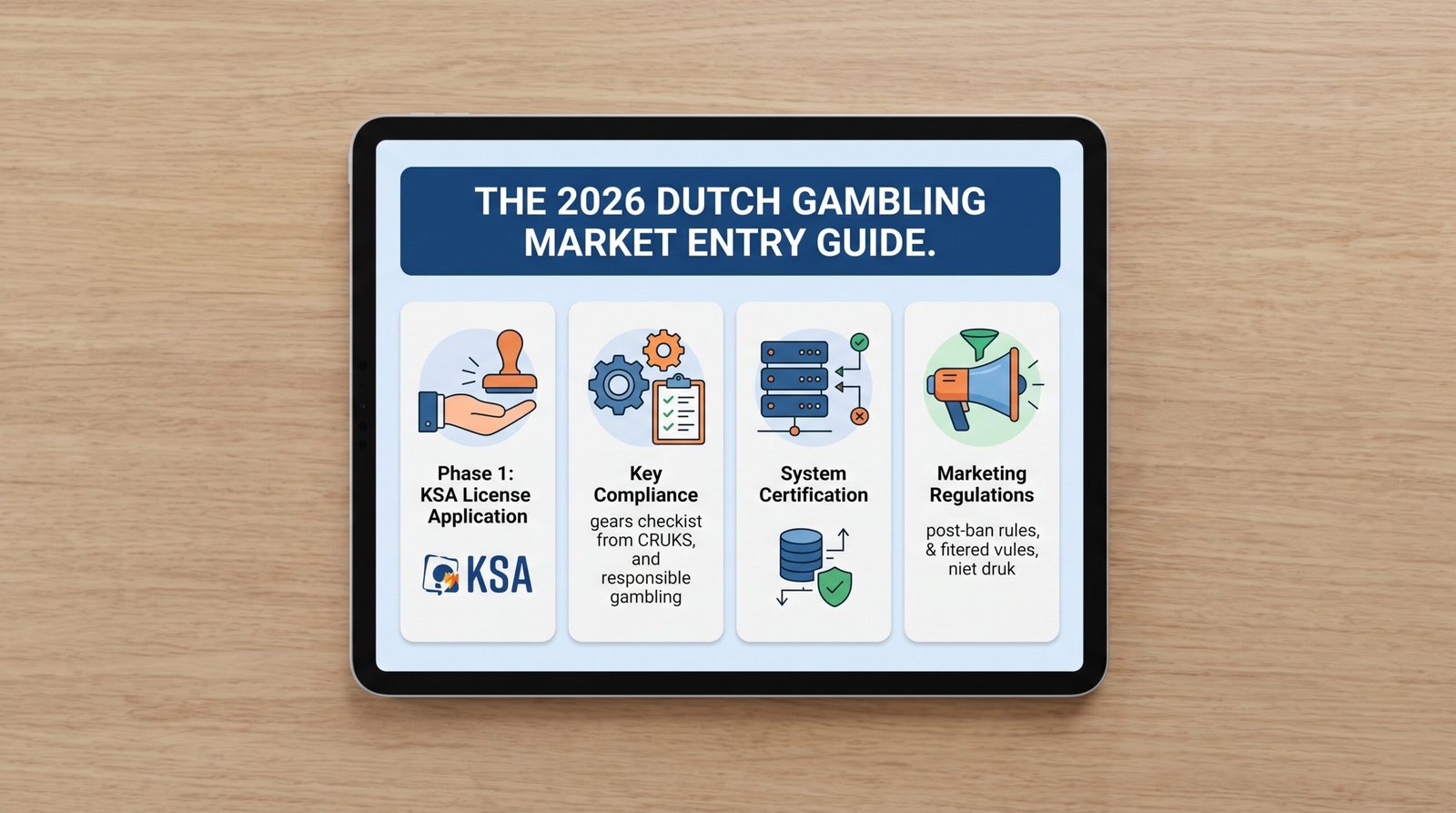
Netherlands Remote Gambling Act 2026 Updates: The Definitive Compliance Guide
The Dutch iGaming landscape is entering its most volatile phase since the market opened in 2021. As the Kansspelautoriteit (Ksa) shifts from market facilitation to aggressive enforcement, operators must prepare for a radical overhaul of the fiscal and regulatory framework coming in 2026.
Central to these updates is the substantial increase in the gambling tax (kansspelbelasting), which is set to rise to 37.8% of gross gaming revenue (GGR) on January 1, 2026. This move, combined with rising administrative fees and a tightening “duty of care,” forces a reassessment of player lifetime value (LTV) and marketing efficiency. Understanding the technicalities of these changes is the difference between operational sustainability and a forced market exit in the coming 24 months.
Reach professionals across the Dutch iGaming market. Explore advertising and partnership opportunities on MauriceKruytzer.com.

The 37.8% Tax Cliff: Fiscal Implications for 2026
The most immediate and debated change in the Netherlands Remote Gambling Act 2026 updates is the tax trajectory. Currently, operators have navigated a 30.5% tax rate, which was already significant by international standards. The jump to 37.8% represents one of the highest tax burdens for regulated online gambling in Europe.
Impact on Channelisation
The primary concern for industry analysts is the impact on channelisation—the percentage of players using licensed rather than illegal sites. A tax rate of nearly 38% leaves little room for competitive odds in sports betting or aggressive bonus structures in online casinos. If licensed operators are forced to worsen their product value to maintain margins, the unlicensed market becomes inherently more attractive to the Dutch consumer.
Operational Margin Pressure
For mid-tier operators, the 37.8% tax rate may prove prohibitive. We expect to see a wave of market consolidation before 2026, as smaller brands struggle to absorb the increased overhead. Larger Tier-1 operators with proprietary technology and high volumes will be better positioned to survive, but even their marketing budgets are likely to be redirected toward compliance and tax obligations rather than player acquisition.
The 2026 License Renewal Cycle
The original KOA licenses issued in October 2021 were granted for a period of five years. This means that 2026 is the inaugural renewal year for the Netherlands’ most established brands. This is not a simple administrative rubber-stamping process; it is a full-scale re-evaluation of an operator’s fitness to hold a Dutch license.
Increased Licensing Fees
From April 2026, the cost of applying for a remote gambling license will rise significantly from €48,000 to €61,300. This increase reflects the Ksa’s growing administrative costs and its mandate to ensure only the most financially robust entities enter the market. Modification fees for existing licenses are also on an upward trend, making every technical or structural change more expensive for the operator.
Integrity Testing (Bibob)
The renewal process will likely involve a fresh “Bibob” screening—the Dutch Public Administration (Probity Screening) Act. This allows the regulator to investigate the integrity of the company, its shareholders, and its financial backers. Given the Ksa’s recent focus on “untouchable” illegal turnover and strict enforcement, any compliance lapses during the first five-year term will be weaponised during the renewal phase.
Duty of Care and Real-Time Monitoring
The Netherlands Remote Gambling Act 2026 updates will solidify the “Duty of Care” (zorgplicht) as the most critical operational pillar. The Ksa has moved away from allowing operators to define their own player protection thresholds. By 2026, we expect fully codified requirements for intervention.
Automated Intervention Thresholds
Operators must now implement systems that monitor player behavior in near real-time. The 2026 landscape will require sophisticated AI-driven tools that detect not just net loss, but changes in speed of play, time of day, and frequency of deposits. The Ksa’s stance is clear: if an operator fails to intervene when a player shows signs of distress, the operator is liable for the harm caused.
CRUKS and Identity Verification
The Central Register of Gambling Exclusion (CRUKS) remains the cornerstone of Dutch player protection. The 2026 updates will likely see stricter technical requirements for the integration between operator platforms and the CRUKS database to eliminate any latency that could allow excluded players to access games.
The Legislative Evaluation of 2026
The KOA Act contained a mandatory evaluation period. The results of this evaluation, currently being synthesised, will dictate the 2026 legislative agenda. Beyond tax and fees, several other areas are under intense scrutiny by the Dutch Ministry of Justice and Security:
- Advertising Restrictions: Following the ban on untargeted advertising (television, radio, and billboards), 2026 may bring even stricter controls on affiliate marketing and sponsored content.
- Loss Limits: There is ongoing political pressure to introduce universal, cross-operator loss limits, rather than the currently self-imposed limits chosen by players.
- Market Entry Hurdles: For new entrants, the bar for technical compliance—specifically the Control Database (CDB) requirements—has never been higher.
Frequently Asked Questions
What is the exact gambling tax rate for 2026?
As of January 1, 2026, the tax rate for both online and land-based gambling in the Netherlands will be 37.8% of the Gross Gaming Revenue (GGR). This is an increase from the 30.5% rate used in previous years.
How much does a Dutch remote gambling license cost in 2026?
The application fee for a new remote gambling license is scheduled to rise to €61,300 in April 2026. This fee is non-refundable, regardless of whether the license is granted.
Will existing licenses automatically renew in 2026?
No. Licenses were granted for a maximum of five years. Operators who received their licenses in the first wave of 2021 must undergo a formal renewal process, which involves a comprehensive review of their compliance history and financial integrity.
What are the fines for non-compliance with the KOA Act?
The Ksa has introduced a strict penalty base. The standard fine for serious violations starts at €800,000. For operators with high turnover, the fine can be calculated as a percentage of their revenue, potentially reaching millions of euros.
What is the ‘Duty of Care’ requirement for 2026?
Operators are legally required to monitor players for signs of problem gambling. By 2026, this is expected to involve mandatory intervention thresholds and stricter reporting to the Ksa regarding how many interventions were performed and their outcomes.
Need accurate Dutch iGaming content built for the local market? View our Dutch iGaming content services to ensure your brand remains compliant and authoritative.