
The real reason AI casino reviews need a human reality check is brutal: 55.5% of people can be fooled by synthetic media, even when they think they are being careful.

Key takeaways: what actually goes wrong with AI casino reviews in 2026
Human reality checks catch the stuff AI glosses over
| Best-practice habits you can copy
|
- Q: What should a credible AI-assisted review verify in 2026?
A: Dutch licence status, withdrawal reliability, bonus terms, and the responsible gambling info that players actually see. - Q: Can AI speed up research without damaging trust?
A: Yes, if humans verify sources and publish with a documented process your readers can audit. - Q: Why do AI reviews still feel “off” to players?
A: Because AI can describe features. It cannot reliably test outcomes, exceptions, and edge cases the way a human review does.
If you want a content workflow that stays compliance-ready while you scale, see our Dutch iGaming content services:
Dutch iGaming Content Services.
If your publication is wrestling with “AI wrote it, who cares?” trust issues, start here:
Google’s 2026 AI Search Reality Check for Dutch iGaming.
Reach professionals across the Dutch iGaming market with your ads and partnerships.
1) AI casino reviews fail at the one job players actually want: trust in outcomes
AI casino reviews often sound confident because they can describe what a site claims. The problem is that claims are cheap, outcomes are not.

The real reason AI casino reviews need a human reality check is simple: AI is great at generating text, not at proving reliability. In 2026, players want evidence on things like withdrawal behavior, bonus terms that survive friction, and whether responsible gambling information is actually present and usable.
That is why the “reality check” has to be documented. Not “I skimmed the site.” Not “it looks legit.” We are talking traceable verification steps, because readers can audit them. If you cannot show how you verified, you are basically running an opinion factory.
- Bonus terms: AI summaries miss exceptions that matter in practice.
- Withdrawals: AI can repeat policy text, it cannot guarantee payout behavior.
- Responsible gambling: it can describe features, it cannot test how they work under stress.
2) The “update problem” in 2026: licences and terms drift faster than content
In Dutch iGaming, details change. Licences change. Bonus terms change. Payment methods change. Customer support behavior changes. Your review has an expiration date, even if the page looks stable.
AI makes this worse if your workflow treats content as a one-time output. In our approach, we assume the review is a living artifact. We verify, we document, and we update when facts shift.
If you are relying on AI to “keep things current,” you are betting on memory that is not guaranteed. AI can be helpful for drafting and structuring, but it must be anchored to fresh verification, especially on licence status and the wording of bonus terms players will be held to.
3) AI only sees what you feed it, and humans catch what it misses
Here is the trap most teams fall into: they scrape, they generate, and they publish. It is a scalable pipeline, but it is not a reliable editorial control system.
Human reality checks close the gaps. We focus on the parts AI routinely glosses over because they require context, judgement, and operational verification: edge cases, contradictory terms, and “yes, but…” clauses.

4) Independence is not a tagline, it is an editorial control system
Players do not care how “objective” your review claims to be. They care whether it shows independence in the actual process.
That means you do not just disclose affiliate relationships. You build a process that does not depend on marketing narratives. We verify licences, review payments and sportsbook rules separately, and we keep a rubric that can be applied consistently across brands.
Independence also affects what you can safely say. If your workflow is tied to promotions, you will soften contradictions. Human reality checks help you stay sharp because someone has to be accountable for the line-by-line truth.
If you want a practical lens on what independence changes in Dutch casino reviewing, this is the relevant piece:
Why Dutch casino reviews need a human “Reality Check” in 2026.
5) Casino content is not just casino content, payments and withdrawals are the real test
Most AI casino reviews treat payments as a feature list. That is not where trust is won or lost.
In 2026, the player reality check is payments and withdrawal behavior, plus how bonus terms interact with verification steps. Humans can test the practical flow, not just restate what a casino site says.
And it gets more interesting when you mix casino and sportsbook experiences. If you review betting journeys, you need the same discipline, because sportsbooks are operational too. They have rules, exceptions, and product behavior that a “template review” cannot capture.
That is why we separate drafting speed from verification. AI can help generate structure. Humans confirm the facts that players will be stuck with.
6) Reality checks also matter for sportsbooks and affiliate pages
This is where many teams get lazy. They build one “casino review style” for everything. Then they wonder why readers call it generic.
In Dutch iGaming, affiliate content is still a big part of the information ecosystem. But affiliate pages have their own trust risks: unclear methodology, outdated terms, and copy-paste claims that do not match what players will experience.
So yes, the reality check principle applies to affiliates too. If you want the angle on where affiliate value still exists in 2026, read:
Affiliates iGaming Opportunities in the Netherlands (2026): Where the Real Value Still Exists.
And if you are building content around sportsbooks like betway sportsbook, the human checks should include the same “does it work in real life” questions: deposit flow, bonus friction, withdrawal outcomes, and whether the terms are readable and consistent.
7) AI output is easy to scale, but verification is where the work (and accountability) lives
Most content teams think the bottleneck is writing. It is not.
The bottleneck is verification, compliance-ready phrasing, and maintaining consistent editorial standards. AI can accelerate drafting, but it cannot replace the human reality check without breaking trust. That is what “scaled publishing” gets wrong when it chases volume over value.
In other words: the text is fast. The truth is slower.
8) Human reality checks must be designed, not improvised
If your reality check is “we hope it is right,” you do not have a system. You have wishful thinking with better formatting.
We treat verification as a workflow. That means you decide what gets checked, how it gets recorded, and when it triggers an update. It also means you build a rubric your writers follow consistently.
Google’s 2026 AI Search Reality Check for Dutch iGaming is basically pointing at the same thing: the danger of scaled, low-value publishing produced with AI. The fix is not banning AI. The fix is doing human-in-the-loop editorial quality, with updateability and unique value.
If you want the exact rubric structure we use, the supporting guide is here:
Google’s 2026 AI Search Reality Check for Dutch iGaming, and what your editorial team should do next.
9) Best approach in 2026: AI drafts, humans verify, you publish with evidence
This is the workflow that keeps you fast without becoming a trust hazard.
- AI helps you draft the review structure (what to cover, how to present it).
- Humans run the reality check on the parts that matter in practice: licences, withdrawals, bonus terms, responsible gambling info.
- Independence gets enforced in the method, not just in the disclosures.
- You publish with a documented process, so readers can understand what was verified.
- You update in 2026 when facts drift, because casino terms do not stay still.
If you are building this with tools, you still need human oversight. Even if the system feels “automated,” the editorial control must stay with humans.

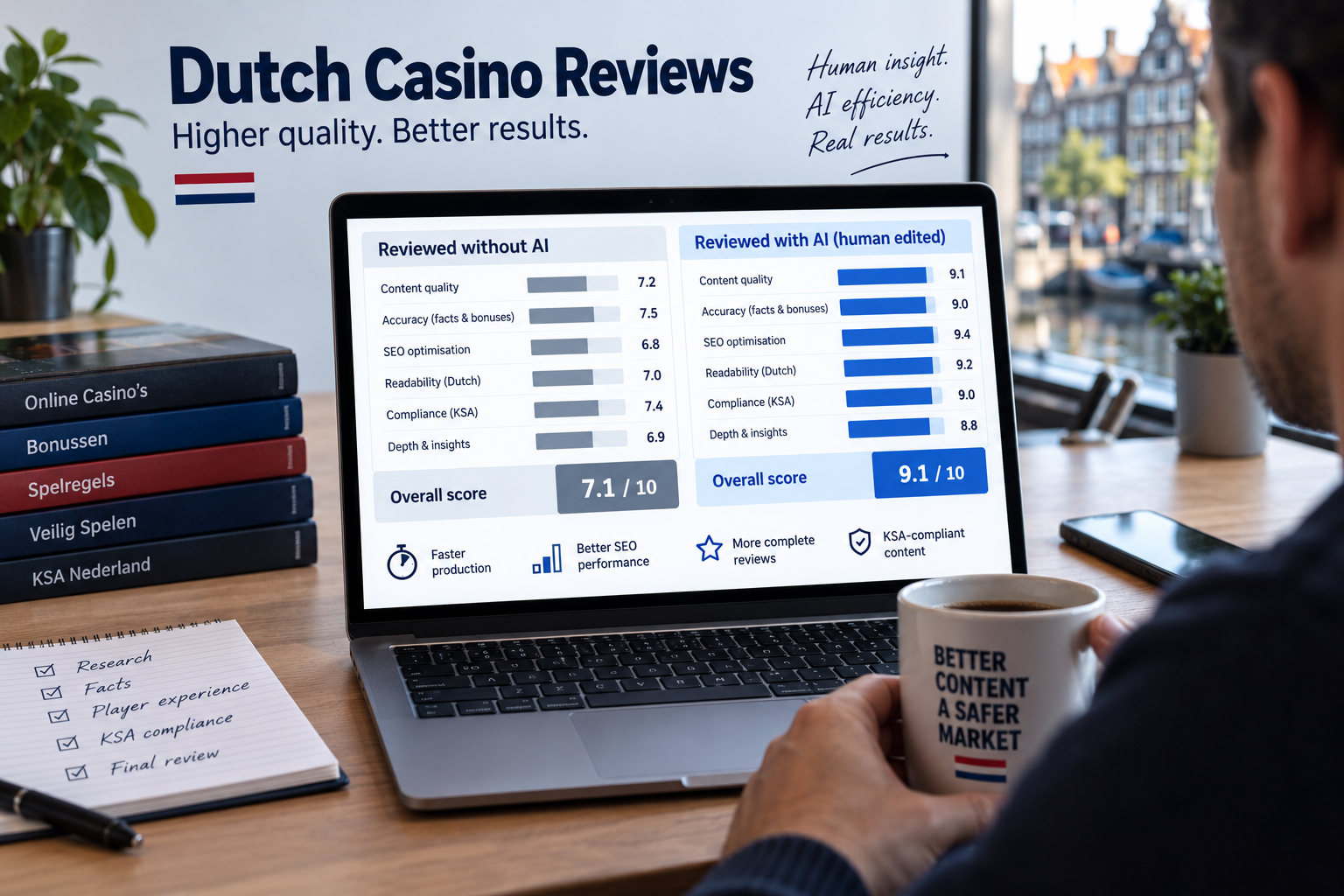
Human-reviewed casino content scores far higher on accuracy than AI-only output.
Bonus reality check: how we keep it compliance-ready in Dutch iGaming
We do not treat compliance as a “late pass.” We treat it as part of editorial integrity. Localization and Dutch proofreading separate compliant operators from the noise.
In practice, that means we use AI for speed, but we keep humans accountable for what gets published. If the text reads foreign, the compliance language is wrong, or the claims cannot be verified, the trust evaporates.
If you want to see how this looks operationally, our portfolio is a useful reference point:
Our Works and case study highlights.
And if you are looking for workflow support, you can also evaluate Harbor through this link:
Harbor for editorial workflows.
Frequently Asked Questions (FAQ)
What is the real reason AI casino reviews need a human reality check in 2026?
The real reason AI casino reviews need a human reality check is that AI can describe features, but it cannot reliably prove outcome behavior like withdrawals, bonus friction, and licence accuracy. In 2026, terms drift and verification gaps create trust problems fast, especially in regulated Dutch iGaming.
Can AI-assisted casino reviews still be trustworthy if humans verify licences and bonus terms?
Yes, AI-assisted reviews can be trustworthy in 2026 when humans run the checks that matter. The review must use a documented process for verification, so the “AI draft” becomes a verified editorial product, not a guess.
How do human reality checks improve casino content for Dutch players?
Human reality checks improve casino content because they confirm the details Dutch players actually experience: withdrawal behavior, responsible gambling information, and bonus terms in the correct Dutch context. That prevents the common “sounds right, fails in practice” problem.
Are AI reviews worse for sportsbook brands like betway sportsbook compared to casino reviews?
They can be worse, because sportsbook rules and edge cases are even more operational. If the AI casino reviews approach gets applied blindly to betway sportsbook style journeys, readers can end up with misleading expectations about terms and outcomes.
How can affiliates avoid low-value AI casino review pages in 2026?
Affiliates should stop treating AI as a publishing shortcut. Use a human reality check for licence status, payment and withdrawal claims, and bonus terms, then publish with transparent methodology so readers know what was verified.
What should an editorial team check before publishing an AI casino review?
In 2026, your editorial team should check licence accuracy, withdrawal reliability evidence, bonus term exceptions, and responsible gambling info. That is exactly where the human reality check matters most for the real reason AI casino reviews need a human reality check.
Is AI traffic and content flooding making trust checks more important?
Yes. When automated systems flood the market, human-in-the-loop verification becomes the differentiator. The real reason AI casino reviews need a human reality check is that trust is harder to manufacture than copy.
Conclusion: the real reason AI casino reviews need a human reality check is accountability
The real reason AI casino reviews need a human reality check is accountability for outcomes. AI can help produce the draft, but only humans can verify what players will experience, especially in 2026 when licences and terms drift and when trust is the product.
If you want scalable editorial output without losing integrity, you need a human-in-the-loop process, a Dutch-focused reality check, and a documented verification standard that readers can audit.
Need Dutch iGaming content built with a verified, compliance-ready workflow?
Written by Maurice Kruytzer