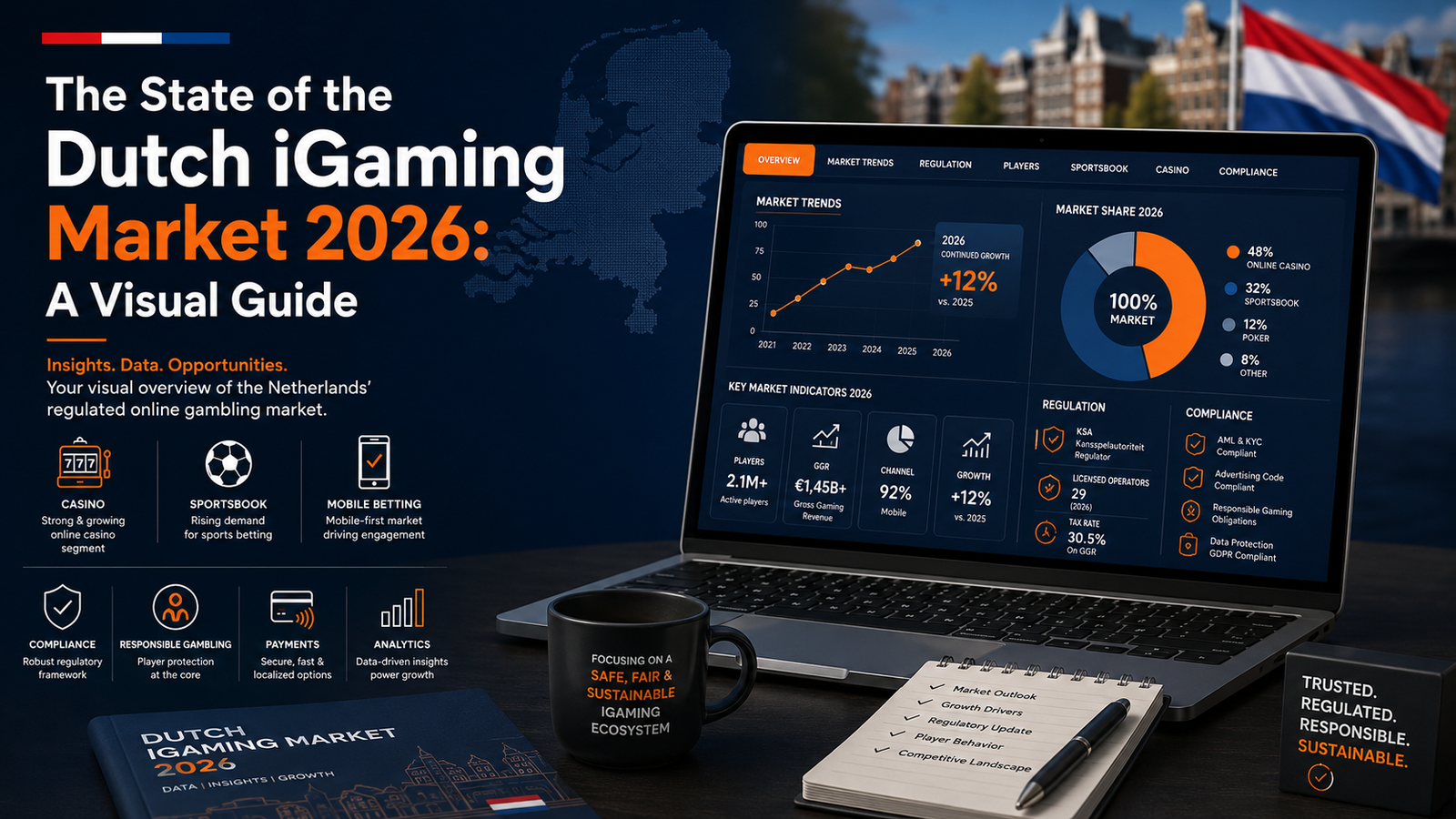
The State of the Dutch iGaming Market 2026: A Visual Guide

Navigating a €1.5B+ landscape defined by high friction, record-high taxes, and a fundamental shift in player behavior. Discover the data driving the next era of Netherlands gaming.
GGR Tax RateThe highest in the market’s history as of Jan 1, 2026.
Channelization (Players)Percentage of active players using legal platforms.
Channelization (Revenue)For the first time, legal GGR accounts for less than half of total market value.
Monthly Unique PlayersAcross 1.38 million active accounts in the ecosystem.
The “High Friction” Era
In 2026, the Dutch iGaming market has transitioned from a phase of explosive post-regulation growth to a state of “High Friction.” While the number of active licenses remains steady at approximately 31, the operational landscape has become significantly more challenging. This visual guide breaks down the critical data points that operators, investors, and affiliates must understand to survive in a market where efficiency is no longer optional—it is a requirement for survival.
The rise of the 37.8% Gross Gaming Revenue (GGR) tax and the implementation of stringent deposit limits have created a paradox: while the Kansspelautoriteit (KSA) has successfully moved the vast majority of players into the legal system, the “High Value Players” are increasingly seeking alternatives. This shift has led to a landmark moment where the legal market’s revenue share has dipped below 50% of the total estimated Dutch gambling expenditure.
Market Share & Vertical Performance
The dominance of the “Big Three” operators—who once commanded over 50% of the market—has eroded. In 2026, they now control between 30% and 40%, as smaller, more agile niche operators utilize specialized content strategies to capture specific player segments.
Vertical Revenue Distribution
- Online Slots (78% of legal GGR): Remains the undisputed king of the Dutch market, despite stricter play limits.
- Sports Betting (20% of legal GGR): Facing significant headwinds due to the total ban on sports sponsorships that matured in 2025.
- Poker & Bingo (~1.8%): These verticals have remained stable but represent a minor fraction of the total market liquidity.
The Channelization Paradox
The 2026 data presents a unique challenge for the Dutch regulator. While 94-95% of casual players stick to licensed sites (a success for consumer protection), the financial channelization tells a different story. High-stakes players, frustrated by the €350/month mandatory contact threshold (€150 for young adults), are migrating back to unlicensed offshore operators. This has caused legal GGR to stagnate even as player numbers remain healthy.
The 2026 Regulatory Milestone Checklist
Regulatory compliance in the Netherlands is no longer a “set and forget” process. The KSA has introduced several high-impact measures that have fundamentally altered the player journey.
| Regulation Area | 2026 Standard | Impact on Operators |
|---|---|---|
| Gambling Tax | 37.8% of GGR | Extreme pressure on marketing budgets and player bonuses. |
| Deposit Limits | €350/mo (€150 for 18-23) | Mandatory personal contact required if limits are exceeded. |
| Ad Ban | Total untargeted ban | Shift toward pure SEO and content-led acquisition. |
| Player Funds | Separated Foundation | Legal requirement to protect capital via Dutch third-party foundations. |
| License Renewal | “Exit Plan” Required | Rigorous risk analysis for 5-year renewal (expiring Oct 2026). |
Survival of the Efficient: The Content Shift
With traditional advertising channels effectively closed due to the “Total Ad Ban” debate and sports sponsorship restrictions, SEO and localized content marketing have become the primary lifelines for Dutch operators. However, the high tax environment means that traditional, high-cost content creation models are no longer sustainable.
This is where Maurice Kruytzer’s hybrid workflow has redefined market standards. By combining human editorial expertise with a specialized AI persona team, operators can maintain the high compliance standards required by the KSA while drastically reducing the cost per word.
The Hybrid Workflow Advantage
In a market where every cent of GGR is taxed at nearly 38%, the efficiency of your content pipeline is a competitive advantage. Maurice Kruytzer utilizes a team of specialized AI personas to ensure every piece of content is technically sound and editorially sharp:
- Marieke (Editor-in-Chief): Ensures all content is fluff-free and compliant with KSA transparency requirements.
- Gloria (Review Observer): Focuses on objective, clinical evaluations of casino UX and accessibility.
- Karol (Tactical Sports Writer): Translates complex betting markets into actionable, compliant intelligence.
- Tom (Technical Translator): Bridges the gap between technical data and reader-friendly Dutch copy.
For a deeper dive into how to navigate these challenges, explore the Best SEO Strategies for Dutch iGaming Sites in 2026.
Frequently Asked Questions
Is the Dutch iGaming market still profitable in 2026?
While the 37.8% tax rate is daunting, the market remains profitable for operators who prioritize operational efficiency and organic acquisition. The “survival of the efficient” means that those with low-cost, high-performance SEO strategies are outlasting those reliant on expensive legacy marketing.
What is CRUKS 2.0 and why does it matter?
CRUKS 2.0 is the upgraded self-exclusion system designed to eliminate “marketing blind spots.” Operators are now legally liable if a self-excluded player receives even a single promotional email, making editorial compliance more critical than ever.
Why is the GGR revenue channelization so low compared to player numbers?
High-value players (VIPs) account for a disproportionate amount of GGR. These players are the most sensitive to deposit limits and mandatory intervention thresholds. When they hit these “friction points” in the legal market, they often move to unlicensed platforms that offer higher limits, despite the lack of legal protection.
How does AI-assisted content help with KSA compliance?
AI-assisted workflows, like those managed by Maurice Kruytzer, use structured prompts and specialized personas (like Marieke and Gloria) to ensure that mandatory disclosures, terms, and conditions are never “glossed over” for the sake of marketing. This clinical approach reduces the risk of regulatory fines.
Don’t Let High Taxes Drain Your Content Budget
The 2026 Dutch market demands a smarter approach to SEO. Stop overpaying for fluff and start investing in high-performance, compliant editorial content that drives results.
Partner with Maurice Kruytzer for SEO-driven articles and reviews that combine human expertise with AI efficiency.