
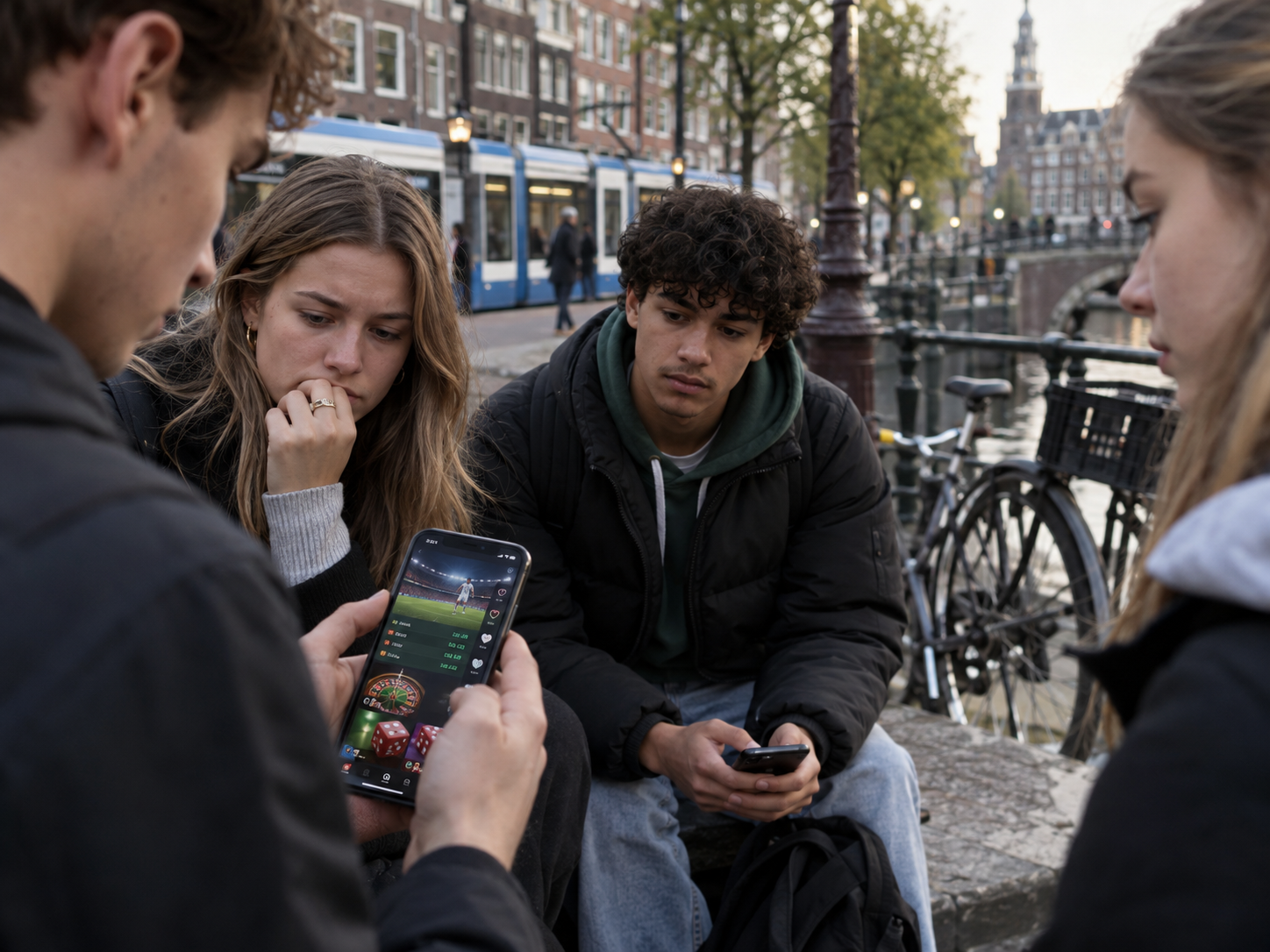
Nearly 50% of TikTok account holders saw gambling content in their feeds over a single week. That is the headline number behind TikTok gambling behaviour in 2026, and it explains why “just keep it educational” often fails in practice.

Key Takeaways
| What’s changing | In 2026, TikTok gambling behaviour is shaped more by algorithmic exposure than by people actively searching for betting. |
| Why it matters | Short-form gambling narratives can turn “learning about risk” into repeated brand-like persuasion. |
| Where the risk hides | Compliance gaps show up in creative, distribution, and audience targeting, not only in deposit funnels. |
| What “mobile-first” should mean | Responsive, short, and context-aware responsible gaming education that matches how users actually consume content in 2026. |
| What we recommend first | We start by fixing content governance, then message intent, then distribution rules (especially influencer-style formats). |
| Learn more | For a practical Dutch angle on explain-first content, see Stop Selling, Start Explaining: Mobile-First Gambling Education for Young Adults. |
| Need help building compliant content? | We can help with Dutch iGaming localisation and content governance via Dutch iGaming content services. |
CTA note: We will keep this focused on TikTok gambling behaviour itself, but if you are building content, you need the boring part right, too.
We do not treat TikTok gambling behaviour as one single “problem.” It is a mix of exposure, narrative style, community effects, and how young adults interpret odds, outcomes, and identity online. In 2026, that mix is especially potent because the platform delivers content fast, personal, and sticky.

And that is where responsible teams get into trouble. A 20-second clip can reach someone long before they see any responsible gaming framing, and “education” can still look like acquisition when the pacing, tone, and distribution match gambling promotion.
Want to reach the Dutch iGaming market? Consider advertising opportunities with MauriceKruytzer.com.
What “TikTok gambling behaviour” looks like in 2026
When people search for TikTok gambling behaviour, they usually mean one of three things. They mean exposure (how often gambling content shows up), interpretation (how people make sense of it), and action (whether it leads to deposits, plays, or further content).
Our starting point is simple. In 2026, the biggest lever is not search. It is the feed. That means even users who never “look for gambling” can still be pulled in by recommendation loops and creator ecosystems.
- Passive exposure is the default: feeds present content before users decide it matters.
- Narratives beat warnings: story formats, edits, and influencer credibility can overpower cautious captions.
- Engagement drives distribution: when viewers watch, comment, or share, the algorithm treats gambling content as “relevant.”
So yes, TikTok gambling behaviour is about betting outcomes, but it is also about attention and identity. In 2026, that is why the same creative concept can behave very differently depending on whether it is positioned as “entertainment,” “analysis,” or “responsible guidance.”
Why TikTok gambling behaviour spreads faster than “actively seeking” content
One reason TikTok gambling behaviour feels louder than other platforms is concentration. A small group can end up seeing a disproportionate amount of gambling content, which can create a “rabbit hole” effect.
There is also a gap between what people notice and what they go looking for. Common Sense Media data (from its Betting on Boys report) highlights that nearly half of boys see posts about gambling on social media, yet only 14% actually went looking for them. That is the behavioural difference between intent and algorithmic exposure, and it matters.

For operators and responsible gaming teams, this is a practical warning. If you assume “people need to seek it out first,” you will underestimate how quickly TikTok gambling behaviour can start.
Youth exposure in the Netherlands and beyond: what the numbers imply
Even if you focus only on licensed iGaming, TikTok gambling behaviour does not stop at regulated advertising boundaries. The feed is a mix of creators, unofficial commentary, brand-adjacent entertainment, and influencer-style content that can blur lines for young viewers.
That is why Common Sense Media participation numbers get the compliance conversation moving. For example, 36% of boys aged 11 to 17 reported gambling in the past year, and 49% of 17-year-old boys have gambled in the past year. These are not “brand marketing metrics.” They are player protection signals.
So what does that mean for Dutch operators thinking about TikTok gambling behaviour in 2026?
- Creative responsibility does not end at the caption, because content style can still encourage risk-taking even without explicit “deposit now” prompts.
- Audience realities matter, because algorithmic exposure can reach beyond the intended segment.
- Responsible messages still need to be designed for TikTok, not copy-pasted from desktop education pages.
If we only fix paid banners but ignore organic influencer distribution, we still carry risk. The Dutch context makes this sharper because compliance expectations are high and the market is small enough that monitoring and enforcement can stay targeted.
Influencers, entertainment formats, and the “education vs promotion” problem
One of the most useful ways to understand TikTok gambling behaviour in 2026 is to separate intent from effect. In multiple Dutch content discussions we see the same logic: “If we cannot advertise to under-24s, we will publish educational organic content instead.” Sometimes that helps, but it is not an exemption.
A 20-second gambling clip can be educational in theory, yet still be risk-driving in practice. Why? Because the viewer experience is entertainment-first. The narrative rhythm, the social proof, and the “watch me do it” energy can make gambling look normal, even when the message includes cautionary words.
There is another effect that teams often miss. Distribution can turn viewers into uncontrolled media buyers, not just passive consumers. In other words, content spreads because people share it, remix it, and comment on it, not because they read a responsible gaming footer.
If you want a direct Dutch framework for explain-first, mobile-first responsible gaming content, this article is a good starting point:
Moving Beyond Banners: Mobile-First RG Education for Gen Z.
And if you are building content for young adults specifically, we prefer the plain-language distinction from our other guidance page:
Stop Selling, Start Explaining: Mobile-First Gambling Education for Young Adults.
Mobile-first responsible gambling education that actually fits TikTok
“Mobile-first” used to mean a responsive page. In 2026, TikTok gambling behaviour shows why that is not enough. The user does not pause to read an education module. They scroll, react, and decide whether the next video feels relevant.
So mobile-first responsible gaming education needs to be built for the format, not pasted into it. That includes pacing, clarity, repetition limits, and how the educational message sits inside an entertainment feed.
From a compliance and risk perspective, we also advise teams to manage three things tightly:
- Message intent: is it explanation, or does it still mirror promotional structure?
- Creator mechanics: influencer credibility can amplify risk, even if the influencer says it is “educational.”
- Distribution governance: how often, where, and to whom the content is shown determines whether it stays safety education or becomes repeated brand-like persuasion.
Practical takeaway: in 2026, responsible gaming education is not just a “landing page.” It is a content system. And that is where content governance matters.
If your team needs localisation and compliance-aware content support, you can see what we cover here:
Dutch iGaming content services.
From engagement to risk: why TikTok matters for gambling brands
It is not surprising that gambling brands pay attention to TikTok. Engagement is high, and content performance can be brutally fast. Digital Applied data puts TikTok’s average engagement rate at 5.53%, more than double Instagram Reels (2.35%). When your creative performs on attention metrics, it also gets more distribution, and that feeds back into TikTok gambling behaviour.
But we do not like the lazy conclusion, “high engagement means high harm.” Engagement is only part of the story. The key question is what viewers do with that attention, and how they interpret gambling content when it looks like entertainment.
This is why we focus on player protection logic, not brand metrics. TikTok gambling behaviour becomes a concern when viewers repeatedly see betting framed as success, when risk education is inconsistent, or when the platform mechanics hide the boundary between content and solicitation.
That is the “why now” number. In 2026, when the feed is that reachable, responsible gaming cannot be optional or slow. It must be designed for TikTok’s speed and how users experience content.
Is TikTok gambling behaviour gendered in 2026?
We also look at demographic patterns because they affect both creative and compliance risk. Dr Joanne Orlando shared survey-based findings that 79% of women surveyed had gambled in the past year, driven by influencers on TikTok betting on reality TV shows like Love Island and MAFS. That points to a real behavioural channel, not just a generic “gambling everywhere” claim.
For teams dealing with TikTok gambling behaviour, this suggests two things. First, influencer content can shape who gambles and what they gamble on. Second, you cannot treat responsible gaming messaging as one-size-fits-all across audience segments.
If your content strategy ignores these differences, you may end up with an “education message” that does not land, while entertainment-style clips keep doing the opposite.
What we’d do first if we had to reduce risk from TikTok gambling behaviour
Let’s get concrete. We cannot wipe TikTok out, and we are not arguing for pretending exposure does not exist. We are arguing for reducing the risk loops that TikTok gambling behaviour can create in 2026.
Here is our practical “start here” checklist for responsible teams and content managers:
- Fix the creative baseline: review whether your “educational” clips still look and feel like promotion.
- Rebuild mobile-first education: short, clear, explain-first formats that match how users watch in 2026.
- Set distribution guardrails: limit repetition and define where content can run, especially when youth exposure is possible.
- Use governance, not just disclaimers: compliance should guide creative decisions before posting.
- Measure behaviours that matter: not only views, also indicators of confusion, misinterpretation, and risk framing.
If you want a deeper discussion of what “mobile-first” should actually mean for RG education, revisit:
Moving Beyond Banners: Mobile-First RG Education for Gen Z.
One sharp observation: TikTok gambling behaviour does not care about your disclaimer if the viewer experience still signals “this is how people win.”

Half of TikTok users saw gambling content in a single week, more than double the reach on Instagram.
How TikTok gambling behaviour fits into broader gambling communication in 2026
TikTok gambling behaviour is not a standalone story. It connects to wider iGaming content trends we see in 2026: shorter formats, faster creative cycles, and education messages that sometimes borrow the same mechanics as promotion.
In practice, that means we need better separation between “responsible gaming” and “content that performs.” If we fail that separation, we end up with compliance risk even without deposit CTAs.

We also see why teams keep trying to “solve” compliance with surface tweaks. But TikTok gambling behaviour is driven by the feed, the creators, and the engagement model. That is why governance and message intent matter more than superficial edits.
And if you are curious how we think about content and audience safety in the Dutch market, we regularly cover related issues on our publication:
MauriceKruytzer.com.
FAQ: Frequently Asked Questions about TikTok gambling behaviour
What is TikTok gambling behaviour in 2026, and why does it look different from other social media?
TikTok gambling behaviour in 2026 is mostly feed-driven exposure, where short-form gambling narratives spread through recommendation and engagement mechanics. It often looks less like a traditional ad and more like entertainment, commentary, or challenge content that users consume quickly.
How likely is gambling content to reach people who do not actively search for it on TikTok?
In 2026, exposure can be high even for users who do not search. Data shared via Common Sense Media shows many young people see gambling posts, but far fewer went looking for them, which points to algorithmic delivery rather than intent.
Can “responsible gambling” education on TikTok still increase risk?
Yes, TikTok gambling behaviour can still be risk-reinforcing if the educational message uses influencer mechanics, entertainment pacing, or repeated brand-like framing. The content may be “educational,” but the viewer experience can still normalize betting.
What does mobile-first responsible gaming content need to do differently in 2026?
In 2026, mobile-first means building education for short-form consumption, not desktop-style reading. We focus on explain-first clarity, pacing that fits TikTok attention spans, and governance that controls distribution frequency and context.
How can operators reduce TikTok gambling behaviour risk without killing content performance?
We reduce risk by changing creative intent and governance, not by banning engagement. That includes setting distribution guardrails, reviewing whether “education” mimics promotion, and measuring signals that indicate confusion or harmful framing.
Does TikTok gambling behaviour affect everyone the same way, or are some groups more exposed?
Some groups appear more exposed or differently influenced, which is why TikTok gambling behaviour is often discussed alongside demographic patterns. Survey-based findings also suggest influencers can shape gambling uptake linked to specific entertainment formats.
Where can we get help with Dutch iGaming content that addresses TikTok gambling behaviour concerns?
If you need content governance and Dutch market localisation, we recommend starting with our Dutch iGaming content services. It helps teams build explain-first responsible messaging that fits mobile consumption patterns in 2026.
Conclusion: what to watch next in TikTok gambling behaviour
In 2026, TikTok gambling behaviour is defined by reach, speed, and how entertainment formats blur the line between education and promotion. The practical issue is not only what gets posted, but how often it gets served, how it is framed, and whether the creative mechanics normalize gambling.
If responsible teams want fewer “feed-driven” risk loops, the work starts with message intent and mobile-first education design, not with disclaimers. The next compliance challenge is making sure that explain-first content stays explain-first once it meets the TikTok engine.
Need Dutch iGaming content that fits how users watch in 2026? View our content services.
Written by Maurice Kruytzer