A gambling message does not need a “deposit now” button to create compliance risk. In 2026, Dutch iGaming teams increasingly face a different problem, repeated exposure to illegal gambling branding inside youth-led content formats.
Illustrative case (NOS, January 2026): reporters identified around 45 TikTok accounts using the illegal gambling brand Skyhills in video or text posts. Some clips reached thousands of views, others passed one million. KSA also noted young people were being offered money to produce promotional content. The lesson for regulated stakeholders is clear, this is not only about “ads”, it is about how illegal offerings spread through creative engagement loops.

Key Takeaways
- TikTok exposure can work without classic “Sign up” CTAs, repeated branding can still move users from familiarity to curiosity.
- Compliance review needs to focus on the whole consumer journey, not just the social post.
- Affiliates are in-scope as potential promoters or facilitators, “we did not make the video” may not be enough.
- Licensed operators should not replicate illegal creative tactics that are designed to appeal to youth.
- Evidence matters, document your checks so you can explain why a campaign was considered compliant at publication time.
Why TikTok Gambling Exposure Often Does Not Look Like Gambling Advertising
Traditional compliance workflows are built around recognizable elements, a banner, a brand, a clear call-to-action, age targeting, and bonus or safety conditions. On TikTok, those markers can be absent in the first frame.
In NOS reporting, some creators added gambling branding to unrelated TV clips or viral formats. The content could spread because it performed well, creators copied the same “meme + logo” structure, and fans repeated the joke. In that scenario, a viewer may encounter the brand repeatedly before they ever see a straightforward registration prompt.
The consumer journey described in the Dutch context is uncomfortable because it can run like this: visibility → familiarity → curiosity → search → gambling site. That sequence explains why compliance teams cannot limit their attention to explicit ad calls.
Platform policy gap. TikTok’s stated policies exclude advertising for unauthorized or illegal gambling services and require age-appropriate handling. Yet NOS reported a mismatch between what TikTok claimed (around 99% removal of gambling advertising) and what reporters still found, numerous videos containing the illegal brand. For regulated businesses, the compliance risk lives exactly in that mismatch.
Licensed Dutch Operators Have Less Creative Latitude Than Illegal Competitors
Dutch rules for online gambling advertising are not just stricter, they also change what is “reasonable” when youth exposure is possible. Advertisements must not target minors or young adults, and additional KSA guidance addresses how online ads should protect vulnerable groups.
Influencer use is also constrained. In February 2026, KSA clarified that influencers, streamers, and comparable online personalities fall within the role model restrictions for online gambling advertising. Their reach can make them attractive to youth audiences, which the regulator treats as a core risk factor.
Illegal operators do not voluntarily accept those limits. That is where the market imbalance becomes operational. A licensed brand may reject a viral creative because of tone, creator profile, or audience overlap. Illegal actors can use precisely those characteristics as an acquisition strategy.
The solution is not “make regulated creative look like illegal creative”. It is governance that detects youth-attracting signals early and stops campaigns that create youth exposure pathways.
What “Youth Culture” Signals Look Like in a Compliance Review
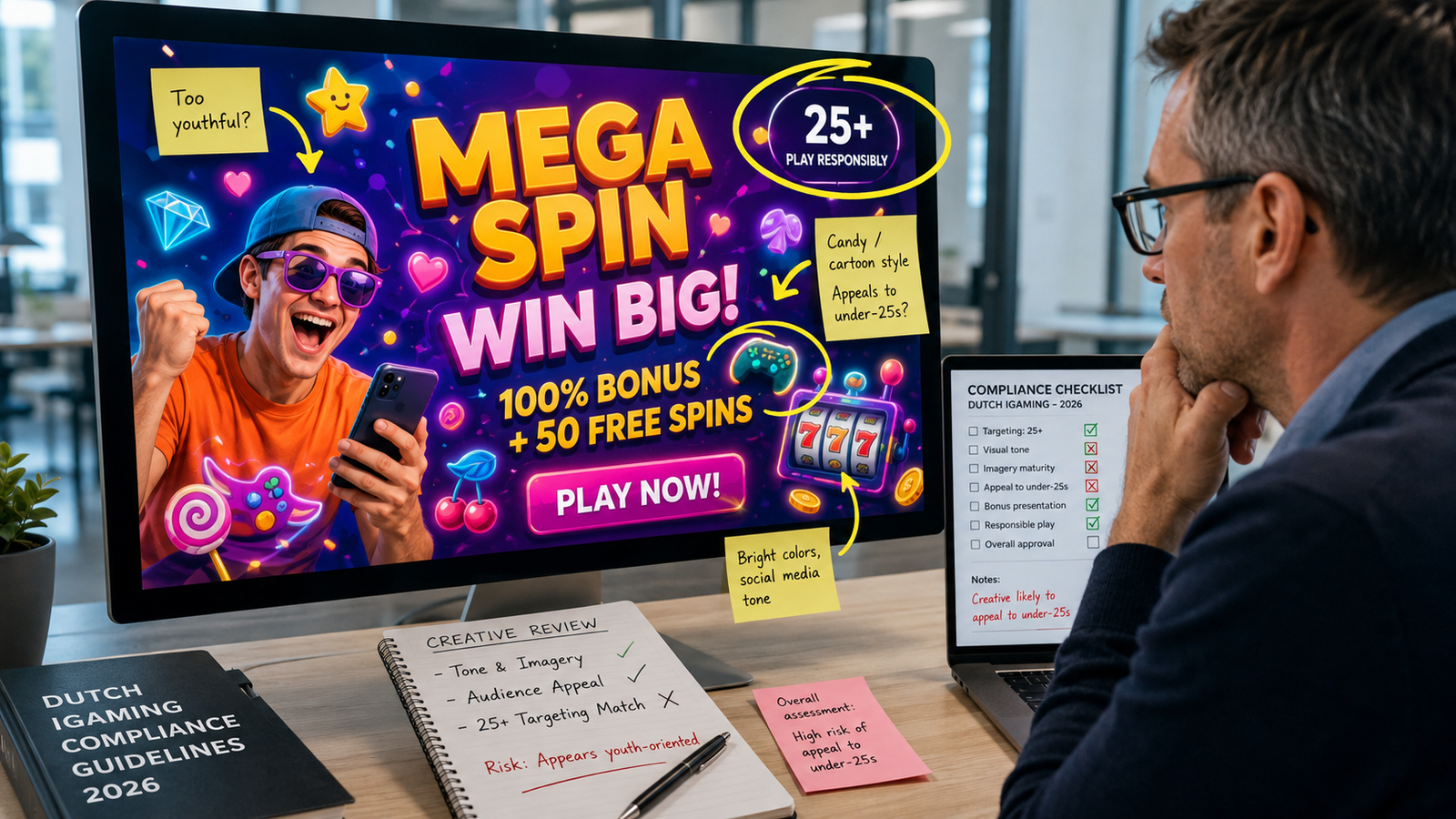
Compliance does not fail only when a post includes bright colours or cartoon-like design. It fails when multiple youth-attracting cues appear together inside a format that young viewers already understand as entertainment.
For TikTok-style social governance, risk flags should include combinations of:
- youth-leaning creator profiles (including gaming personalities)
- meme formats dominated by teenagers
- school-related humour or youth slang
- cartoon or animated characters used as attention hooks
- viral challenges and editing styles copied from mainstream youth content
- “easy money” narratives or similar short-cut messaging
KSA has already treated creative appeal as relevant. In a 2025 advertising case, the regulator objected to using an actor and comic or animated characters it believed primarily appealed to younger audiences. That reasoning should guide your internal review before a campaign goes live.
Practical rule: do not judge only the “media buy” setting. Ask whether the creative itself was designed to attract people you should not be pursuing. If the content is engineered for youth attention, the post should not pass a Dutch compliance check.
Affiliate Compliance Cannot Stop at “We Didn’t Create the Post”
Affiliates often rely on a familiar defence. “We did not create the original video.” That may be a partial answer, but it does not cover the operational questions KSA enforcement can focus on.
Teams should be able to show:
- Did you commission the creator
- Did you pay for exposure (or provide structured placements)
- Did you provide tracking links or campaign identifiers
- Did you route traffic to your landing pages
- Did you knowingly amplify content after spotting problematic material
- Did you keep the creator in your program after repeated risk signals
KSA’s enforcement strategy against illegal gambling includes what it refers to as promoters or facilitators. The examples include affiliates, influencers, websites, apps, payment providers, and social platforms that help illegal offers reach consumers.
A useful warning came from September 2025, when KSA issued orders with periodic penalty payments against three influencers. The influencers showed gambling at illegal operators and encouraged followers to participate. Each violation could trigger a payment of €25,000, with a cap up to €75,000. For affiliate teams, that case underlines how “content involvement” can be interpreted beyond direct production.
If you want a stronger compliance position, treat traffic acquisition as part of the product. The social post is the front door, your program is the delivery system.
A Social Creative Review Should Produce Evidence, Not Opinions
One of the weakest phrases inside content governance is “compliance approved it”. Approved what, based on which information, and on what date.
For high-risk TikTok-style creatives, keep a short evidence trail that explains why you believed the campaign was compliant when it went live. In practice, that evidence should include:
- Brand legality checks: your KSA licence verification (or documented confirmation that no gambling offer is promoted)
- Intended audience logic: the age range and why it fits Dutch requirements
- Distribution path: paid, organic, affiliate, creator production, reposting
- Creator review: influencer, streamer, or other possible role model considerations
- Creative risk assessment: youth language, meme structure, games, animation, celebrity references
- Claims verification: bonus statements, payout statements, odds and safety claims checked against substantiation
- Landing page match: whether the page preserves the same promises and limitations
- Tracking ownership: which affiliate or campaign receives credit
- Approval date and responsible reviewer: clear accountability at the time of publication
This is not bureaucracy for its own sake. The point is to answer, later, why your team believed the campaign was compliant at publication time.
Landing Pages Must Preserve the Creative’s Promises and Limitations
Social compliance can fail after the click. Even if a post passes internal review, the landing page can change the consumer experience dramatically.
Consider a restrained creative that says something like, “compare legal Dutch sportsbooks.” If the destination then opens with aggressive bonus language, “instant winnings” messaging, or guarantees that imply guaranteed income, your overall consumer journey stops being responsible.
To reduce this risk, require landing pages to preserve:
- The same claims and limitations that justified the creative
- Licensed operator status (verified through KSA records when relevant)
- Any payout timing wording explained accurately (processing time vs funds arrival)
- Bonus conditions displayed clearly, not hidden behind long scroll depth
- No implication that gambling provides guaranteed income
Affiliates face an extra challenge. Your page can sit between a platform that moderates less strictly than you would like and an offshore operator that does not follow Dutch duties of care. That makes your landing page alignment a non-negotiable gate.
Platforms Have Responsibility, but Your Governance Cannot Outsource Risk
It is tempting to put everything on creators. But TikTok controls recommendation systems, ad tools, and moderation processes. KSA clearly expects more proactive actions from platforms.
NOS reported the regulator made more than fifty requests in the preceding months to remove problematic gambling videos, and wanted platforms to act proactively rather than waiting for individual reports.
TikTok’s stated policy bans illegal gambling advertising and requires age-appropriate handling. Still, a gambling logo pasted onto a comedy clip can be harder for automated systems to identify than a conventional casino ad. That does not make the exposure harmless, it only makes the moderation problem technically harder.
For regulated stakeholders, this means you cannot treat platform enforcement as your compliance backstop. Your review process needs to assume problematic content can remain visible long enough to generate exposure.
Reporting on Illegal Gambling Without Accidentally Promoting It
Journalists, responsible gambling organizations, and legal affiliates also face a compliance-shaped dilemma. How do you report on an illegal gambling brand without producing additional demand for it?
The answer is restraint. In practice, there is rarely a need to repeatedly display the illegal operator’s logo, show bonus details, explain how to register, or provide direct links.
Instead:
- Describe the risk in plain terms
- Explain why the service is illegal for Dutch targeting
- Direct readers to KSA or official information about the legal market
- Keep instructions limited, avoid content that functions like a tutorial
This matters even more with younger audiences. Curiosity is part of the exposure pathway described in the Dutch reporting. If your coverage repeatedly fuels brand recognition, you may accidentally contribute to the same acquisition loop you are trying to stop.
How to Build a Dutch iGaming Governance Approach That Does Not Lose to a Race to the Bottom
There is frustration inside the regulated market. Licensed operators deal with tighter advertising rules, while illegal competitors can appear through social media, influencers, and offshore affiliate networks with limited Dutch player protection.
Lowering standards for licensed companies would not solve the fundamental problem. It would simply increase gambling exposure among Dutch consumers from both “sides” of the market.
KSA’s approach targets the network around illegal operators, including affiliates, social platforms, and payment infrastructure. That creates an opportunity for legitimate publishers and responsible marketing teams.
Use verification as part of your service promise:
- Show the licence status where relevant
- Document why a creative is appropriate for Dutch audiences
- Separate editorial information from promotion in your workflows
- Treat “it was a joke” sharing as a potential acquisition loop risk when youth exposure is plausible
That is the core TikTok compliance lesson in 2026. The most dangerous “advertisement” may not look like an advertisement at all, it may look like youth entertainment with a brand logo attached.
If you need a compliance-ready content workflow for Dutch iGaming, explore Dutch iGaming AI Content Strategy and related governance guidance on the site. For deeper regulatory alignment, also review Online Gambling Compliance FAQ: A Strategic Guide for Regulated Operators in 2026.
Next Steps: Practical Actions for Dutch Teams
Use the framework above to tighten your workflow before campaigns go live. A simple operational checklist often works better than long policy documents.
- Implement a structured creative review that scores youth-attracting signals.
- Require landing page alignment as a gate, not a follow-up.
- For affiliate partnerships, track creator changes and ongoing risk signals, not only initial onboarding.
- Create a short, auditable evidence trail for each high-risk campaign.
- Train teams to report illegal brands with restraint, avoiding repeat logo exposure or “how to register” instructions.
FAQ
Does TikTok policy compliance protect a licensed operator?
No. Platform policies help, but your exposure risk depends on what remains visible long enough to reach young audiences. Your governance needs to assume moderation can lag and focus on creative and journey alignment.
What is the biggest compliance difference between a TikTok post and a traditional gambling ad?
The absence of clear ad markers. A logo and a youth-led meme format can still create familiarity and curiosity, pushing users to search for the illegal brand without an obvious registration CTA.
How should affiliates document compliance when creators post risky content?
Document who commissioned the creator, what you paid for, what tracking and landing pages you used, and what you did after risk signals appeared. KSA’s promoter and facilitator concept can extend beyond direct production.
Is it acceptable to include the illegal operator logo in reporting?
Use restraint. If reporting repeats brand exposure, provides promotional context, or functions like a registration tutorial, it can unintentionally support the same acquisition loop you are warning against.
Final Word
In 2026, Dutch iGaming compliance on TikTok is less about spotting a classic advertisement and more about managing how creative formats move users along the visibility to search pathway. The right approach combines youth-risk governance, landing page alignment, affiliate accountability, and an evidence trail that makes your decisions explainable at the moment of publication.
Want help building a compliant workflow for Dutch iGaming content? Explore Dutch iGaming Content Services, or contact Maurice Kruytzer for editorial support on regulated-market publishing and compliance-ready processes.