
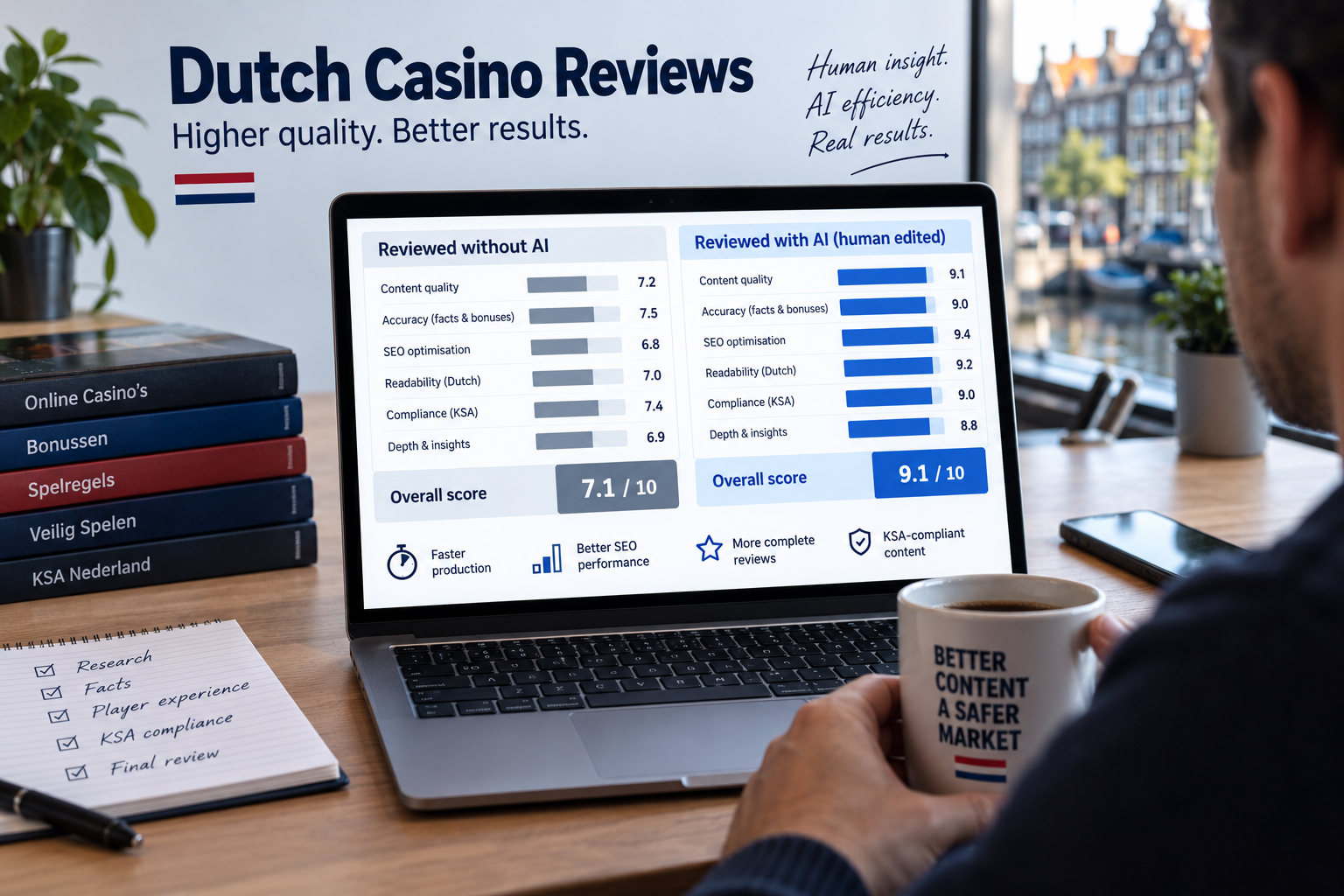
In 2026, 65.4% of illegal gambling adverts targeted Dutch users below 24 years of age, and that single figure tells you why a Dutch casino review cannot be a copy-paste checklist anymore. A “casino review” is often treated like a comfort read, but for players it is actually a filter between regulated safety and the gray market noise.
Key Takeaways
| 1) Reviews must verify, not just describe | We treat licensing, terms, and promo claims as things to audit, not things to repeat. |
| 2) Fast payout and user experience are review criteria | Being “licensed” does not automatically mean being good at withdrawals when it matters. |
| 3) Human oversight catches compliance misses | Automated checks struggle with real-world Dutch ad targeting and duty of care signals. |
| 4) “AI-assisted” still needs a review protocol | AI can draft, but a human must validate accuracy, tone, and compliance boundaries. |
| 5) Methodology beats vibes | We use a phase-based methodology, from discovery to financial integrity checks. |
| 6) A “casino review” should explain trade-offs | Great games can still come with messy processes, confusing terms, or weak player protection UX. |
| 7) Independent verification reduces affiliate spin | When we benchmark claims, we link them to what players actually experience. |
- What should you check in a casino review in 2026? Licensing verification, bonus terms clarity, withdrawal reality, and how responsibly the operator behaves when players need help.
- Why do Dutch casino reviews need human oversight? Because in 2026, ad targeting and compliance gaps are too frequent to rely on platforms or automation.
- How do you know a review is trustworthy? Look for a published methodology and evidence-based checks, not “overall impression” writing. See our casino review methodology.
1) The 2026 reality is messy, and reviews have to reflect that
Most people click a casino review to answer one question, “Is this actually good for me?” In 2026, the honest answer depends on details that are hard to fake at scale, like withdrawal flows, identity verification friction, bonus term handling, and whether responsible gambling features work in practice or only in marketing copy.

Here is the problem we see in Dutch iGaming content: too many reviews behave like a brochure. They describe offers, collect screenshots, and then stop. A human “Reality Check” in 2026 is what closes the gap between what an operator claims and what a player experiences.
We also have to factor in the wider ecosystem. As illegal promotion becomes more aggressive and more targeted, the distinction between “a Dutch licensee” and “a Dutch-friendly brand” becomes less obvious to readers who only skim scores and pros and cons.
2) A human Reality Check should verify licensing and terms, not just mention them
In the Netherlands, players do not choose casinos like they choose streaming services. They make decisions with a regulatory backdrop, and that backdrop should be more than a badge.
In a strong casino review, a license claim should be verifiable, and the important terms should be readable without mental gymnastics. We expect a review to flag contradictions, unclear bonus mechanics, misleading wagering explanations, and edge-case conditions that usually show up only when players try to withdraw.
This is why we push a phase-based approach. The review should have a discovery and compliance phase, then analysis, then functional observation, then financial integrity checks. It sounds formal, but it simply prevents “review writing” from turning into “claim repeating.”
If you want the framework, we detail it in casino review methodology, because methodology is how you keep human oversight consistent across brands, bonuses, and content updates.
3) In 2026, fast payout claims are where reviews either earn trust or lose it
Players often remember how quickly they get money, not how many games a lobby has. So when a casino review talks about withdrawals, we want evidence-based reality, not generic optimism.
That is why we treat withdrawal and payout performance as a review criterion, not a footnote. Being licensed is not the same as being fast, stable, and transparent at the moment a player wants to leave.
4) Human oversight matters more than ever because ad targeting breaks the old assumptions
In 2026, many players trust the look and feel of an operator, or the fact that they saw the brand in “normal” places. But ads can travel far, including into channels where the audience is the real target, not the message.
That is exactly where the human “Reality Check” in 2026 needs to show up. A review should help players distinguish between regulated availability and aggressive, potentially illicit promotion. If content creators cannot explain how they verified identity, promotions, and player protections, they are not reviewing, they are guessing.
And if you are thinking, “Surely platforms and regulators catch everything,” you are assuming perfect moderation and perfect compliance interpretation. Human reviewers exist because the system is under pressure, not because it is flawless.
5) Google’s 2026 direction reinforces what we already do, unique value and real checks
We also see a parallel shift in content quality expectations. Google’s 2026 framing is not about banning tools, it is about how teams publish, whether pages add distinct value, and whether scaled output turns into commodity content.
That direction lines up with what a casino review must do to be useful in 2026. If the review does not bring a unique point of view, evidence, and an explainable process, it becomes interchangeable with every other page.
For teams who use AI for drafting or research support, our position is simple: AI can help speed up parts of production, but humans must be responsible for accuracy and compliance. We lay out the practical workflow behind that in Dutch iGaming AI Content Strategy.
6) What a “casino review” should include in 2026, beyond bonus lists and star ratings
A casino review that deserves attention in 2026 should cover both the product and the process. Games matter, but operational reality matters at least as much.
- Functional onboarding: Is signup actually smooth in the Dutch context, and does it match what the review claims?
- Verification experience: How painful is identity verification, and what documents are requested?
- Bonus term clarity: Are terms explainable, or do they hide complexity in legalese?
- Withdrawal and payout reality: How fast, how predictable, and what friction appears during withdrawals?
- Player protection UX: Are limits and responsible gambling tools easy to find and easy to use when a player needs them?
- Customer support behavior: Not just response time, but whether support resolves practical issues.
- Compliance signals, in plain language: What protections exist, and how do they work in practice?
Notice the pattern. We are not asking for “more text.” We are asking for more evidence and more clarity.
7) Don’t let “human-readable” become human blind spots, the review still needs a protocol
Humans can fail too. In 2026, the risk is not only automation getting it wrong, it is also reviewers drifting into confirmation bias, or trusting sources without validating them.
That is why our review approach stays protocol-based. We define phases, specify what gets checked, and require verification where it matters. The goal is repeatability, not mood-based judgment.
When you combine that with AI-assisted research and drafting, you get speed without losing the core. That is also what we mean when we say “human-verified content,” not “AI-generated content.”
8) Images that add proof, not just decoration
Some review sites throw in screenshots for comfort. In 2026, we treat images as evidence carriers. If a casino review includes visuals, they should help you verify what is being claimed.
For example, we use visuals from our 2026 editorial reality-check workflow to support how we think about verification, compliance context, and review value. Here are a few from our editorial resources that fit this article’s point about human checks in 2026:


9) What we recommend to players (and what we expect from reviewers) in 2026
We are not in the business of claiming that one review can protect you from every risk. But a human “Reality Check” in 2026 can reduce avoidable mistakes by insisting on verification, evidence, and clarity.
If you are reading a casino review in 2026, use this quick checklist:
- Does the review show its method? If it does not, assume the quality is inconsistent.
- Does it discuss withdrawals realistically? Look for specifics and trade-offs.
- Does it explain bonus terms clearly? If terms are vague, move on.
- Does it address player protection UX? Not just “there is responsible gambling,” but how it behaves.
- Does it help you identify compliance and ad context? If it ignores promotion reality, it is incomplete.
If reviewers cannot answer these items, their work is closer to entertainment than decision support.
10) Where the “Reality Check” sits in a 2026 editorial workflow
The Reality Check is not a single step. It is a set of decisions baked into the workflow, especially when teams use AI for research and drafting.
Our approach is that AI handles research support and drafting structure, while a human verifies licensing claims, checks compliance boundaries, and validates that the user experience description matches what we observed. That is the difference between “content created” and “content verified.”
If you want a practical reference for what teams should do next in 2026, we also cover the topic in Google’s 2026 AI Search Reality Check for Dutch iGaming.

Offline licensee social media ads lag far behind online-only operators on compliance standards.
CTA: Need a Dutch-proof casino review workflow?
We support Dutch iGaming content teams with editorial process, localisation, quality review, and compliance checks. If you need a human Reality Check built into your publication workflow, explore Dutch iGaming content services.
CTA placement note: This message supports the publication, but it does not replace the editorial value in the article.
Frequently Asked Questions about human-verified casino reviews in 2026
Why do Dutch casino reviews need a human Reality Check in 2026 instead of AI summaries?
Because a human Reality Check in 2026 verifies claims that AI summaries can blur, like licensing details, withdrawal reality, and player protection UX. In other words, we treat a casino review as evidence, not as copy.
What should I look for in a casino review if I play in the Netherlands in 2026?
Look for clear bonus terms, realistic withdrawal discussion, and how the review explains player protections in practice. A strong casino review also distinguishes regulated operators from the wider promotional noise.
Can a “licensed” casino still have a bad user experience, and how would a review show that?
Yes. Even in 2026, not all licensed operators meet fast payout expectations, so withdrawal speed and friction still matter. A human-reviewed casino review should test the process and describe trade-offs plainly.
How do Dutch reviewers avoid affiliate bias in 2026 casino review content?
They publish method, verify key claims, and separate marketing language from operational reality. The best approach is independent checks and repeatable steps, so a casino review cannot “sound positive” by accident.
Are AI-assisted casino reviews allowed in 2026, or will they be wrong more often?
AI-assisted drafting can be fine in 2026 if humans validate accuracy and compliance. The risk is scaled low-value publishing, where reviews become repetitive and fail to add the unique evidence players need.
What is the fastest way to tell if a casino review is trustworthy in 2026?
Scan for a clear methodology, concrete discussion of withdrawals, and specific player experience details. If the review only lists pros and cons without showing how it checked the claims, assume you are not getting the Reality Check you think you are.
Conclusion: The human Reality Check is the only reliable part of a Dutch casino review in 2026
Why Dutch casino reviews need a human “Reality Check” in 2026 is simple. Players face a 2026 market where ad targeting, compliance gaps, and operational friction do not announce themselves through star ratings.
When we demand verification, phase-based methodology, and human oversight over AI-assisted drafting, the casino review becomes decision support instead of marketing reflection. That is the difference between reading about a casino and actually understanding what it means for you in 2026.
CTA: Want us to help your Dutch iGaming editorial team raise the standard?
Operators, publishers, and content teams that need a structured, compliant workflow can start with advertise with us.
Written by Maurice Kruytzer