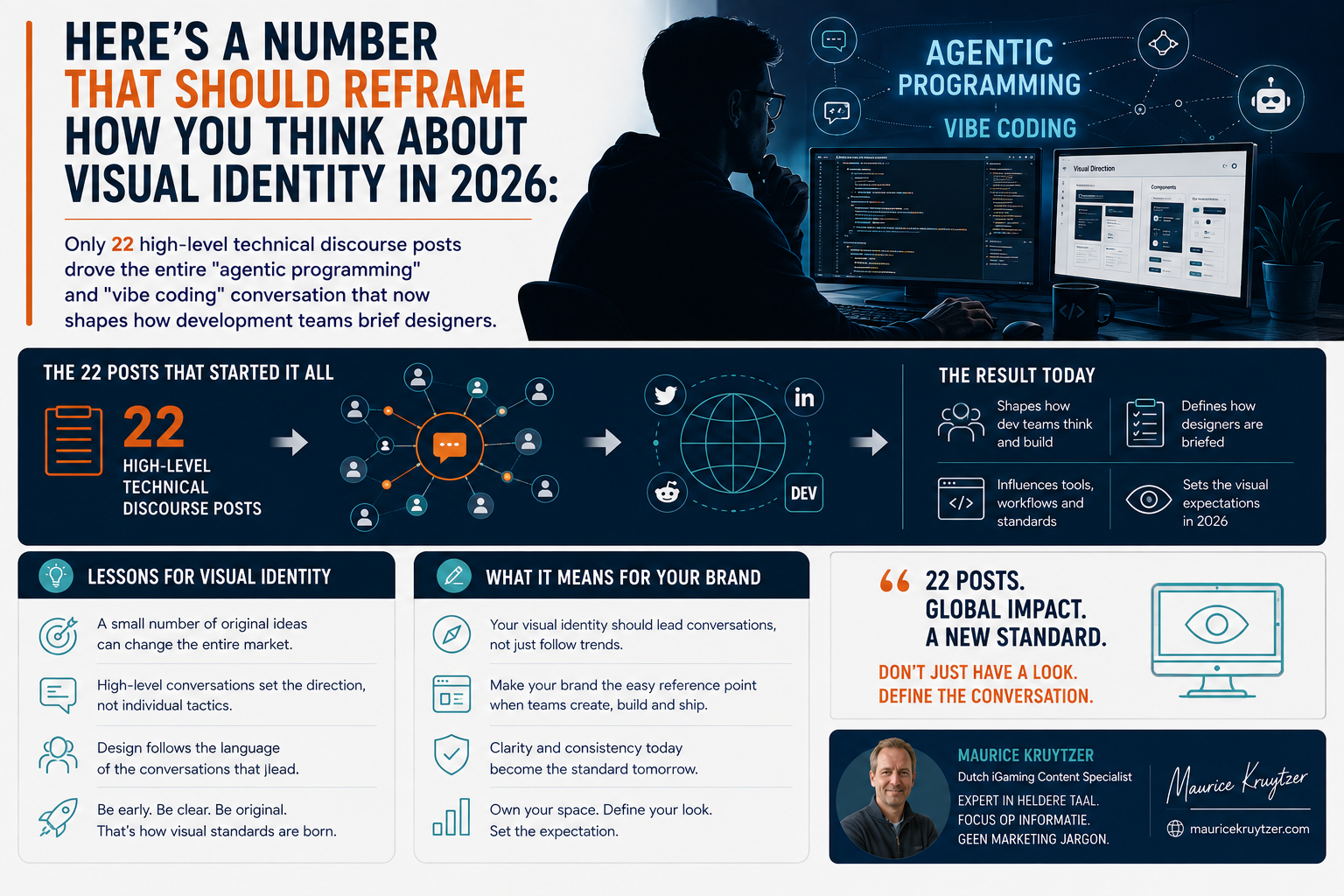
Here’s a number that should reframe how you think about visual identity in 2026: only 22 high-level technical discourse posts drove the entire “agentic programming” and “vibe coding” conversation that now shapes how development teams brief designers. That small signal is exactly why tech-native iGaming brand identity systems built on modular, motion-first, coding-inspired visual languages have stopped being a design trend and started being an operational requirement for operators launching across the Dutch market in 2026.
Key Takeaways
- Static style guides are dying. Modular design systems now replace fixed PDFs because iGaming brands ship new products, markets and promotions faster than any printed guideline can track.
- Motion-first branding is the baseline, not a nice-to-have, especially for sportsbook brands operating inside live betting windows.
- Coding-inspired visual languages (component libraries, token systems, terminal-style typography) let brand teams ship consistent assets the same way developers ship code.
- Compliance is a design constraint, not an afterthought. KSA licensing rules dictate how much motion, colour intensity and layout freedom a Dutch-facing brand can actually use.
- Modular architecture scales art direction across markets without losing visual consistency, something we cover in depth in our visual guide to the Dutch iGaming market.
- AI workflows accelerate asset production, but human editorial oversight still decides what actually ships, the same principle behind our editorial trust framework.
- Localization breaks or builds trust. A modular system that looks sharp in English but reads foreign in Dutch fails the moment a player lands on the page.
What Tech-Native iGaming Brand Identity Systems Actually Mean in 2026
Most agencies still treat brand identity like a logo file and a colour palette. It isn’t that anymore.
A tech-native iGaming brand identity system in 2026 works like a codebase: components, tokens, states and variants that assemble on demand. Instead of a designer opening a PDF style guide, a product team pulls pre-approved modules the same way a developer pulls a component from a shared library.
This shift matters because iGaming brands ship faster than almost any other regulated vertical. New promotions, live odds widgets, jackpot counters and seasonal campaigns need visual consistency without a design bottleneck every time something launches.
That is the entire premise behind modular design systems: build once, reuse everywhere, and let motion and coding-inspired detailing carry the brand’s technical credibility.
Best for Multi-Market Operators: Modular Design Systems Over Static Style Guides
If you operate across several markets, a fixed style guide breaks the moment a second market launches. Modular grid graphic design solves this by treating layout as a set of repeatable units rather than a fixed page template.
Design modularity works the same way modular software design works: small, independent, testable pieces that combine into larger structures without rewriting the whole system.
- Best for: operators running the same brand across NL, BE and DE with different compliance rules per market
- Core benefit: one grid, one token system, market-specific compliance overlays
- Trade-off: requires upfront investment in a proper modular design architecture before any campaign work starts
We wrote about this exact tension between speed and compliance in our fluff-free content playbook for Dutch iGaming sites. The logic transfers directly to visual systems: fluff-free structure beats decorative one-off design every time.
Best for Sportsbook Brands: Motion-First Branding During Live Betting Windows
Casino brands can afford a slower visual rhythm. Sportsbook brands cannot.
Motion-first branding exists because odds change in real time, and a static brand system cannot communicate urgency, risk or momentum the way animated states can. A well-built motion system tells a player something is live before they read a single word.
Heavy scripts, bloated images and clumsy pop-ups kill user trust before the content ever gets read. The same is true for motion: unnecessary animation slows the page and undermines the exact urgency it was meant to create.
Best practice for sportsbook brands in 2026:
- Use motion only where it signals a real state change (odds shift, market close, live goal)
- Keep animation weight under control on mobile-first architecture, since most Dutch bettors are on mobile during live matches
- Reserve heavier motion for desktop dashboards, not mobile betslips

Best for Casino Affiliates: Coding-Inspired Visual Languages That Scale Fast
Casino affiliates publish more pages, more reviews, and more comparison content than almost anyone else in this vertical. A coding-inspired visual language keeps that volume from looking sloppy.
Think terminal-style typography, monospaced data tables, grid overlays that mimic code editors, and colour tokens that behave like variables rather than fixed hex values. This is where “tech-native brand identity 2026” stops being a buzzword and becomes a literal design decision: brands borrow the visual grammar of the tools their own development teams use daily.

That maintainability logic applies directly to brand systems. A modular asset library needs its own version control, review cycle and audit trail, exactly like a codebase does.
Best for Regulated Markets: Compliance-Ready Modular Architecture
The regulated Dutch market rewards trust and punishes shortcuts. That applies to visual identity as much as it applies to content.
KSA licensing rules restrict certain colours, animation intensity and messaging patterns tied to responsible gambling. A modular platform design handles this well because compliance rules become a layer, not a rebuild.
- Compliance tokens sit on top of the base design system
- Market-specific overlays swap in without touching the core grid
- Every module gets reviewed against the current KSA guidelines that determine content visibility before it ships
Compliance-ready design is now a competitive advantage, not a constraint. Brands that treat KSA rules as an architectural layer move faster than brands that treat them as a last-minute checklist.
Best for Multi-Language Rollouts: Art Direction at Scale Without Losing Consistency
Art direction at scale is the hardest part of any modular design system. It’s easy to build a component library. It’s hard to keep every market feeling like the same brand.
This is where localization and a Dutch translator become part of the design process, not an afterthought bolted on at the end. A visual system that reads perfectly in English can still feel foreign once the Dutch copy, tone and compliance language go in.
We approach this the same way we approach content: a localization specialist and Dutch proofreading pass happen before anything ships, whether it’s a landing page or a component in a design token library.

A 1+4 modular approach gives iGaming brands flexible coding-inspired visual systems.
Where Human Editorial Oversight Fits Inside a Modular Brand System
I do not hide the fact that I use AI in my own editorial process. I lean into it, the same way brand teams now lean into AI-generated component variants.
But a modular design system without human review is just a fast way to ship inconsistent brands. The difference between a system that scales and one that collapses under its own complexity is human-in-the-loop oversight, at every layer.
I’m Maurice Kruytzer, a Dutch content specialist and Dutch gambling content expert, and this exact review layer is what I bring to editorial work sitting alongside these visual systems. The specialists behind every layer of a compliant, tech-native brand rollout typically include:
- A Dutch SEO writer and SEO copywriter shaping the on-page language around the visual system
- An iGaming content writer and affiliate content expert handling review and comparison content
- An AI content strategist managing the AI workflows that draft component copy and microtext
- A localization specialist and Dutch translator making sure the tone survives translation
- A content manager overseeing Dutch content operations across every market variant
- A Dutch casino copywriter, Dutch crypto writer and Dutch sportsbook writer covering vertical-specific tone
- A Dutch editor running final Dutch proofreading before anything publishes
Most of these roles get treated as separate hires by agencies. We treat them as one continuous review pipeline, the same pipeline described in our Dutch iGaming content services overview.
Building a Scalable Publication Pipeline Around Your Brand System
A modular design system is only as good as the pipeline that feeds it. If your technical foundation is wrong, no amount of visual polish will save the brand.
Our approach combines boots-on-the-ground research with high-speed digital filters, the same scalable publication pipeline we use for content, applied here to brand assets:
- Draft: AI-assisted component and copy generation based on approved tokens
- Review: human editorial pass for tone, compliance and market fit
- Localize: Dutch proofreading and translation checks per market
- Ship: component enters the shared library for reuse across teams
- Audit: quarterly review against KSA rules and platform updates
This is the same discipline behind choosing between AI-assisted teams and traditional copywriters. Speed without review is a liability. Review without speed is a bottleneck. A modular pipeline needs both.
Conclusion
Tech-native iGaming brand identity systems built on modular, motion-first, coding-inspired visual languages are not a passing aesthetic in 2026. They are the direct result of operators shipping products faster than static style guides can keep up with.
Modular design systems solve the scale problem. Motion-first branding solves the urgency problem, especially for sportsbooks. Coding-inspired visual languages give brand teams a shared grammar with their own development staff.
None of it works without editorial discipline behind it. As a freelance writer, Dutch SEO writer and affiliate marketing specialist working inside this exact space, I build the content layer that keeps modular brand systems compliant, consistent and genuinely trustworthy in the Dutch market. If your visual system needs an editorial partner that understands both the design side and the KSA rules governing it, explore our recent work or get in touch to talk through your rollout.
Frequently Asked Questions
What is a tech-native iGaming brand identity system?
A tech-native iGaming brand identity system is a modular set of design components, tokens and motion states that function like a codebase rather than a fixed style guide. It lets operators ship new products and markets fast while keeping the visual language consistent across every touchpoint.
Why is motion-first branding important for sportsbook brands specifically?
Motion-first branding communicates real-time changes like live odds shifts and market closures that static design cannot show. For sportsbook brands, this urgency signal directly affects how players interpret in-play betting opportunities.
How do modular design systems help with KSA compliance?
Modular design architecture treats compliance rules as a layer on top of the base system rather than a full rebuild. This lets operators adjust colour, messaging and animation per market without breaking the underlying brand structure, which keeps content and visuals aligned with current KSA licensing requirements.
Is a coding-inspired visual language worth adopting in 2026?
Yes, for brands that publish content and update products frequently, a coding-inspired visual language (component libraries, tokens, terminal-style detailing) reduces design bottlenecks significantly. It works especially well for casino affiliates and multi-market operators managing high content volume.
What’s the difference between modular design systems and traditional style guides?
A traditional style guide is a fixed document that goes out of date the moment a new market or product launches. A modular design system is a living library of reusable components that update centrally and propagate everywhere they’re used.
Do AI workflows replace human designers in modular brand systems?
No, AI workflows accelerate the drafting of variants and component copy, but human editorial and design review still decides what actually ships. The strongest tech-native brand systems in 2026 pair AI speed with human-in-the-loop oversight for compliance and consistency.
How does localization affect a modular brand identity system in the Dutch market?
Localization determines whether a modular system feels native or foreign once Dutch copy, tone and compliance language are added. A Dutch translator and proofreading pass need to happen at the component level, not just on final published pages, to keep the brand credible.